
Date: 2026-05-11
You’ve got a tiny signal from a microphone, a guitar pickup, or a music player. You want to make it loud enough to drive a speaker. That’s where an amplifier audio circuit comes in. It takes a weak signal and gives it the muscle it needs.
But how do you actually build one? What components do you need? And what’s the difference between all those "Class A", "Class AB" and "Class D" things you keep hearing about?
Let’s walk through it together – no engineering degree required. Just plain talk about what an amplifier does, how it works, and how you can build a simple one yourself.
What Is an Amplifier Audio Circuit, Really?
At its core, an amplifier (or "amp") is a circuit that boosts a weak electrical signal. It’s the thing that takes the faint voltage from your microphone – just a few millivolts – and turns it into a much bigger signal that can push a speaker cone back and forth.
Think of it this way: a weak signal is like a person whispering instructions. The amplifier is like a loudspeaker that shouts those same instructions to a crowd. It doesn’t change the message – it just makes it much, much louder.
The Key Components You’ll Meet
Every audio amplifier circuit needs a few basic building blocks. Here are the main characters:
Transistors – These are the star players. They do the actual amplifying. A tiny current flowing into the base of a transistor controls a much larger current flowing through it. That’s the magic. You can think of a transistor like a tap: a small twist of the handle (input signal) controls a big flow of water (output power).
Resistors – These control how much current flows where. They set the "gain" (how much amplification you get) and keep the transistors working in their proper range. Without them, things would overheat or distort badly.
Capacitors – These block steady DC voltage while letting the changing AC audio signal pass through. They also filter out unwanted noise and help keep the sound clean. Think of a capacitor like a gate that only lets the wiggly part of the signal through.
Power supply – The amplifier can’t create energy out of nothing. It takes power from a battery or a wall adapter and shapes it into a stronger version of the input signal.
Speaker or headphones – The final destination. The amplified signal makes the speaker cone move, which pushes air and creates sound waves.
How Does It Actually Work? (The Simple Version)
Let’s trace a signal through a basic audio amplifier circuit.
Input – You plug in a microphone or a music player. The audio signal is a tiny, wiggling voltage.
Transistor does its job – The signal enters the base of a transistor. That little current "opens the tap" and allows a much larger current to flow from the power supply through the transistor.
Output – The result is a bigger, stronger version of your original signal. It now has enough power to drive a speaker.
The whole thing happens thousands of times per second, following the shape of your music or voice.
A Closer Look at the Classes (A, B, AB, D)
If you’ve shopped for an amplifier or read about them online, you’ve seen these letters. They describe how the amplifier’s output transistors behave. Here’s the everyday explanation:
Class A – The output transistors are always on, even when there’s no signal. This gives very clean sound with almost no distortion. But it’s extremely inefficient – most of the power turns into heat, not sound. Class A amps run hot and are usually big and expensive.
Class B – The transistors take turns: one handles the positive part of the signal, the other handles the negative part. This is more efficient than Class A, but it introduces "crossover distortion" where the two halves meet. That’s why pure Class B is rare in audio systems.
Class AB – This is the sweet spot. The transistors conduct for more than half of the signal cycle but less than the full cycle. Class AB gives you better efficiency than Class A and much lower distortion than Class B. It’s the most common type of amplifier you’ll find in home stereos and musical equipment.
Class D – These are "switching" amplifiers. Instead of running the transistors in a linear way, they turn them fully on and off thousands of times per second. This is incredibly efficient – over 90% in many cases – so very little heat is wasted. Modern Class D amps sound great and are perfect for portable speakers, subwoofers, and car audio systems.
What’s Your Goal? Clean or Loud?
Here’s a quick way to choose:
If you want the absolute cleanest sound and don’t mind heat and cost, look at Class A.
If you want a great all-rounder – good sound, decent efficiency, and reasonable size – Class AB is your friend.
If you need maximum power in a small package or you’re building a battery-powered device, go with Class D.
Can You Really Build an Amplifier Yourself?
Absolutely. And it’s a great way to learn.
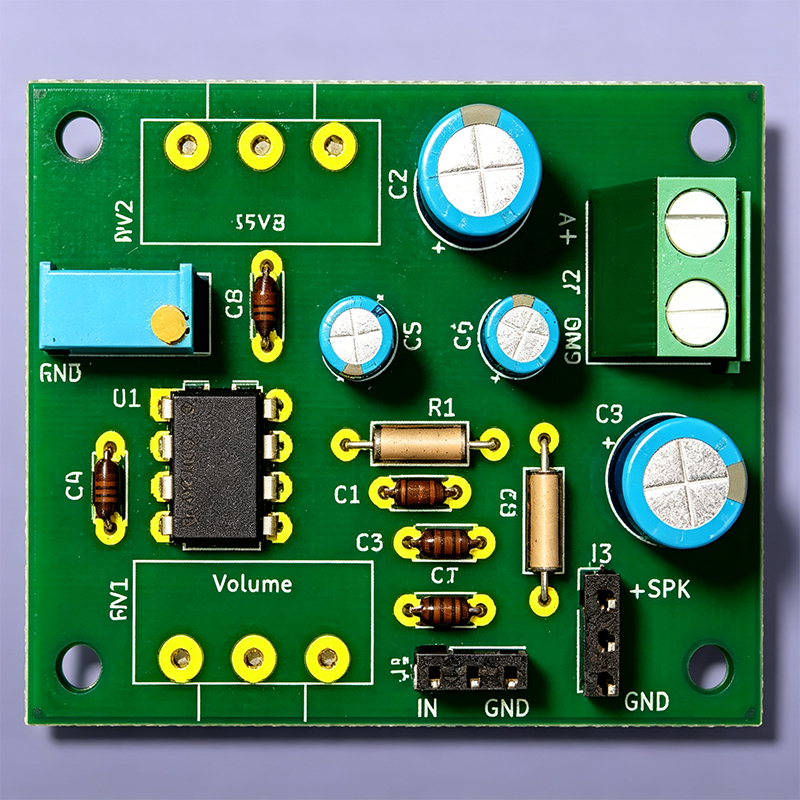
A classic beginner project is building a small amplifier using an LM386 chip. This little integrated circuit contains all the core amplifier parts in one package. You only need a handful of external components: a couple of capacitors, a few resistors, a potentiometer for volume control, and a speaker. The whole thing can be built on a breadboard in an hour or two.
The LM386 is popular because it runs on a wide range of voltages (5V to 12V), needs very few extra parts, and is cheap and easy to find. It won’t shake the walls – it only puts out about 0.5 to 1 watt – but it’s perfect for powering small speakers, headphones, or portable projects.
If you want more power, you can step up to chips like the LM380 or even build a discrete amplifier using individual transistors. But for your first build, the LM386 or similar "amp in a chip" is the way to go.
Signs Something’s Wrong (And How to Fix It)
Even simple amplifier circuits can act up. Here are some common problems and what might be causing them:
No sound at all – Check your power supply first. Is the battery dead? Are all connections secure? Also check that the input signal is actually present – try a different source.
Distorted or fuzzy sound – Your input signal might be too strong. Try turning down the volume at the source. Or you might have a bad solder joint or a loose connection. Check your work step by step.
Quiet output even at full volume – The gain might be set too low. Check your resistor values. If you’re using an LM386, adding a capacitor between pins 1 and 8 increases the gain dramatically.
Buzz or hum in the background – This is often caused by poor power supply filtering. A larger capacitor (like 1000µF to 4700µF) across the power input can help smooth things out.
Amplifier gets extremely hot – This could mean a short circuit or that you’re drawing too much current. Check for solder bridges or accidental connections between power and ground. Also make sure your speaker impedance matches what the amplifier expects (e.g., 4Ω or 8Ω).
Making It Sound Better
Once your basic amplifier works, here are a few tweaks that can improve the audio quality:
Add a volume control – A simple potentiometer (pot) on the input lets you adjust the level.
Improve the power supply – Add a large capacitor (like 1000µF or more) across the power input to reduce hum.
Filter out noise – Small capacitors (0.1µF or so) placed close to the amplifier chip’s power pins can filter out high-frequency noise.
Protect the speaker – Many amplifier chips have built-in protection features, but adding a fuse or a capacitor in series with the output can prevent DC from reaching your speaker.
Safety Stuff (Because Real Components Get Hot)
Amplifier circuits – especially higher-power ones – can get hot. Some parts can burn you if you touch them. And capacitors can hold a charge even after power is removed. So here’s the short version:
Don’t touch the circuit while it’s powered on.
Let hot components cool down before handling them.
Discharge large capacitors with a resistor before touching them.
Work on a clean, non-conductive surface.
And seriously – don’t lick the battery terminals. Just don’t.
Wrapping It Up
An amplifier audio circuit is one of the most satisfying electronic projects you can build. It takes a tiny, weak signal and turns it into something you can actually hear. Whether you’re making a guitar practice amp, a portable Bluetooth speaker, or just learning how electronics work, understanding the amplifier is a huge step forward.
Start simple – maybe an LM386 on a breadboard. Get it working. Listen to it. Then experiment with different components, different chips, and different designs.
And if you get stuck? Check your connections. Check your power. And remember: everyone’s first amplifier hums, buzzes, or just sits there silently. That’s how you learn.

Kaboer manufacturing PCBs since 2009. Professional technology and high-precision Printed Circuit Boards involved in Medical, IOT, UAV, Aviation, Automotive, Aerospace, Industrial Control, Artificial Intelligence, Consumer Electronics etc..


 English



 Wechat
 +86 13670210335
 +86 13670210335
 E-mail