
Date: 2026-05-11
You’re in the middle of a project. You’ve got your soldering iron in one hand, a coil of solder in the other. You touch the solder to the tip… and nothing happens. It just sits there. So you crank up the heat. Still nothing. Then you go too far and everything turns into a brown, burnt mess.
Sound familiar? The problem is, you didn’t know the exact temperature where solder melts. And honestly, most people don’t. But once you understand the numbers, soldering becomes way less frustrating.
So let’s answer that question once and for all: at what temperature does solder melt? And while we’re at it, let’s talk about why different solders melt at different temperatures, and what that means for your work.
Most common solders melt between 180°C and 190°C (356°F – 374°F).
That’s the typical range for lead-based solder (like 63/37 or 60/40 tin-lead). If you’re using lead-free solder, it melts a bit higher – usually around 217°C to 227°C (423°F – 440°F).
But that’s just the average. Different solders have different melting points. Let me break it down.
Before we go further, let’s make sure we’re talking about the same thing. Solder is a metal alloy – a mixture of two or more metals – that melts at a relatively low temperature. You use it to join electronic components to circuit boards or to connect wires.
The two most common metals in solder are tin and lead. But lead-free solders often use tin mixed with silver, copper, or bismuth.
The exact mixture changes the melting point. Think of it like baking: different recipes give you different results.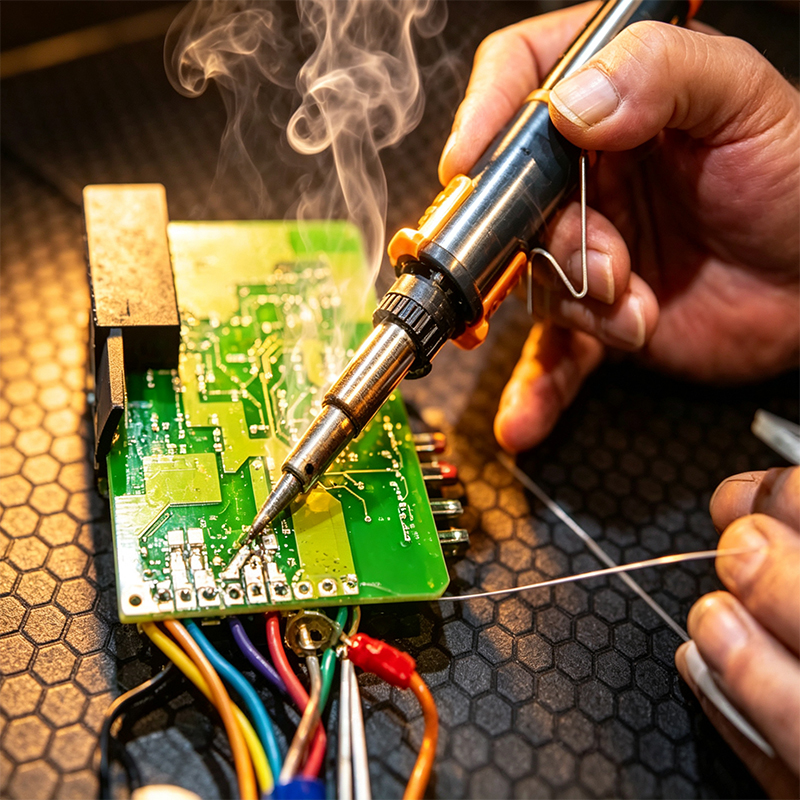
For decades, the go-to solder was a mix of 60% tin and 40% lead (60/40) or 63% tin and 37% lead (63/37). These are called eutectic solders – a fancy word that just means they melt at a single, specific temperature instead of a range.
63/37 tin-lead eutectic: melts at exactly 183°C (361°F).
60/40 tin-lead: melts between 183°C and 190°C (361°F – 374°F). It starts to melt at 183°C and becomes fully liquid at 190°C.
These are still widely used in hobbyist and repair work because they flow nicely and are easy to work with.
Because of health and environmental concerns (lead is toxic), most commercial electronics today use lead-free solder. The most common type is SAC305 – that’s tin with 3% silver and 0.5% copper.
SAC305 lead-free solder: melts around 217°C to 220°C (423°F – 428°F).
Other lead-free solders vary:
Tin-copper (Sn99.3Cu0.7) – melts around 227°C (441°F)
Tin-silver (Sn96.5Ag3.5) – melts at 221°C (430°F)
Tin-bismuth (Sn42Bi58) – melts much lower, around 138°C (280°F) – great for heat-sensitive components
If you set your soldering iron too low, the solder won’t melt properly. You’ll end up with a “cold joint” – dull, grainy, and unreliable. It might look connected, but it will fail over time.
If you set it too high, you risk burning the flux (the stuff inside solder that helps it flow), damaging components, or lifting copper pads off the circuit board.
The sweet spot is usually 30°C to 50°C above the melting point. So for leaded solder, aim for 350°C (662°F) on your iron. For lead-free, go to 370°C – 400°C (698°F – 752°F).
Sometimes you need solder that melts at a much lower temperature. For example, if you’re repairing a flexible circuit or a component that can’t handle heat, you might use bismuth-based solder.
Tin-bismuth (Sn42Bi58): melts at 138°C (280°F) – almost 50°C lower than leaded solder.
This is great for rework or when you’re soldering near heat-sensitive parts. The downside? It’s more brittle, so don’t use it for mechanical connections.
Every spool of solder has the alloy printed on the label. Look for something like “Sn63/Pb37” or “SAC305”. Then just look up that alloy’s melting point online. It takes ten seconds.
If you’re using old, unlabeled solder from a mystery drawer… honestly, just get a new spool. It’s not worth the guesswork.
Use flux – It lowers the effective melting point by cleaning the surfaces and helping heat transfer.
Match your iron tip to the job – A small tip for tiny components, a larger tip for big joints. A tiny tip loses heat too fast.
Don’t touch the joint with the iron for too long – Heat is a tool, not a torture device. A couple of seconds is usually enough.
When you want to remove solder, you don’t need a higher temperature. You just need to re-melt it at the same temperature it melted at originally. But adding fresh solder often helps – it brings new flux and improves heat flow.
| Solder Type | Composition | Melting Point (°C) | Melting Point (°F) |
|---|---|---|---|
| Leaded (eutectic) | 63/37 Sn/Pb | 183°C | 361°F |
| Leaded (standard) | 60/40 Sn/Pb | 183–190°C | 361–374°F |
| Lead-free (common) | SAC305 | 217–220°C | 423–428°F |
| Lead-free (tin-copper) | Sn99.3Cu0.7 | 227°C | 441°F |
| Low-temp | Sn42/Bi58 | 138°C | 280°F |
| High-temp (silver) | Sn96.5/Ag3.5 | 221°C | 430°F |
Here’s a simple rule of thumb:
For leaded solder (63/37 or 60/40) – set your iron to 350°C (662°F).
For lead-free (SAC305) – set your iron to 370–400°C (698–752°F).
For low-temp bismuth solder – set your iron to 250–280°C (482–536°F) – but be careful, it melts easily.
And always test on a scrap piece first. Every iron is a little different.
If someone asks you “at what temperature does solder melt?” you can say:
“For most common solders, between 180°C and 220°C. Leaded solder melts lower, around 183–190°C. Lead-free melts higher, around 217–227°C.”
Now you know. Go solder something with confidence.

Kaboer manufacturing PCBs since 2009. Professional technology and high-precision Printed Circuit Boards involved in Medical, IOT, UAV, Aviation, Automotive, Aerospace, Industrial Control, Artificial Intelligence, Consumer Electronics etc..


 English



 Wechat
 +86 13670210335
 +86 13670210335
 E-mail