
Date: 2026-05-13
You’ve soldered everything perfectly. The board works. But then you drop the device, or it gets shaken inside a car, or a heavy component vibrates loose. Suddenly, your perfect circuit fails – not because of bad soldering, but because nothing was holding things in place except those tiny solder joints.
That’s where circuit board glue comes in. It’s the unsung hero that keeps components stuck down, protects against vibration, and even helps with heat or electricity. Let’s talk about the different types, when to use them, and how to avoid common mistakes.
What Is Circuit Board Glue?
Circuit board glue is any adhesive used on a PCB to hold components, seal areas, conduct electricity, or transfer heat. It’s not the same as regular craft glue or super glue – though some super glues can work in a pinch. Most circuit board glues are specially formulated to handle heat, resist electricity (or conduct it intentionally), and not damage sensitive electronics.
You’ll see glue on boards for several reasons:
Keeping heavy components from breaking off – Large capacitors, transformers, connectors.
Protecting against vibration – In cars, drones, or anything that moves.
Preventing shorts – Covering exposed wires or solder joints.
Conducting electricity – As a replacement for solder in some cases.
Transferring heat – From hot chips to heatsinks.
The Main Types of Circuit Board Glue
Let’s break down the most common adhesives you’ll encounter.
1. Silicone Glue (RTV – Room Temperature Vulcanizing)
This is the soft, rubbery white or clear glue you often see holding large capacitors or globs of wires on a board. It cures at room temperature into a flexible rubber. It’s great for vibration damping and thermal resistance (some types handle up to 200°C).
Pros: Flexible, good vibration protection, high temperature resistance, electrical insulator.
Cons: Can take hours to cure, some types release acetic acid (vinegar smell) that can corrode copper – look for “neutral cure” silicone.
Best for: Securing large components, wire dressing, protecting against shock.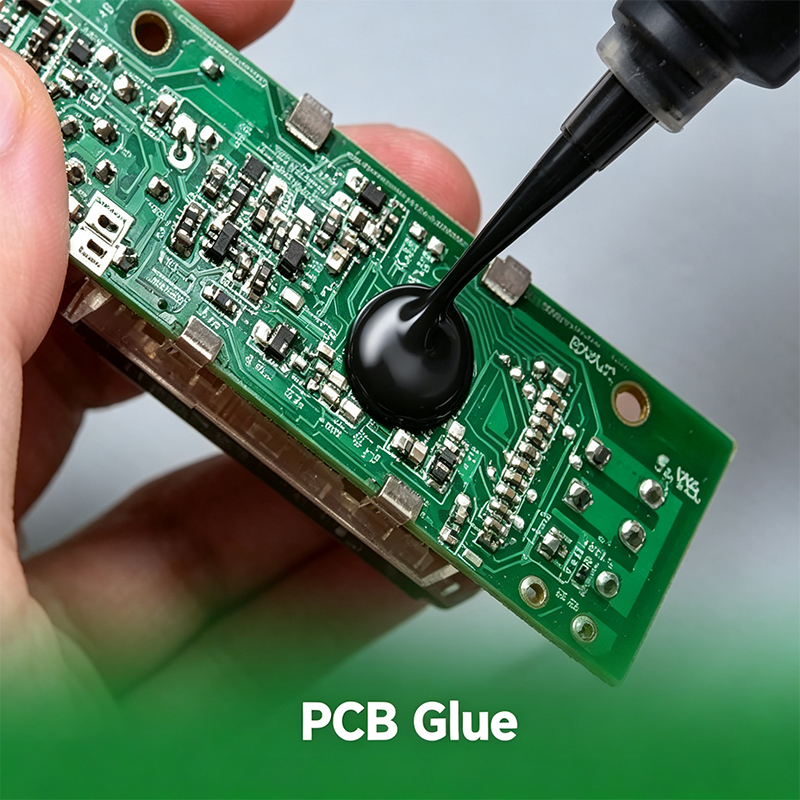
2. Epoxy Glue
Epoxy is a two-part adhesive (resin + hardener) that cures into a very hard, strong solid. It’s the heavy lifter of circuit board glues. Once it sets, it’s not coming off easily.
Pros: Extremely strong, good chemical resistance, can be thermally conductive (with fillers).
Cons: Hard to remove, can be brittle under extreme shock, some types shrink slightly during cure.
Best for: Potting (encapsulating whole circuits), bonding heatsinks, permanent component fixing.
3. Acrylic Adhesives (often from Loctite or 3M)
These are fast-curing, often one-part adhesives that harden with UV light or heat. They’re clean and precise, great for automated assembly lines.
Pros: Fast cure (seconds with UV), good strength, clear finish.
Cons: Requires UV lamp or oven, more expensive.
Best for: Precision bonding of small components, wire tacking, surface-mount component underfill.
4. Cyanoacrylate (Super Glue)
Yes, ordinary super glue can be used on circuit boards, but with caution. It’s very thin, flows into crevices, and bonds almost instantly. However, it can be brittle and may outgas fumes that leave a white residue on nearby components.
Pros: Very fast, easy to find, strong for small parts.
Cons: Brittle, poor vibration resistance, can fog nearby surfaces, difficult to remove.
Best for: Quick fixes, securing small wires, temporary repairs – but not for high-vibration or long-term critical applications.
5. Conductive Glue (Silver or Carbon Based)
This glue conducts electricity. It’s a paste filled with tiny silver or carbon particles. You can use it to make electrical connections without soldering – useful for heat-sensitive components or flexible circuits.
Pros: No heat needed, works on flexible substrates, can be used on temperature-sensitive parts.
Cons: Higher resistance than solder (not for high power), expensive (silver-based), can crack over time.
Best for: Repairing flexible PCBs, attaching components that can’t be soldered, prototyping on unusual materials.
6. Thermally Conductive Glue (for Heatsinks)
When a chip gets hot, you often stick a heatsink on top. Regular glue would block heat transfer. Thermally conductive glue (usually epoxy or silicone with ceramic or metal fillers) lets heat pass through while holding the heatsink in place.
Pros: Transfers heat, secures heatsinks without clips.
Cons: Lower thermal conductivity than thermal paste alone, permanent bond.
Best for: Bonding heatsinks to chips in high-vibration environments (drones, cars).
What Is “Potting”?
Potting means filling an entire enclosure or area of a board with liquid glue (usually epoxy or silicone) that hardens into a solid block. It protects against moisture, dirt, vibration, and even reverse engineering (since you can’t see the components). Potting is common in automotive electronics, power supplies, and outdoor sensors.
What Is “Conformal Coating” vs Glue?
Don’t confuse glue with conformal coating. Conformal coating is a thin, paint-like layer that goes over the whole board to protect against moisture and dust. Glue is a thicker, localized application. Coating covers everything; glue only where you put it.
Common Uses of Circuit Board Glue (Real Examples)
Big capacitors – In power supplies, large electrolytic caps are glued down to prevent their heavy bodies from snapping their leads during shipping or vibration.
Wire management – A dab of silicone keeps loose wires from flopping into a fan.
Transformer mounting – Heavy transformers are often epoxied to the board.
Underfill for BGAs – A special epoxy is wicked under BGA chips to strengthen solder balls against thermal expansion.
Fixing broken traces – Conductive glue can bridge a cracked copper trace.
Bonding heatsinks – Thermally conductive epoxy attaches heatsinks to hot chips without clips.
How to Choose the Right Glue for Your Project
Ask yourself these questions:
Do you need electrical conductivity? → Yes → conductive glue. No → insulating glue.
Does it need to transfer heat? → Yes → thermally conductive glue (or thermal paste plus mechanical hold).
Will it face vibration or shock? → Yes → flexible silicone or soft epoxy, not brittle super glue.
Do you need to remove it later? → Yes → avoid permanent epoxies; use silicone or a removable adhesive.
How fast do you need it to cure? → Fast → UV acrylic or cyanoacrylate. Overnight → silicone or epoxy.
Is the board flexible? → Yes → flexible glue (silicone); rigid epoxies may crack.
How to Apply Circuit Board Glue (Tips)
Clean the area – Use isopropyl alcohol to remove grease, flux, or dust. Glue sticks better to clean surfaces.
Use a small amount – A tiny dab is often enough. Too much glue can overflow onto connectors or movable parts.
Avoid sensitive areas – Keep glue off gold contacts, edge connectors, potentiometers, or switch internals.
Let it cure fully – Don’t move or power up the board until the glue has hardened per instructions.
Don’t glue over heat sinks – Glue acts as an insulator unless it’s specially formulated for heat transfer.
Common Mistakes (And How to Avoid Them)
Using super glue on a flexible cable – It will crack as soon as the cable bends. Use silicone instead.
Applying conductive glue across two close pads – You can create a short. Use a needle or toothpick to apply tiny amounts.
Glue that emits corrosive fumes – Some silicones release acetic acid while curing. Keep the board ventilated or use “neutral cure” types.
Glue that swells or shrinks – Can stress solder joints. Use low-shrink epoxies.
Gluing a component that needs replacement – If you glue a fuse or a battery holder, future repairs will be a nightmare. Only glue non-serviceable parts.
How to Remove Circuit Board Glue (When You Must)
Silicone – Peel or cut with a sharp knife. Remaining residue can be rubbed off with isopropyl alcohol.
Epoxy – Very hard to remove. You can try carefully heating it (but not too hot to damage the board) or using a chemical epoxy remover, but often you just have to cut around it.
Super glue – Acetone (nail polish remover) can soften it, but acetone may also damage solder mask and plastic components. Use sparingly.
Conformal coating – Special strippers exist, but for small repairs, you can scrape it off gently with a scalpel.
A Quick Story: The Un-glued Capacitor
A manufacturer once skipped the glue on large capacitors in a power supply. They saved a few cents per board. Six months later, hundreds of units came back from the field – the capacitors had cracked their solder joints during shipping and the power supplies failed. The glue cost less than a penny per board when done in volume. Sometimes, that little dab of glue is the cheapest insurance you can buy.
Final Answer – What Is Circuit Board Glue?
Circuit board glue is any adhesive used on PCBs to hold components, protect against vibration, conduct electricity, or transfer heat. The main types are silicone (flexible, good for vibration), epoxy (strong, permanent), conductive (repairs traces), and thermally conductive (for heatsinks). Choose based on your needs: flexibility, strength, conductivity, or heat transfer.
Next time you see a blob of white or clear rubber on a board, you’ll know – that’s not sloppy manufacturing. That’s a smart engineer protecting your device.

Kaboer manufacturing PCBs since 2009. Professional technology and high-precision Printed Circuit Boards involved in Medical, IOT, UAV, Aviation, Automotive, Aerospace, Industrial Control, Artificial Intelligence, Consumer Electronics etc..


 English



 Wechat
 +86 13670210335
 +86 13670210335
 E-mail