
Date: 2026-05-07
Have you ever wondered why the bottom of a high-end cooking pan is made of copper, or why the heavy-duty heatsink in your gaming PC feels so heavy? It all comes down to one physics superpower: copper thermal conductivity.
In the tech world of 2026, where AI processors are running hotter than ever and electric vehicle batteries are being pushed to their limits, copper isn't just a metal—it's the lifeblood of thermal management.
To put it simply, thermal conductivity is a measure of how fast heat can "travel" through a material. Think of it like a highway for heat. The higher the number, the faster the traffic moves.
Copper has a thermal conductivity of approximately 390 to 400 W/m·K (Watts per meter-Kelvin). To give you some perspective:
Aluminum: ~235 W/m·K (Good, but not elite)
Steel: ~50 W/m·K (The slow lane)
Air: ~0.026 W/m·K (Basically a brick wall for heat)
It’s all about the electrons. In copper, the atoms share a "sea" of free electrons. When one side of a copper plate gets hot, these electrons start vibrating and flying around like crazy, carrying that kinetic energy (heat) to the cooler side almost instantly. This is the same reason why copper is great at conducting electricity—heat and electricity are basically cousins in the world of physics.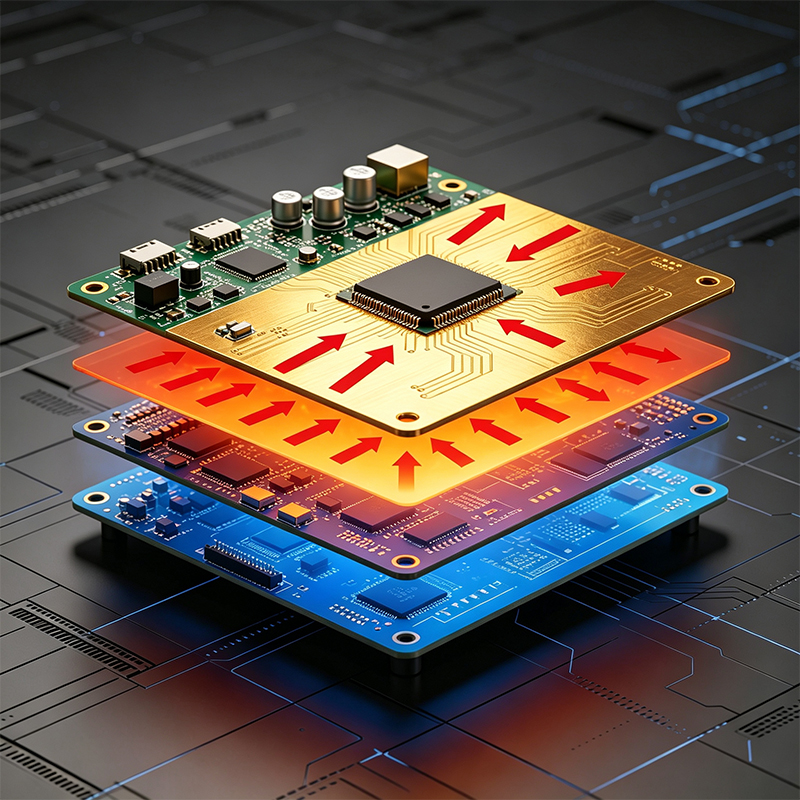
In 2026, copper thermal conductivity is more relevant than ever because our devices are getting smaller but more powerful.
Smartphones & HDI PCBs: Inside your phone, tiny layers of copper (often in HDI boards) act as "thermal highways," pulling heat away from the CPU so the phone doesn't throttle.
Electric Vehicles (EVs): EV battery packs generate massive amounts of heat during fast charging. Copper busbars and cooling plates ensure the battery doesn't turn into a fireball.
AI Data Centers: The massive GPU clusters training the next ChatGPT need copper vapor chambers and liquid cooling cold plates to survive the intense heat they generate.
You’ll often see aluminum used in cheaper heatsinks. Why? Because it’s lighter and costs less. But when space is a luxury—like in a Rigid-Flex PCB or a compact laptop—copper wins every time. It moves heat so much more efficiently that you can use a much smaller copper plate to do the job of a giant aluminum one.
If heat is the enemy of electronics, then copper is the primary weapon. Understanding copper thermal conductivity helps engineers build faster, safer, and longer-lasting gadgets. Next time your laptop fan kicks in, just remember there’s likely a tiny piece of copper working overtime to keep things from melting down.

Kaboer manufacturing PCBs since 2009. Professional technology and high-precision Printed Circuit Boards involved in Medical, IOT, UAV, Aviation, Automotive, Aerospace, Industrial Control, Artificial Intelligence, Consumer Electronics etc..


 English



 Wechat
 +86 13670210335
 +86 13670210335
 E-mail