
Date: 2026-06-15
You manufacture HVAC equipment, industrial heaters, or home appliances. Inside your product, there's a board that monitors temperature, controls ignition, drives fans, and ensures safety. That board is the furnace control board.
Whether you make gas furnaces, commercial ovens, industrial dryers, or heat blowers, the control board is the core component. If it fails, the whole system stops. If it's unstable, customers complain. A well‑designed, reliably manufactured furnace control board directly determines your product's reputation.
In this guide, I'll explain what a furnace control board does, its common types, what to consider when customizing, and how to pick a trustworthy manufacturing partner. Plain English, no fluff.
A typical furnace control board handles these tasks:
Temperature sensing – Reads signals from thermocouples, thermistors, or thermopiles.
Ignition control – On gas furnaces, it activates the igniter (spark or hot surface) and opens the gas valve.
Safety monitoring – Checks if the flame is present; shuts off gas if the flame goes out unexpectedly.
Fan/motor control – Drives blowers, circulators, exhaust fans, and pumps.
User interface – Accepts commands from a thermostat, knobs, or touch panel and displays status.
Communication – Talks to building automation systems or IoT modules.
Simply put, a furnace control board is a temperature‑controlled brain with safety features. Its reliability is critical – a faulty board can cause gas leaks, overheating, or even fires.
Based on the application environment and mechanical constraints, furnace control boards fall into two main categories:
| Type | Characteristics | Best For |
|---|---|---|
| Rigid furnace control board | FR4 material, sturdy, low cost, mounts on non‑bending surfaces | Wall‑hung boilers, water heaters, industrial ovens, dryers |
| Rigid‑flex furnace control board | Rigid sections plus flex interconnects – can fold or conform to curved housings | Compact boilers, portable heaters, ovens with moving doors |
Rigid boards are the most common – cheap and mature. Rigid‑flex is ideal when space is extremely tight or when the control board has to be split across a hinge (e.g., an oven door panel). Rigid‑flex eliminates connectors and cables, improving reliability.
Unlike standard consumer electronics, furnace control boards operate in harsh environments: high temperature, high humidity, dust, voltage spikes, and electromagnetic interference. Design must address:
1. Wide temperature range
The board may see -20°C to 85°C or higher. Use industrial or automotive‑grade components. Choose capacitors rated for 105°C.
2. High reliability
The board must never freeze or misbehave. Use a power supply with margin, include a watchdog timer on the MCU, and add filtering on sensitive signals.
3. Safety certifications
For the US and European markets, furnace control boards usually need UL, CE, or CSA certification. The PCB itself should be UL94 V‑0 rated. Circuit design must meet creepage and clearance requirements.
4. Noise immunity
Furnaces have inductive loads (motors, ignition coils, solenoid valves) that generate large EMI spikes. Add TVS diodes, common‑mode chokes, and RC snubbers on inputs and outputs.
5. Moisture and dust protection
Many furnace control boards are coated with conformal coating (acrylic, urethane, or silicone) to resist humidity, sulfur, and dust. The coating quality directly affects long‑term reliability.
1. Has the supplier made similar control boards before?
Furnace control boards have special safety and certification requirements. A PCBA shop that only does consumer electronics may not understand gas safety logic. Look for a supplier with HVAC or appliance industry experience.
2. Can you help with safety testing and certification?
Many small manufacturers don't have their own safety lab. If your supplier can pre‑test (hi‑pot, insulation resistance, ground continuity) and works with a certification body, it saves you months.
3. Is rigid‑flex suitable for my furnace application?
Standard polyimide flex material works from -40°C to +150°C – fine for most furnace interiors. But if the flex part must bend repeatedly (e.g., an oven door), you need rolled‑annealed copper and dynamic flex design. We have experience with rigid‑flex furnace boards.
4. How do you apply conformal coating?
Ask about coating thickness, area (full or selective), material (acrylic, urethane, silicone), and curing method (thermal or UV). A good coating dramatically improves board life in harsh environments.
5. What are your lead times and minimum order quantities?
Furnace control boards are often high volume, but there are also small‑batch custom projects. You need a supplier that is flexible.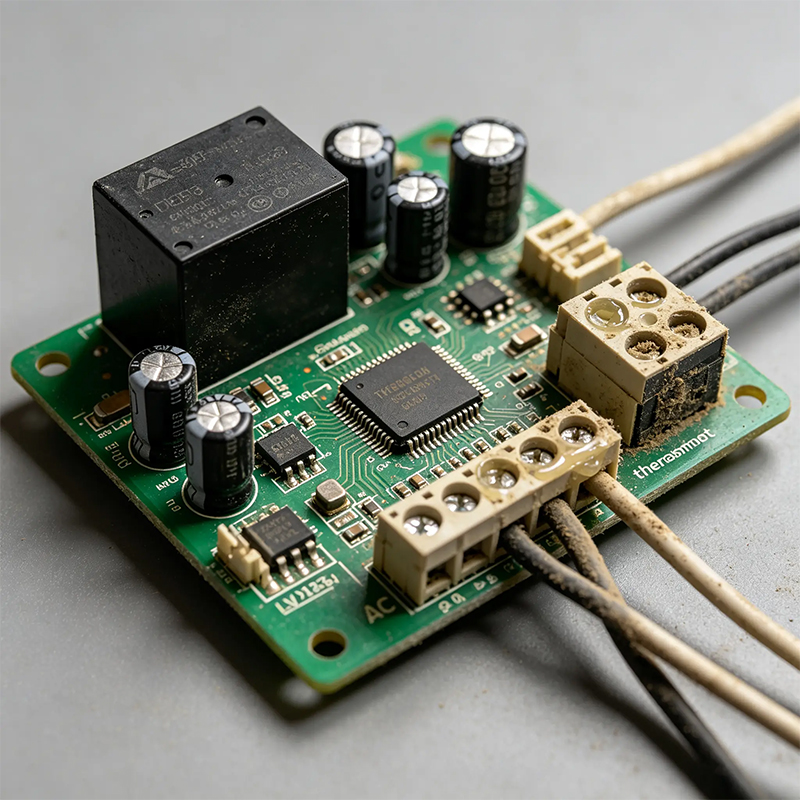
We are not just a PCBA shop. We are a one‑stop manufacturer that designs and makes flexible PCBs, rigid‑flex boards, HDI high‑frequency boards, and then does full PCBA. For furnace control boards – where reliability is everything – we bring proven experience.
Safety‑conscious design – We've built UL, CE, and CSA certified furnace boards. We understand gas safety logic, creepage distances, and fail‑safe requirements.
All in‑house – PCB fab, SMT, testing, and conformal coating under one roof. No hand‑offs, better quality control.
Rigid‑flex expertise – Need a board that folds or fits a curved housing? We do rigid‑flex that eliminates connectors and wires.
Environmental testing – We have temperature/humidity chambers and aging racks. We can test your boards from -20°C to 85°C with cycling.
Automated conformal coating – Precision spray lines with selective coating capability. Consistent thickness, no missed areas.
Furnace control boards we have built: wall‑hung boiler control boards, commercial water heater boards, industrial oven controllers, oven display panels.
Three simple steps:
Send us your files – Schematic, PCB design (or functional description), BOM, and any safety requirements.
We review and quote – Within 24 hours, you'll receive a DFM report, sample and volume pricing, and estimated lead time.
Sample, test, then scale – We build 10‑20 samples. You run functional and environmental tests. Then we move to pilot and volume production.
A furnace control board is not a typical consumer electronics board. It must work reliably for years in high heat, humidity, and electrical noise – and it involves gas safety. Choose the wrong manufacturing partner, and you'll face high field failure rates or even safety incidents.
If you're developing or improving a furnace control board, send us your requirements. We won't push a big contract – we'll first run a free DFM review and let our expertise speak.
When you contact us, please include:
Product type (gas furnace, oven, dryer, etc.)
Functional requirements (number of sensors, outputs, communication needed)
Estimated annual quantity (samples, small batch, or mass production)
We'll give you an honest answer – what we can do, what we can't, and how to modify your design to make it work. Let's build a furnace control board that's safe, reliable, and built to last.

Kaboer manufacturing PCBs since 2009. Professional technology and high-precision Printed Circuit Boards involved in Medical, IOT, UAV, Aviation, Automotive, Aerospace, Industrial Control, Artificial Intelligence, Consumer Electronics etc..


 English



 Wechat
 +86 13670210335
 +86 13670210335
 E-mail