
Date: 2026-05-20
You’ve got a circuit board that’s too big for your project. Maybe it’s a prototype board, a breakout, or an old PCB you want to reuse. Or you have a panel of multiple small boards that need to be separated. Whatever the reason, you need to cut the board down to size.
But circuit boards aren’t like paper or plastic. They’re made of fiberglass and copper. Cut them wrong, and you’ll crack the board, damage traces, or breathe in dangerous dust. Don’t worry – with the right techniques and tools, you can cut PCBs cleanly and safely.
Let’s walk through the best ways to cut circuit boards, what tools to use, and how to avoid common mistakes.
First, What Are Circuit Boards Made Of?
Most rigid circuit boards use FR4 – a fiberglass cloth soaked in epoxy resin. It’s tough, heat‑resistant, and surprisingly hard. Underneath the green solder mask is a thin layer of copper. FR4 is what makes cutting different from cutting wood or plastic. Fiberglass dust is nasty stuff – it irritates your skin, eyes, and lungs.
Flexible circuit boards (those orange, bendy ones) are made of polyimide film with copper traces. You cut them differently – more like cutting a thick sheet of plastic.
Why Would You Need to Cut a Circuit Board?
Common reasons:
Separating panelized boards – Manufacturers often make many small boards on one large panel. You need to cut them apart (this is called “depanelization”).
Shrinking a prototype – A prototype board might be larger than your final enclosure. You trim off the excess.
Recycling or reusing – Salvaging a section of an old board for a new project.
Custom shapes – Cutting a board to fit into an irregular enclosure.
Tools You Can Use to Cut Circuit Boards
From cheap and simple to more precise, here are your options.
1. Score and snap (the most common method for straight cuts)
This works for rigid FR4 boards that are not too thick (up to about 1.6mm). You score a line along where you want to cut, then snap the board along that line.
Tools: A carbide scriber, a sharp utility knife, or a purpose‑built PCB scoring tool. A metal ruler.
How to do it:
Place the board on a flat, firm surface.
Align the ruler exactly on the cut line.
Drag the scriber or knife firmly along the ruler 5–10 times, until you have a deep groove (about halfway through the board thickness).
Flip the board. Score the other side along the same line.
Place the board with the scored line aligned with the edge of a table. Press down on the overhanging part. The board should snap cleanly along the groove.
Pros: Cheap, fast, no dust.
Cons: Only works for straight cuts. Can crack nearby traces if you’re too close to copper. Requires practice.
2. Shears / Guillotine cutter
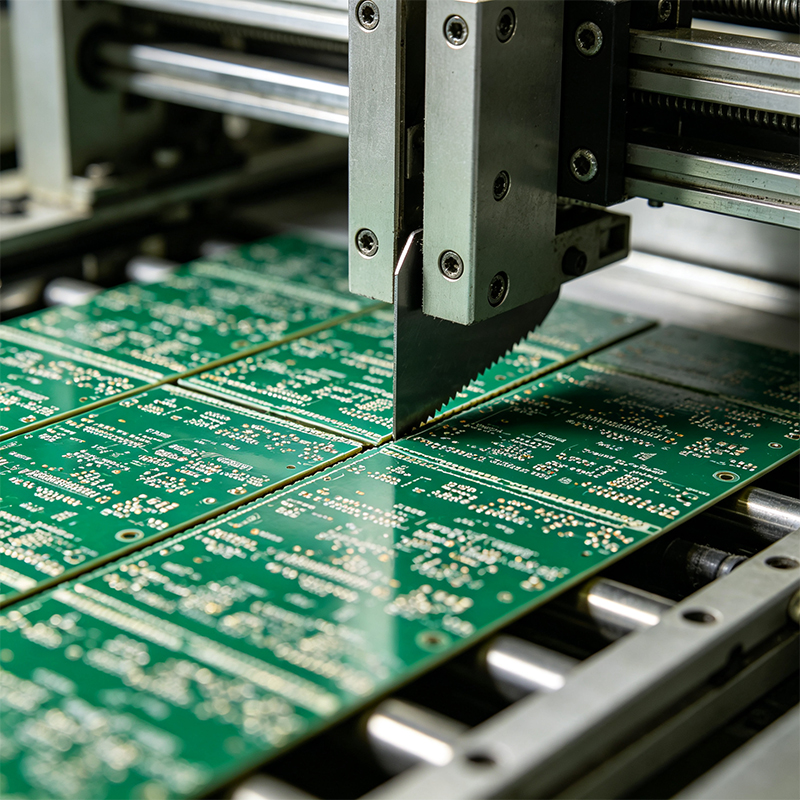
A dedicated PCB shear (manual or pneumatic) looks like a heavy paper cutter. You slide the board in, pull the handle, and the blade slices through cleanly.
Pros: Very clean cuts, no dust, fast for many boards.
Cons: Expensive tool (1000+). Only straight cuts. Not for thick boards (>2mm).
3. Jigsaw / scroll saw with fine‑tooth blade
For non‑straight cuts (curves, circles, cutouts), a saw is the way to go.
Tool: Jigsaw or scroll saw with a very fine metal‑cutting blade (like 32 TPI). Or a coping saw for hand work.
How to do it:
Mark your cut line.
Clamp the board securely.
Cut slowly, letting the blade do the work. Don’t force it.
Sand the edges smooth afterward.
Pros: Can cut any shape.
Cons: Creates fiberglass dust – you must wear a mask and eye protection. Blade wears out quickly. Rough edges need sanding.
4. Dremel / rotary tool with cutoff wheel
A Dremel with a fiberglass‑reinforced cutoff wheel can zip through PCBs quickly.
How to do it:
Mark the cut line.
Clamp the board.
Wear safety glasses – the wheels can shatter.
Cut along the line, moving steadily.
Pros: Fast, good for curves and small cutouts.
Cons: Lots of dust. Rough edges. Wheels wear out and can break.
5. CNC router / milling machine
For precision cuts, complex shapes, or batch work, a CNC router is ideal. You program the cut path, and the machine does the rest.
Pros: Extremely accurate, clean edges, can also drill holes.
Cons: Expensive equipment, requires learning G‑code or CAD/CAM software.
6. Handsaw (hack saw or coping saw)
In a pinch, a fine‑tooth hacksaw (32 TPI) can cut PCBs. Use a coping saw for curves.
Pros: Cheap, no power tools needed.
Cons: Slow, requires effort, edges are rough, dust is produced.
How to Cut Flexible Circuit Boards (FPCBs)
Flexible PCBs are completely different. You can cut them with:
Scissors – Sharp, heavy‑duty scissors work perfectly for straight or curved cuts on thin flex circuits (less than 0.2mm thick). No dust. Don’t use your best fabric scissors – the copper will dull them.
Utility knife – Score and tear. For thicker flex (with stiffeners), score both sides with a knife and then tear.
Die cutting – For volume production, custom steel‑rule dies punch out flex circuits cleanly.
Do not use a saw or Dremel on flexible PCBs – the material will melt or fray.
Important Safety Rules When Cutting PCBs
Fiberglass dust is hazardous. It causes skin irritation and can damage your lungs if inhaled. Here’s how to protect yourself:
Wear a dust mask (N95 or better) – Even for “small” cuts. You don’t see the dust, but it’s there.
Wear safety glasses – Tiny bits of fiberglass or broken cutoff wheels can fly into your eyes.
Work in a well‑ventilated area – Or better, outside.
Clean up with a wet paper towel – Don’t blow the dust away (you’ll just spread it). Wipe it up.
Wash your hands and clothes afterward – Fiberglass dust itches.
Step‑by‑Step: Cutting a Rigid PCB with Score & Snap (Most Beginner‑Friendly)
Let’s say you have a 100×80mm board and you need it to be 100×60mm.
Mark the cut line – Use a fine marker and a ruler. Measure twice.
Check for traces – Look at the board. Are there copper traces crossing your cut line? If yes, you’ll damage them. Either change the cut location or know that those traces will be lost.
Score the top side – Place a metal ruler along the line. Drag a carbide scriber or the back of a utility knife (not the sharp edge – use the corner of the blade) firmly along the ruler 5–10 times until you feel a deep groove.
Score the bottom side – Flip the board and repeat.
Snap – Place the board with the scored line exactly at the edge of a table. Hold the larger part down firmly. Press down sharply on the overhanging part. It should snap cleanly.
Sand the edge – Use fine sandpaper (400 grit) to smooth the cut edge. Be gentle – you don’t want to scrape off solder mask elsewhere.
Check for shorts – Inspect the cut edge under magnification. If any copper traces are left exposed and touching each other, carefully scrape away excess copper with a knife.
How to Cut a PCB Without Damaging Traces
Keep your cut line at least 1–2mm away from any copper traces or pads. Even if the trace doesn’t cross the line, the mechanical stress of snapping can crack nearby copper.
If you must cut through traces (e.g., salvaging a section of an old board), be prepared to repair them later with jumper wires. Or use a saw (not score & snap) to reduce stress.
For boards with components already soldered – Remove components near the cut area first. The vibration or stress can crack solder joints.
How to Cut V‑Groove Panels (Depanelization)
Many manufacturers put V‑shaped grooves (V‑scoring) between small boards on a panel. You don’t need to cut – you just snap them apart.
Method: Align the V‑groove with the edge of a table. Press down on one side. The board will separate along the groove.
Tool: You can buy a manual “PCB separator” or simply use your hands (be careful – the board can snap unevenly).
Tip: For long panels, work from one end to the other, not all at once.
What About Cutting Circuits on a Flexible PCB?
To cut a flexible circuit to shape:
Use sharp scissors – Cut along the outline. For internal cutouts, poke a hole with a sharp blade and then cut.
Use a sharp utility knife – For straight cuts on a cutting mat.
Don’t use a saw – It will fray the polyimide.
Can You Cut a Circuit Board with a Laser Cutter?
Yes, but with extreme caution. CO₂ lasers can cut FR4, but they also burn the epoxy and release toxic fumes (chlorine, bromine). You need a laser with excellent ventilation and a fume scrubber. Most hobby lasers are not suitable – you’ll fill your shop with acrid smoke and possibly damage the laser. For polyimide flex circuits, a laser works beautifully – clean edges, no fraying. But still, ventilate.
How to Smooth Rough Cut Edges
After cutting, the edge will be rough and possibly have small fiberglass splinters. Sand it smooth:
Use 400–600 grit sandpaper on a flat block.
Sand gently in one direction.
For V‑groove snaps, the edge is already clean – no sanding needed.
A Real‑World Example: Trimming a Prototype Board
A hobbyist ordered a 100×160mm prototyping board but only needed a 100×80mm section for a compact sensor project. He marked the line 80mm from one end, scored both sides with a carbide scriber, snapped it over the edge of his workbench, and sanded the edge. Total time: 3 minutes. The board fit perfectly into his enclosure.
When Should You NOT Cut a Circuit Board?
If traces or vias cross the cut line – You’ll break the circuit. Either redesign the board or find another solution.
If the board has internal ground or power planes – Cutting through a plane can create a short or open, depending on the internal copper. It’s risky.
If the board is thicker than 2.4mm – Score & snap becomes difficult. Use a saw or Dremel.
If the board is already assembled with expensive components – The stress of cutting could crack solder joints. Depanelize before assembly.
Final Answer – How to Cut a Circuit Board
To cut a rigid circuit board safely:
For straight cuts: score & snap (scribe both sides, then snap over a table edge). Cheap, fast, no dust.
For curves or complex shapes: use a jigsaw, Dremel, or CNC router – but wear a dust mask and safety glasses.
For flexible circuits: use sharp scissors or a utility knife – no saws.
Always check for copper traces crossing your cut line. Keep the cut at least 1–2mm away from traces. Wear a mask and glasses. Sand edges smooth. And never forget: fiberglass dust is nasty – clean up with a wet paper towel.

Kaboer manufacturing PCBs since 2009. Professional technology and high-precision Printed Circuit Boards involved in Medical, IOT, UAV, Aviation, Automotive, Aerospace, Industrial Control, Artificial Intelligence, Consumer Electronics etc..


 English



 Wechat
 +86 13670210335
 +86 13670210335
 E-mail