
Date: 2026-02-28
Have you ever opened a laptop or looked inside a piece of industrial equipment and wondered how all those separate circuit boards talk to each other? The answer is PCB connectors—the unsung heroes that make modular electronics possible.
Think of PCB connectors as the traffic hubs of your electronic system. They're the meeting points where signals and power flow from one board to another, or from the outside world into your carefully designed circuitry. Without them, every connection would have to be soldered directly—imagine trying to upgrade your computer's memory if you had to desolder and resolder every pin.
This guide walks you through everything you need to know about PCB connectors—the different types, how to choose the right one, what pitfalls to avoid, and how working with the right manufacturing partner ensures your connectors perform as intended.
A PCB connector is an electromechanical component that creates a separable interface between a printed circuit board and another part of your system—whether that's another PCB, a wire harness, a display, or an external device .
The beauty of connectors is that they make systems modular, serviceable, and upgradeable. A failed component can be swapped out. A system can be expanded by plugging in a new card. Assembly becomes faster because subassemblies can be built separately and then connected.
Connectors come in thousands of shapes and sizes, but they all serve the same fundamental purpose: creating reliable, repeatable connections that can be made and unmade as needed.
When you need to connect one PCB directly to another, board-to-board connectors are the answer . These come in several configurations:
Mezzanine connectors stack boards parallel to each other with a controlled gap—think of how a Raspberry Pi HAT attaches. They're perfect for compact designs where space is at a premium .
Card-edge connectors are what you see on PCIe cards and memory modules. The board itself has gold-plated contacts that slide into a matching slot on the motherboard . This design is incredibly common in computers and modular industrial systems.
Backplane connectors handle the highest densities, with hundreds of pins connecting multiple cards to a central backplane in servers and telecom equipment .
Sometimes you need to connect external wiring to your PCB. That's where wire-to-board connectors come in . They're everywhere—from the battery connector in your phone to the sensor connections in industrial machinery.
Common types include:
Pin headers and sockets: The classic 2.54mm pitch headers you see on Arduino boards
Terminal blocks: Screw or spring terminals for industrial wiring
JST connectors: Those small white connectors on drone batteries and 3D printer components
Crimp connectors: Wires are crimped into terminals that then snap into plastic housings
For connecting flexible circuits or flat cables, FPC (Flexible Printed Circuit) and FFC (Flat Flexible Cable) connectors are the go-to choice . They're what connect your smartphone's display to its main board—thin, lightweight, and designed for tight spaces.
Many use ZIF (Zero Insertion Force) mechanisms—you flip open a latch, insert the cable, and close it to lock everything in place .
When signals get fast—into the gigahertz range—you need specialized connectors that maintain signal integrity :
USB, HDMI, and Ethernet connectors for standard interfaces
SMA and U.FL for RF signals in wireless and 5G applications
SFP+ for fiber optic and high-speed data links in networking gear
For high-current applications, power connectors are built to handle the heat . They have larger contacts, thicker wires, and designs that minimize resistance. Think of the power input on a laptop or the battery connectors in an electric vehicle.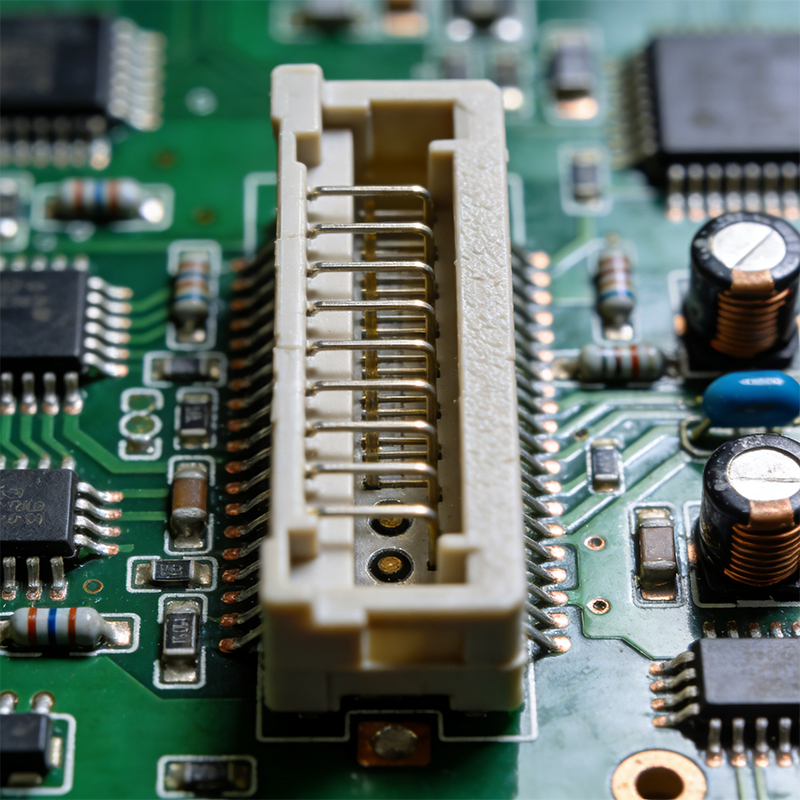
Selecting a connector isn't just about finding one that physically fits. You need to consider several factors :
Current rating tells you how much current each pin can safely carry. Exceed it, and the connector overheats . Remember that ratings often assume all pins are carrying current simultaneously—if only a few pins are used, they can sometimes handle more, but always check the datasheet.
Voltage rating determines the maximum voltage the connector can handle without arcing between pins . This depends on the spacing between contacts (creepage and clearance) and the insulating materials.
Contact resistance should be as low as possible—every milliohm generates heat and drops voltage .
Mating cycles tell you how many times you can plug and unplug before the connector wears out . A connector rated for 50 cycles is fine for internal connections that rarely get touched. One rated for 10,000 cycles might be needed for a battery connector in a consumer device.
Insertion force matters for manufacturing and user experience . Some connectors need a firm push; others use zero-insertion-force designs for delicate applications.
Locking mechanisms keep connectors mated in high-vibration environments . You'll find latches, screws, or friction locks depending on the application.
Where will your product live?
IP ratings tell you about protection against dust and water . IP20 is fine for indoor use; IP67 means it can survive being dunked.
Temperature range matters for automotive or outdoor equipment .
Chemical resistance is crucial if your product will see oils, solvents, or cleaning agents.
Pitch is the distance between pin centers . Common sizes include:
2.54mm (0.1") : The classic, easy to work with, good for through-hole
1.27mm: Higher density, often used in SMT connectors
0.5mm and finer: For ultra-compact designs like smartphone internals
Smaller pitch saves space but makes assembly more challenging and requires tighter manufacturing tolerances .
How does the connector attach to your board?
Through-hole (THT) : Pins go through holes and are soldered on the opposite side. Strong mechanical connection, good for high-stress applications.
Surface-mount (SMT) : Pins solder to pads on the board surface. Allows smaller connectors and double-sided mounting.
Press-fit : Pins press into plated holes without solder . Common in high-reliability applications.
Connectors take abuse—cables get yanked, boards get inserted and removed. If you don't provide adequate strain relief, that stress transfers to the solder joints, which eventually crack .
Solution: Use connectors with built-in strain relief, add additional mechanical mounting (like screws or standoffs), and route cables so they don't pull directly on the connector .
Power connectors get hot. If you pack them too close to heat-sensitive components, you'll create reliability problems .
Solution: Provide adequate copper on the PCB to spread heat, use thermal vias, and keep space around high-current connectors .
At high speeds, connectors become part of the transmission line. A poorly chosen connector can ruin your carefully designed impedance control .
Solution: For high-speed signals, use connectors designed for controlled impedance, follow manufacturer layout recommendations, and keep differential pairs together .
Some connectors are nearly impossible to solder by hand. Others require precise alignment that's hard to achieve in production .
Solution: Think about assembly during design. For fine-pitch connectors, ensure your assembly house has the right equipment. Add alignment features where needed.
The base metal of the contacts is usually phosphor bronze or beryllium copper—both offer good spring properties and conductivity .
Plating is where the magic happens :
Gold: The gold standard (pun intended). Gold doesn't oxidize, provides low contact resistance, and withstands many mating cycles . Typical thicknesses range from 0.1μm to 0.8μm for most applications, with heavier plating for extreme reliability.
Tin: Cheap and solderable, but oxidizes over time. Tin-plated connectors are fine for applications with few mating cycles .
Selective plating: Gold only where it matters (the contact area), tin elsewhere—a cost-effective compromise .
Understanding connectors is one thing. Actually building reliable products that use them—especially when flexible circuits, rigid boards, and complex assemblies are involved—requires a partner who understands the whole picture.
At Kaboer, we've been at the forefront of PCB manufacturing since 2009 . We specialize in turning connector-intensive designs into reality, particularly when flexible circuits and rigid-flex boards are involved.
When you're designing with flexible PCBs or rigid-flex boards, connectors take on new importance . A flex circuit might need to bend around corners, fit into impossibly tight spaces, and still maintain reliable connections through thousands of flex cycles.
That's where our expertise comes in. We manufacture:
1-30 layer flexible PCBs that can route signals exactly where you need them
2-32 layer rigid-flex boards that combine the stability of rigid sections with the flexibility of bendable circuits
HDI and high-frequency boards for applications demanding maximum performance
Our 0.17mm flexible layers offer excellent bending toughness, while our ultra-thick rigid sections (up to 8mm) provide rock-solid support for heavy-duty connectors and high-power modules .
A connector is only as good as its solder joints. That's why our in-house PCBA (Printed Circuit Board Assembly) service is such an advantage . We don't just make your boards—we populate them with connectors and components, ensuring every joint meets our stringent quality standards.
Our assembly capabilities include both surface-mount and through-hole technologies, so whether you need fine-pitch board-to-board connectors or rugged terminal blocks, we can handle it all .
We're not just claiming quality—we're certified for it :
ISO 9001:2015 for quality management
IATF 16949:2016 for automotive applications
ISO 14001:2015 for environmental management
UL and RoHS compliance
With monthly production capacity exceeding 150,000 square meters for FPC and rigid-flex boards, plus 80,000 square meters for rigid PCBs, we have the scale to handle projects from prototype to high-volume production .
We believe the best partnerships are built on trust and transparency. That's why we genuinely welcome our global clients to visit our factory in Shenzhen .
Come see our advanced manufacturing lines, meet our engineering team, and discuss your connector integration challenges face-to-face. Watch how we handle everything from precision FPC fabrication to automated SMT assembly, all under one roof.
PCB connectors may not be the most glamorous part of your design, but they're absolutely critical to your product's success. Choose the wrong connector, and you'll face field failures, assembly headaches, or performance issues. Choose the right one—and partner with a manufacturer who understands how to integrate them seamlessly—and your product will thrive.
At Kaboer, we've spent over 15 years perfecting the art of bringing complex board designs to life . Whether you're working with standard rigid boards, advanced flex circuits, or intricate rigid-flex assemblies, we have the expertise and capability to make your project successful.
Ready to discuss your next project? Contact us today to learn how Kaboer can help you build electronics that last. Better yet, come visit us in Shenzhen and see for yourself.

Kaboer manufacturing PCBs since 2009. Professional technology and high-precision Printed Circuit Boards involved in Medical, IOT, UAV, Aviation, Automotive, Aerospace, Industrial Control, Artificial Intelligence, Consumer Electronics etc..


 English



 Wechat
 +86 13670210335
 +86 13670210335
 E-mail