
Date: 2026-03-05
Every smartphone, computer, and electronic device you use has one thing in common: a circuit board. But have you ever wondered where this invention came from?
The story of the PCB is longer and more interesting than most people realize. It involves inventors from multiple countries, a world war, and decades of innovation. Let's take a journey through the history of the printed circuit board.
To understand why the PCB was such a big deal, you need to picture electronics before it existed.
In the early 1900s, electronic devices were built using point-to-point wiring. Technicians would connect components by hand, one wire at a time, soldering each connection individually. The result was often a messy tangle of wires that was:
Difficult to build – Every unit was hand-assembled
Hard to repair – Finding a broken connection meant tracing through a rat's nest
Inconsistent – No two units were exactly alike
Bulky – All those wires took up space
As electronics became more complex, this approach was clearly unsustainable. Something had to change .
The idea of "printing" circuits instead of wiring them by hand emerged surprisingly early.
1903: German inventor Albert Hanson filed a patent for "printed" wires on flat, insulated boards. His concept described foil conductors laminated to an insulating board—remarkably similar to how flexible circuits are made today .
1913: Thomas Edison himself experimented with chemical methods for plating conductors onto linen paper. Even the famous inventor saw the potential .
1925: American Charles Ducas took a significant step forward. He printed circuit patterns on insulating boards and used electroplating to build up conductive paths. This was one of the first practical methods for creating circuits without wires .
But these early efforts faced a major problem: the electronic components of the day—vacuum tubes—generated enormous heat. The materials available just couldn't handle it. The world wasn't quite ready for PCBs yet .
The man most often credited as the "father of the modern printed circuit" is Paul Eisler, an Austrian engineer .
Working in England in 1936, Eisler developed the foil etching technique that became the foundation of PCB manufacturing. His method:
Start with copper foil bonded to an insulating base
Print the circuit pattern onto the copper using an acid-resistant ink
Etch away the unprotected copper, leaving only the desired traces
Eisler incorporated this technology into a radio set—the first device to use what we'd recognize as a modern PCB .
But like earlier inventors, Eisler struggled to find commercial interest. His timing, however, was about to change dramatically.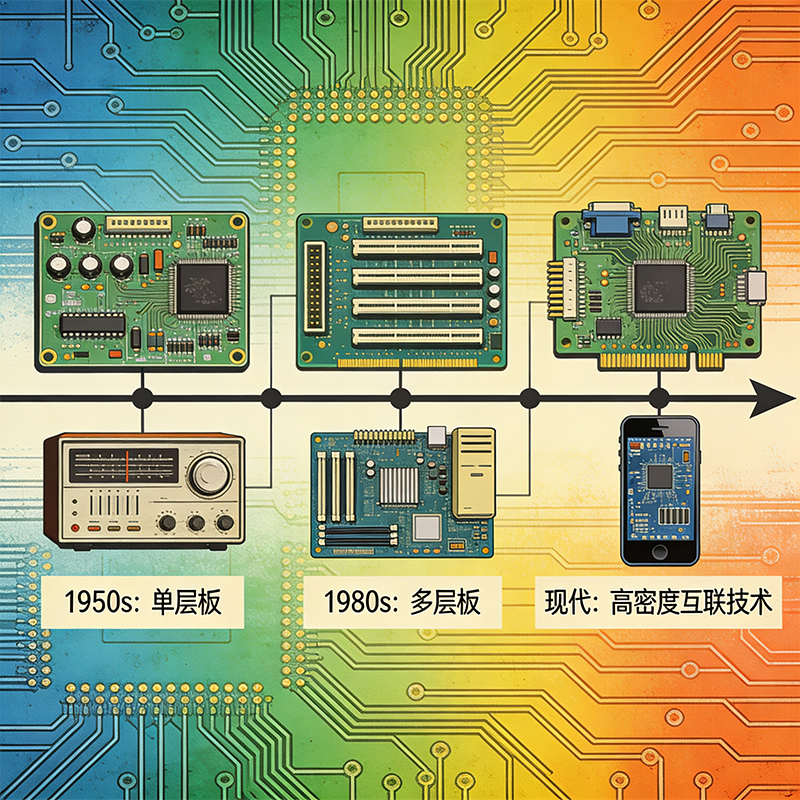
World War II created urgent demand for electronics that were compact, reliable, and could be mass-produced.
The most critical application was the proximity fuse—a device that detonated shells near their target rather than only on impact. These fuses had to survive being fired from guns and operate flawlessly under extreme conditions .
The solution? Ceramic substrates with printed circuits using silver paint for conductors and carbon for resistors. This technology, developed by companies like Centralab, was produced in massive quantities during the war .
1943: The U.S. military began using printed circuit technology extensively in portable radios and other equipment. The reliability and consistency of printed circuits proved invaluable .
After the war, the technology was released for commercial use.
1948: The U.S. officially opened PCB technology for commercial applications .
1947-1948: Epoxy resins began being used for board substrates, offering better performance than earlier materials .
1949: The U.S. Army Signal Corps developed the Auto-Sembly process, which allowed component leads to be inserted into a copper foil pattern and dip-soldered. This was the beginning of automated assembly .
1950s: With vacuum tubes being replaced by smaller, cooler-running transistors, PCBs finally found their place. The combination of better components and improved materials made printed circuits practical for mainstream products .
The first commercially successful PCBs were single-sided—copper traces on only one side of the board. Simple and cost-effective, they dominated the 1950s and are still used today for basic electronics .
1953: Motorola developed plated through-hole technology, which allowed reliable connections between both sides of a board. This was a breakthrough that enabled double-sided PCBs .
1950s-1960s: Polyimide and other advanced materials emerged, improving heat resistance and enabling more demanding applications .
As electronics grew more complex, single and double-sided boards weren't enough. The solution was multi-layer PCBs—multiple circuit layers stacked and bonded together.
1961: Hazeltine Corporation developed multi-layer boards based on plated through-hole technology .
1960s-1970s: Multi-layer boards became increasingly common, especially for aerospace, military, and mainframe computer applications where density and reliability were critical .
By the mid-1980s, multi-layer boards accounted for the majority of PCBs produced in the United States .
The next major shift was Surface Mount Technology (SMT) . Instead of inserting component leads through holes, SMT components were soldered directly to pads on the board surface .
This change brought huge benefits:
Smaller components
Higher density
Both sides of the board could be used
Better high-frequency performance
Automated assembly
SMT transformed electronics manufacturing and enabled the miniaturization that gave us laptops, camcorders, and eventually smartphones .
1995: The microvia process was introduced, allowing even smaller holes and more layers within a board. This enabled High-Density Interconnect (HDI) technology, which is essential for today's compact devices .
1960s-1990s: Flexible circuits developed in parallel, with key contributions from V. Dahlgreen (1960), FD-R (1969), and others. By the 1990s, flexible PCBs and rigid-flex designs were finding commercial applications .
Late 1990s-2000s: Environmental concerns drove the shift to lead-free soldering, requiring new materials and processes .
While PCB technology was developed in the West, its production center shifted dramatically in recent decades.
1956: China began PCB research and development .
1980s: Foreign investment brought advanced production lines to China .
2003: China became the world's second-largest PCB producer, surpassing the United States .
2006: China became the world's largest PCB manufacturer, a position it holds today .
Currently, China produces more PCBs than any other country, with a thriving industry centered in the Pearl River and Yangtze River Deltas .
Today's PCBs are marvels of engineering:
HDI boards with microvias and lines measured in microns
Flexible circuits that bend and fold in wearables and foldable phones
Rigid-flex designs combining the best of both worlds
High-frequency materials for 5G and radar
Metal-core boards for LED lighting and power electronics
Embedded components buried within the board layers
Current trends include even higher densities, better materials for high-speed signals, and more sustainable manufacturing processes .
From Albert Hanson's 1903 patent to today's ultra-thin smartphone boards, the PCB has come an incredible distance. What started as a clever idea for replacing messy wires evolved into the foundation of all modern electronics.
The basic concept remains the same: an insulating board with conductive traces connecting components. But the execution has been refined to an astonishing degree. Today's PCBs pack more computing power into a square centimeter than entire rooms of electronics could manage just decades ago.
And the story isn't over. As electronics continue to evolve, so will the boards that power them.
*This article was brought to you by Kaboer, your partner in custom PCB manufacturing since 2009. From flexible circuits to rigid-flex and HDI boards, we're proud to be part of this ongoing story.*

Kaboer manufacturing PCBs since 2009. Professional technology and high-precision Printed Circuit Boards involved in Medical, IOT, UAV, Aviation, Automotive, Aerospace, Industrial Control, Artificial Intelligence, Consumer Electronics etc..


 English



 Wechat
 +86 13670210335
 +86 13670210335
 E-mail