
Date: 2026-06-01
If you’ve ever looked closely at a circuit board, you’ve seen those little shiny circles or rectangles where components are soldered. Those are PCB pads. They seem simple – just a bit of exposed copper – but they’re one of the most important features on any board. Without good pads, you can’t solder components reliably, and your whole device might fail.
Let’s explore what PCB pads are, the different types, how they’re made, what can go wrong, and how to fix common pad problems.
What Is a PCB Pad?
A PCB pad is a small area of exposed copper on a circuit board where a component lead is soldered. It’s the electrical and mechanical connection point between the component and the board.
Think of pads as tiny metal “landing pads.” The component’s leg or pin sits on the pad, and molten solder bonds them together. Pads are usually covered with a thin protective layer (called a surface finish) to keep the copper from oxidizing and to make soldering easier.
Why Are Pads So Important?
Electrical connection – They carry current between the component and the copper traces.
Mechanical support – They hold the component in place, especially for surface‑mount parts.
Heat transfer – They help pull heat away from the component during soldering and operation.
Repairability – Good pads make it possible to desolder and replace components.
The Two Main Types of PCB Pads
Different components use different pad designs.
1. Through‑hole pads (for components with leads)
These have a hole in the center. You push the component’s wire through the hole, then solder it on the opposite side. The pad is the copper ring surrounding the hole. You’ll find these on large connectors, transformers, electrolytic capacitors, and many through‑hole resistors.
The ring of copper around the hole is called the annular ring. If it’s too narrow, the pad may lift or crack during soldering.
2. Surface‑mount pads (for SMD components)
These have no hole. The component sits directly on top of the pad, and you solder it from the same side. Surface‑mount pads come in many shapes:
Rectangular pads – For resistors, capacitors, and diodes.
Flat, elongated pads – For ICs with leads on two or four sides (SOIC, QFP).
Small round pads – For BGAs (ball grid arrays) – each ball of solder sits on its own tiny pad.
Thermal pads – Large pads under power chips to help dissipate heat. Often have multiple small vias (thermal vias) to conduct heat to inner layers.
How Are PCB Pads Made?
The process is part of standard PCB manufacturing:
The bare board starts with a thin layer of copper on both sides (or just one side for single‑sided boards).
A photoresist is applied, and the circuit pattern – including the pads – is exposed and developed.
The unwanted copper is etched away, leaving only the traces and pads.
A solder mask (the green or other color coating) is applied over the board. The mask is opened (windows are left) exactly where the pads are, so the copper is exposed.
A surface finish (HASL, ENIG, OSP, etc.) is applied to the exposed pads to protect them and make them solderable.
The result: clean, solderable pads ready for component placement.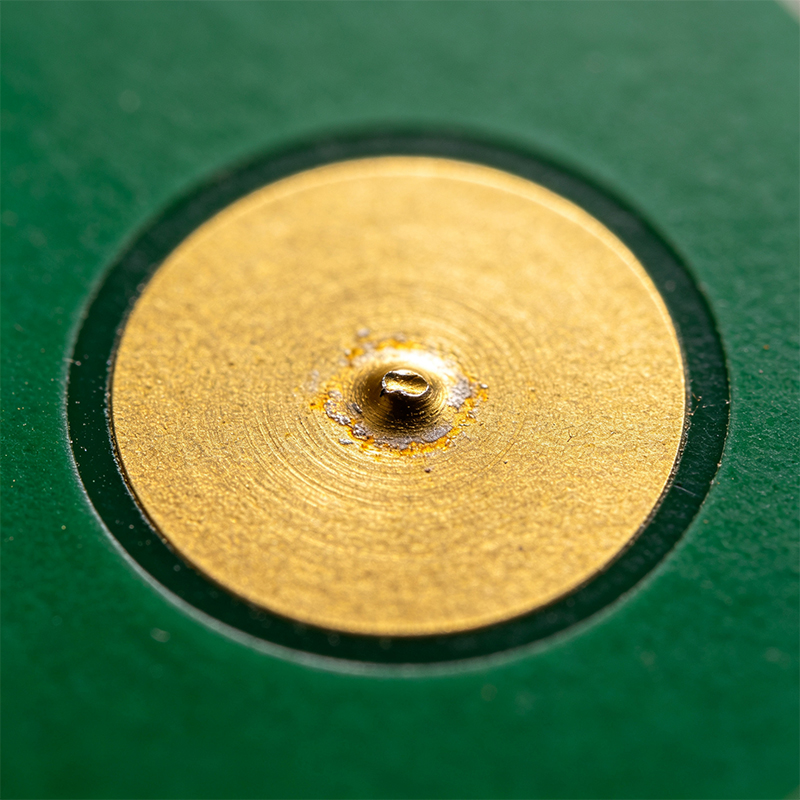
What Are Pads Made Of?
Base copper – Usually 1oz (35µm) or 0.5oz (18µm) thick. For high‑current pads, thicker copper (2oz, 3oz) may be used.
Surface finish – A thin coating to protect the copper and provide a good soldering surface. Common finishes: HASL (tin‑lead or lead‑free), ENIG (gold over nickel), OSP (organic), immersion silver, etc.
Solder mask – The green (or other color) coating that covers everything except the pads.
Pad Shapes and Sizes
Pads are not random. Their size and shape are carefully designed according to component specifications and IPC standards. The key dimensions include:
Pad width – Should be slightly wider than the component lead or terminal.
Pad length – Long enough for good solder fillet but not so long that solder wicks away.
Annular ring – For through‑hole pads, the width of copper from the hole edge to the pad edge. Minimum is usually 0.15‑0.2mm for standard boards.
Clearance – The gap between a pad and surrounding copper (like a ground plane). Too small, and you risk shorts; too large, you waste space.
Common Pad Problems (And How to Fix Them)
1. Lifted pad – The most frustrating issue. The copper pad peels off the board.
Cause: Too much heat, pulling a component before the solder is fully melted, or poor adhesion during manufacturing.
Fix: If the pad is completely gone, you’ll need to run a jumper wire from the component lead to the trace it should connect to. If the pad is partially attached, you can sometimes glue it back with epoxy, then carefully re‑solder.
2. Missing pad – The pad was never there (manufacturing defect) or was torn off.
Fix: Scrape the solder mask off the trace leading to the missing pad. Tin the exposed copper. Solder one end of a fine wire to the trace, and the other end to the component lead. This is called a “bodge wire.”
3. Oxidized or tarnished pad – The pad looks dark or dull. Solder won’t stick.
Cause: Age, humidity, or improper storage.
Fix: Gently clean with a fiberglass pen or fine sandpaper. Then apply flux – it should solder normally. For ENIG (gold) pads, oxidation is rare; for HASL or OSP, it’s common.
4. Solder mask over pad – The green coating accidentally covers part of the pad.
Cause: Poor manufacturing alignment.
Fix: Scrape off the excess solder mask carefully with a sharp knife or a fiberglass pen. Be careful not to damage the copper.
5. Bridged pads – Two adjacent pads are connected by a blob of solder.
Cause: Too much solder paste, misaligned stencil, or poor soldering technique.
Fix: Apply flux and use a clean soldering iron to wick away the excess. Or use desoldering wick.
6. Insufficient pad size – The pad is too small for the component, leading to weak solder joints.
Cause: Poor design.
Fix: Redesign the board. In a pinch, you can add a larger copper piece (e.g., a cut‑off resistor lead) to extend the pad, but this is temporary.
Pad Surface Finishes – Which One Is Best?
The finish on a pad affects solderability, shelf life, flatness, and cost.
| Finish | Solderability | Flatness | Shelf Life | Cost | Best For |
|---|---|---|---|---|---|
| HASL (lead‑free) | Good | Poor (uneven) | ~12 months | Low | Low‑cost, through‑hole heavy |
| ENIG (gold) | Excellent | Excellent | 12+ months | Medium‑high | Fine‑pitch SMT, BGAs, edge connectors |
| OSP | Good (after cleaning) | Excellent | 3‑6 months | Very low | High‑volume, short assembly window |
| Immersion silver | Excellent | Very good | 6‑12 months | Medium | High‑frequency, tight tolerances |
| Immersion tin | Excellent | Good | 6‑12 months | Medium | Press‑fit connectors |
For most hobbyists and general‑purpose boards, ENIG is the most forgiving. For prototypes, OSP is cheap but short‑lived.
What About Pads on Flexible PCBs?
Flexible circuits (polyimide base) also have pads, but they’re a bit different. The copper is usually rolled annealed (softer and more flexible). The pads are covered with a polyimide coverlay instead of hard solder mask. Stiffeners (small FR4 or polyimide pieces) are often glued behind pads where connectors will be attached, to prevent the flex from bending at that spot.
Repairing a lifted pad on a flex is harder – the polyimide doesn’t hold glue well, and heat can melt the material. Use low temperature and a very fine soldering tip.
How to Design Good Pads (A Quick Note for Designers)
If you’re designing a PCB, follow these guidelines:
Follow the component datasheet – It will recommend pad dimensions and spacing.
Use IPC standards – IPC‑7351 provides standard land patterns (pad shapes) for surface‑mount components.
Add teardrops – Where a trace meets a pad, add a teardrop (a small tapered widening). This reduces stress and prevents cracking.
Use thermal relief – For pads connected to large copper pours (like ground planes), use thermal relief spokes so the pad doesn’t sink too much heat during soldering.
Avoid solder mask defined (SMD) pads for fine‑pitch – For very small BGAs, you want “non‑solder mask defined” pads (copper defined) to ensure consistent pad size.
A Real‑World Example: Why a Lifted Pad Killed a Guitar Pedal
A friend’s guitar effects pedal stopped working. He opened it and found that a large capacitor had been bumped, lifting its pad off the board. The pad was completely gone. He scraped the solder mask off the trace that used to connect to that pad, tinned the exposed copper, and soldered a small wire from the capacitor lead to the trace. The pedal worked again. Total repair time: 15 minutes.
Final Answer – What Is a PCB Pad?
A PCB pad is the exposed copper area where a component is soldered to the circuit board. There are two main types: through‑hole pads (with a hole) and surface‑mount pads (no hole). Pads are made of copper with a protective surface finish (HASL, ENIG, OSP, etc.). Common pad problems include lifting, oxidation, and solder bridges – many of which can be repaired with basic tools.

Kaboer manufacturing PCBs since 2009. Professional technology and high-precision Printed Circuit Boards involved in Medical, IOT, UAV, Aviation, Automotive, Aerospace, Industrial Control, Artificial Intelligence, Consumer Electronics etc..


 English



 Wechat
 +86 13670210335
 +86 13670210335
 E-mail