
Date: 2026-04-02
Let’s be real for a minute. Most design software makes PCB routing look like a fun game of "Connect the Dots." But if you’ve ever had a high-speed prototype come back from the lab with massive EMI issues, or a flexible board that cracked after three bends, you know that routing is where the real engineering happens.
At our facility, we don’t just manufacture boards; we see thousands of designs every year. We’ve noticed that the difference between a product that works and one that ends up in the scrap bin usually comes down to the routing strategy—especially when you're pushing the limits with HDI or Rigid-Flex technology.
If you are working on a custom flexible PCB, the rules of the game change completely. You aren't just routing for electrical connectivity; you’re routing for mechanical survival.
Avoid the "I-Beam" Effect: One of the most common mistakes we see is stacking traces directly on top of each other on a two-layer flex circuit. This creates a stiff "I-Beam" that will snap when bent. We always recommend staggering your traces.
The Power of Teardrops: In flexible circuits, the transition from a thin trace to a large pad is a massive stress point. Always use teardrops. It’s a tiny detail that prevents your traces from peeling off during assembly or use.
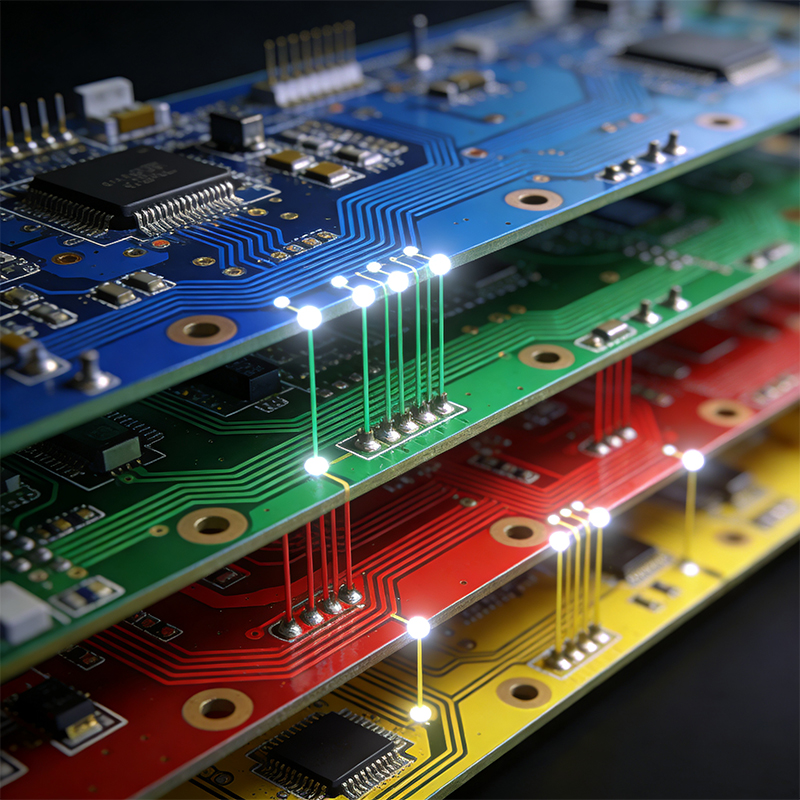
When you're dealing with high-frequency, high-speed HDI boards, pcb routing becomes an exercise in physics.
Impedance is Everything: If your differential pairs aren't matched perfectly, your signal integrity goes out the window. We use specialized software to verify your stack-up and trace widths before we even hit the production floor.
Via Management: In HDI designs, using blind and buried microvias is essential for saving space. But how you route into those vias matters. Avoid "stub" traces—they act like tiny antennas that broadcast interference.
We’ve seen brilliant designs that are simply impossible to build. For example, routing traces too close to the board edge or using a trace width that's too thin for the copper weight you've chosen.
This is why we focus on a Manufacturing-First approach. When we look at your PCB routing, we aren't just looking for shorts; we're looking for yield. Can this board be produced 10,000 times with 99.9% reliability?
Based in the heart of China’s high-tech manufacturing hub, we bridge the gap between your complex CAD files and a physical, working product.
Specialized in Complexity: Whether it's a 12-layer HDI board with laser vias or a complex rigid-flex assembly for a medical wearable, we’ve done it.
Real Feedback: We don't just take your money and print the board. If our engineers see a routing issue that will cause assembly failures later on, we’ll reach out and suggest a fix.
One-Stop Solution: From the first trace of PCB routing advice to the final PCBA testing, we handle the entire lifecycle.
Don't wait until you've already ordered 500 boards to realize there's a routing flaw.
Send us your Gerber files today. Our engineering team will do a preliminary review of your routing and stack-up. Let’s make sure your next project isn't just a great design on screen, but a high-performance reality in the field.

Kaboer manufacturing PCBs since 2009. Professional technology and high-precision Printed Circuit Boards involved in Medical, IOT, UAV, Aviation, Automotive, Aerospace, Industrial Control, Artificial Intelligence, Consumer Electronics etc..


 English



 Wechat
 +86 13670210335
 +86 13670210335
 E-mail