
Date: 2026-04-10
If you are a hardware engineer or an electronics procurement manager, you’ve probably used the terms smd and smt interchangeably a thousand times. But when it comes to high-stakes industrial PCB production, knowing the nuance between the two—and how they interact—is the difference between a successful launch and a massive field failure.
Simply put, SMD (Surface Mount Device) refers to the physical components, while SMT (Surface Mount Technology) is the entire ecosystem of machinery, solder paste, and thermal profiles used to place those devices onto a board. In 2026, as we push the limits of High-Speed HDI and custom Flexible PCBs, the synergy between these two is where the magic happens.
Think of SMD as the "bricks" and SMT as the "masonry technique."
In the old days of through-hole technology, everything had long "legs" that poked through the board. Today, SMD components are tiny, leadless, and designed to sit directly on the copper pads. This shift is what allowed us to shrink smartphones and wearables. But SMT is the heavy lifter here—it involves the precision stencils, the high-speed pick-and-place robots, and the reflow ovens that melt the solder just enough to create a bond without frying the chip.
When you’re working on an HDI (High Density Interconnect) board, the smd and smt relationship becomes incredibly tight.
In HDI designs, we often use 01005 or even 008004 sized SMD resistors. These things are smaller than a grain of pepper! Standard SMT lines can’t handle this. You need specialized vacuum nozzles and elite-level 3D Solder Paste Inspection (SPI). If the paste is off by just a few microns, you’ll end up with a circuit shorting issue or a "tombstoning" component that stands straight up instead of lying flat.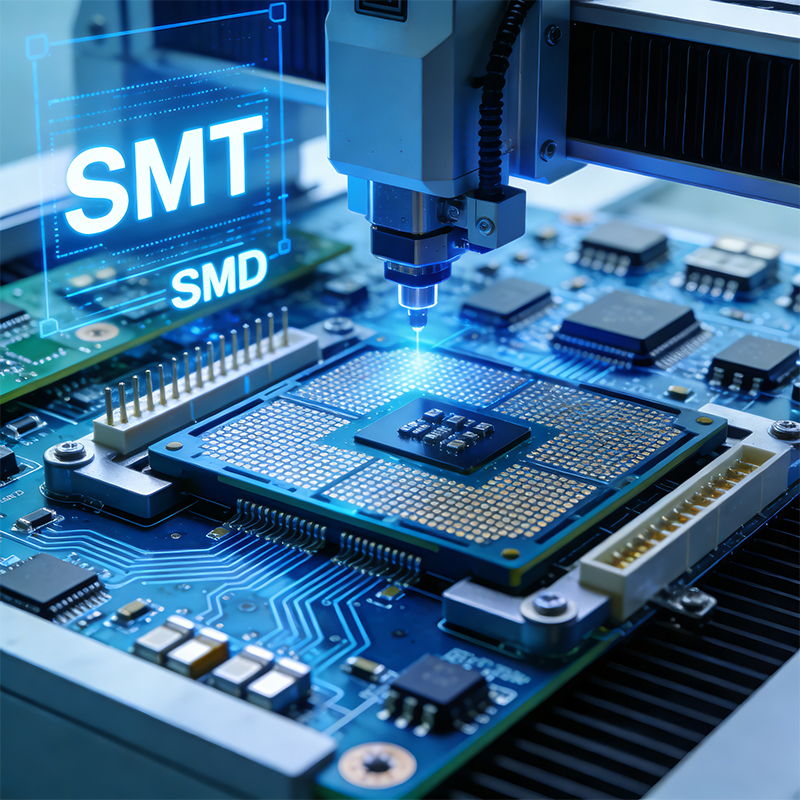
Assembling components on a flexible pcb board is like trying to build a LEGO set on a piece of fabric. The "flex" part makes the SMT process notoriously difficult.
Because the substrate is thin polyimide, it can warp or expand in the reflow oven. If your manufacturer doesn't use custom "nesting" fixtures or high-quality flex pasting adhesives, those tiny SMD joints will crack the moment the board is bent. We’ve perfected the thermal profiling to ensure that our Rigid-Flex boards maintain 100% connectivity, even in high-vibration industrial environments.
In 2026, "looking at the board" isn't quality control. To truly master smd and smt, you need data.
Every project we handle undergoes a "BOM Scrub" to ensure all SMD components are compliant with RoHS directive and currently available (no one wants "Ghost Parts" stalling their line). During production, we use Automated Optical Inspection (AOI) and X-ray to look inside the solder joints of BGA chips. We don't just hope there isn't an open circuit; we verify it with 100% certainty.
Whether you are looking for a quick-turn prototype of a custom Flexible PCB or a full-scale PCBA production run, the way your partner manages smd and smt is everything.
Stop gambling with your hardware. At our facility, we combine decades of experience with the latest 2026 manufacturing tech to ensure your boards are built to last. Send us your Gerber files and BOM today. Let's talk about how we can make your next project a reality.

Kaboer manufacturing PCBs since 2009. Professional technology and high-precision Printed Circuit Boards involved in Medical, IOT, UAV, Aviation, Automotive, Aerospace, Industrial Control, Artificial Intelligence, Consumer Electronics etc..


 English



 Wechat
 +86 13670210335
 +86 13670210335
 E-mail