
Date: 2026-05-27
You’ve probably used an FPC today without even knowing it. When you opened your laptop, folded your smartphone, or put on a fitness tracker – you relied on a Flexible Printed Circuit (FPC).
But what exactly is an FPC? How is it different from a regular circuit board? And why is it so important for modern electronics? Let’s break it down in plain English.
What Is an FPC?
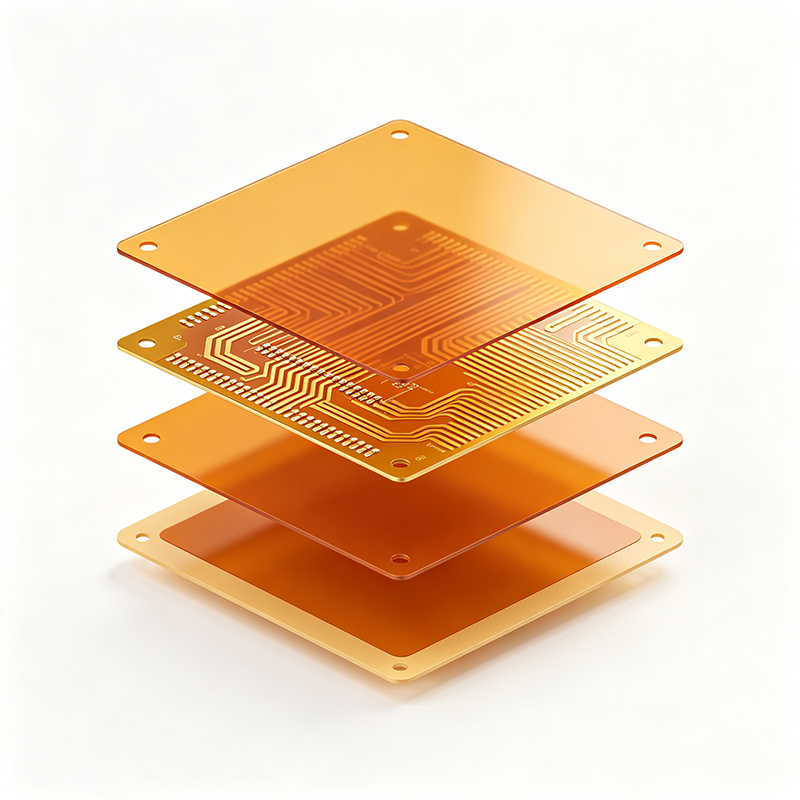
FPC stands for Flexible Printed Circuit. It’s a type of circuit board that can bend, fold, and twist. Unlike the stiff, green fiberglass boards you’re used to seeing (called rigid PCBs), an FPC is built on a thin, flexible plastic film – usually polyimide (the same material as Kapton tape).
Think of it as a circuit board that acts more like a piece of paper. You can roll it up, fold it over, or snake it through a narrow gap. Yet it still carries electrical signals just like a rigid board.
FPC vs. Regular PCB – What’s the Difference?
| Feature | Regular Rigid PCB | FPC (Flexible PCB) |
|---|---|---|
| Base material | FR4 (fiberglass) | Polyimide (plastic film) |
| Flexibility | None – breaks if bent | Yes – can bend, fold, twist |
| Thickness | 0.8‑2.4mm typical | 0.05‑0.3mm typical |
| Weight | Heavier | Very light |
| Cost | Lower | Higher (special materials/processes) |
| Best for | Standard electronics | Compact, moving, or lightweight devices |
Why Would You Need an FPC?
Regular rigid boards are great for many things, but they have limits. When your product needs to be thin, light, or fit into an odd shape, an FPC is often the answer.
Here are the main reasons designers choose FPCs:
Space saving – FPCs are paper‑thin. They can go where rigid boards can’t – around corners, through hinges, inside curved enclosures.
Weight reduction – Replacing a bundle of wires and several connectors with one thin FPC can save a lot of weight. That matters for drones, wearables, and aerospace.
Reliability – Every connector is a potential failure point. FPCs can eliminate multiple connectors by creating a single, continuous circuit. Fewer joints mean fewer things that can break.
Dynamic flexibility – Some products need circuits that move constantly – like a printer head or a folding phone hinge. FPCs can bend thousands of times without cracking (if designed correctly).
Ease of assembly – Plugging one FPC into a connector is much faster than routing and crimping a dozen loose wires.
Where Are FPCs Used?
You’d be surprised how many everyday devices contain FPCs. Here are some common examples:
Smartphones – The cables connecting the main board to the display, camera modules, buttons, and battery are almost always FPCs.
Laptops and tablets – The ribbon that goes through the hinge to the screen is an FPC. So are the cables for the keyboard, touchpad, and webcam.
Wearables – Fitness trackers and smartwatches use FPCs to wrap around your wrist. Hearing aids use tiny FPCs to fit inside the ear.
Printers – The moving print head is connected by a long, flexible FPC that bends back and forth thousands of times.
Medical devices – Endoscope cameras, implantable sensors, and portable monitors rely on thin, biocompatible FPCs.
Automotive – Dashboard displays, steering wheel controls, battery management systems in electric vehicles.
Cameras and drones – Interconnecting lens modules, gimbals, and flight controllers.
How Is an FPC Made? (The Simple Version)
Making an FPC is similar to making a rigid PCB, but with flexible materials and special care. Here’s the basic process:
Start with a flexible base – A sheet of polyimide film is coated with a thin layer of copper.
Create the circuit pattern – A light‑sensitive coating is applied, exposed to UV light through a mask, and developed. The unwanted copper is etched away, leaving only the desired traces.
Apply a coverlay – A protective polyimide film (like a flexible solder mask) is laminated over the traces. It leaves only the contact pads exposed.
Drill holes – Tiny holes for vias are laser‑drilled (mechanical drills can damage the flexible material).
Plate the vias – The holes are plated with copper to connect different layers.
Add stiffeners (optional) – Small pieces of FR4 or polyimide are glued to areas where connectors will be attached, to make those spots rigid.
Apply surface finish – The exposed pads are plated with gold (ENIG) or tin for good solderability and corrosion resistance.
Cut to shape – Individual FPCs are cut from the panel using a laser or precision die.
The result is a thin, durable, flexible circuit that can be bent and folded.
What About Stiffeners?
An FPC is flexible everywhere – but sometimes you don’t want a certain area to bend. For example, the end that plugs into a connector needs to be stiff, otherwise it would flop around and break. That’s where stiffeners come in. A small piece of FR4 (rigid fiberglass) or polyimide is glued to that area, making it rigid while the rest of the board stays flexible.
FPC vs. FFC – Don’t Confuse Them
People often mix up FPC and FFC (Flexible Flat Cable). Here’s the difference:
FFC – A simple laminated cable with straight, parallel conductors. Very cheap. Only straight lines. No components.
FPC – A true flexible circuit board. Traces can go in any direction (curves, branches). Can have components (resistors, capacitors, even chips) soldered directly onto it. More expensive, but much more capable.
Think of FFC as a “flexible wire”, and FPC as a “flexible circuit board”.
Designing an FPC – Key Things to Know
If you ever design an FPC, keep these rules in mind:
Bend radius – Don’t bend the FPC too sharply. Minimum bend radius is usually 5‑10 times the thickness. Bend tighter, and the copper traces will crack.
Bend area – No vias, no components, and no sudden changes in trace width in the area that bends.
Trace direction – Traces should run perpendicular to the bend axis (across the bend), not parallel to it.
Teardrops – Add teardrops where traces meet pads to reduce stress and prevent cracking.
Stiffeners – Always put a stiffener under any connector or heavy component.
What Are the Limitations of FPCs?
No technology is perfect. Here are some downsides:
Higher cost – FPCs use more expensive materials (polyimide) and more complex processes than rigid boards.
Longer lead time – Prototypes can take 10‑15 days, compared to 3‑5 days for simple rigid boards.
More difficult to repair – Hand soldering on an FPC is tricky because the material can melt or warp if overheated.
Limited copper thickness – Very thick copper (for high current) is hard to make flexible. For power applications, you may need to use multiple parallel traces or switch to a different solution.
Heat sensitivity – While polyimide can handle soldering temperatures, repeated heating (rework) can damage it.
Real‑World Example: Your Smartphone’s Display Cable
Inside your smartphone, there’s a thin, flat ribbon connecting the main board to the display. That ribbon has to go around the battery, fold at the edge, and survive the phone being opened and closed (if it’s a foldable) or just the normal assembly process. That’s an FPC. It carries high‑speed video data, touch signals, and power – all on a cable thinner than a credit card.
The Future of FPCs
As devices get smaller, thinner, and more foldable, FPCs are becoming even more important. Foldable phones, rollable displays, smart clothing, and miniaturized medical implants all rely on FPC technology. Manufacturers are also developing transparent FPCs and stretchable circuits (where the circuit can stretch like rubber), pushing the boundaries even further.
A Quick Summary
FPC = Flexible Printed Circuit, a circuit board that bends.
Made of polyimide film with etched copper traces.
Advantages – Saves space, reduces weight, improves reliability, allows dynamic bending.
Used in smartphones, laptops, wearables, printers, medical devices, cars, drones.
Not the same as FFC (which is just a simple flat cable).
What We Do (Briefly)
We’re a custom circuit board manufacturer that specializes in flexible PCBs, rigid‑flex boards, HDI high‑frequency boards, and PCBA. If you need an FPC for your product – whether it’s a simple single‑layer flex or a complex multi‑layer dynamic flex – we can design and manufacture it for you. We also offer assembly and testing.
Final Answer – What Is an FPC?
An FPC (Flexible Printed Circuit) is a circuit board built on a thin, flexible polyimide film instead of a rigid fiberglass base. It can bend, fold, and twist, making it perfect for compact, lightweight, or moving electronics. FPCs are used in almost every modern gadget – from smartphones and laptops to medical devices and drones. They save space, reduce weight, and improve reliability by eliminating connectors and wires.

Kaboer manufacturing PCBs since 2009. Professional technology and high-precision Printed Circuit Boards involved in Medical, IOT, UAV, Aviation, Automotive, Aerospace, Industrial Control, Artificial Intelligence, Consumer Electronics etc..


 English



 Wechat
 +86 13670210335
 +86 13670210335
 E-mail