
Date: 2026-02-28
Ever looked inside your smartphone and wondered how hundreds of tiny components fit into such a small space? The answer is SMT—Surface Mount Technology.
SMT is the method used to mount electronic components directly onto the surface of a printed circuit board. It's the reason your phone can be thin, your laptop can be powerful, and your smartwatch can do everything it does. Without SMT, electronics would still look like they did decades ago—big, bulky, and full of wires poking through boards.
This guide explains what SMT is, how it works, why it matters, and how it compares to older technologies—all in plain language.
SMT stands for Surface Mount Technology. It's a way of assembling electronic circuits where components are mounted directly onto the surface of a PCB, rather than inserting leads through holes.
Think of it like this:
Old way (Through-Hole Technology) : You drill holes in a board, push component leads through, and solder them on the other side. It's like putting a nail through a piece of wood and hammering it from the back.
SMT way: You put glue-like solder paste on the board's surface, place components on top, and heat everything so the components stick. It's like putting stickers on a surface—no holes needed.
The components used in SMT are called Surface Mount Devices (SMDs) . They're much smaller than traditional components, with tiny metal ends or short pins instead of long wire leads.
SMT emerged in the 1960s but really took off in the 1980s with consumer electronics. Today, it's the standard for almost all electronic manufacturing.
SMT didn't become dominant by accident. It offers huge benefits over older methods:
SMD components are tiny—often just fractions of a millimeter. You can fit many more components on the same board area. A typical SMT board can have 40-60% smaller footprint than an equivalent through-hole board, with weight reduced by 60-80%.
This is why your smartphone can pack more computing power than a desktop computer from twenty years ago.
Short leads mean less parasitic inductance and capacitance. At high frequencies, long wires act like antennas and cause problems. SMT's short connections make it ideal for high-speed circuits like processors, memory, and wireless communication.
SMT is designed for automation. Machines place components much faster than humans can insert leads. This reduces labor costs and increases production speed. Overall manufacturing costs can be 30-50% lower compared to through-hole assembly.
With automated assembly, every joint is consistent. There's less variation than with manual soldering. SMT joints also handle vibration better because components are lower profile and have shorter leads.
Since there are no leads poking through, you can mount components on both sides of the PCB. This doubles the available space without making the board bigger.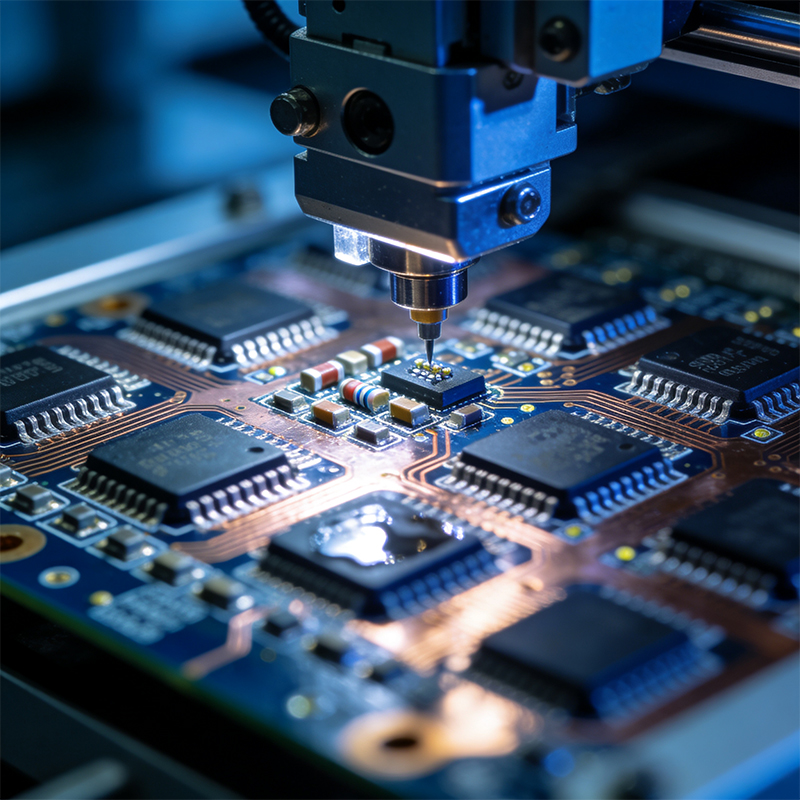
SMT assembly follows a straightforward sequence. Think of it like baking cookies:
First, you need to put "glue" where components will go. A stainless steel stencil with holes matching the PCB pads is placed over the board. Solder paste—a grayish mixture of tiny solder balls and flux—is spread across the stencil. It deposits precisely on the pads.
This step is critical. Too little paste, and joints will be weak. Too much, and you get shorts between pads.
The board moves to a pick-and-place machine. This high-speed robot uses vacuum nozzles to pick components from reels and trays, then places them onto the sticky solder paste with incredible precision—often within 25 microns (about a quarter of a human hair).
Modern machines can place tens of thousands of components per hour.
Now the board enters a reflow oven—a long tunnel with carefully controlled temperature zones. The board travels through four stages:
Preheat: Gradually warms up to about 150°C, preventing thermal shock
Soak: Holds temperature to activate flux and equalize heat across the board
Reflow: Peaks at 235-250°C, melting the solder to form permanent connections
Cooling: Controlled cooling solidifies the solder into strong joints
The whole process takes just a few minutes.
Finally, the assembled board gets checked. Automated Optical Inspection (AOI) uses cameras to verify component placement and solder quality. For hidden joints like BGA chips, X-ray inspection sees inside.
| Feature | SMT | Through-Hole |
|---|---|---|
| Component size | Tiny, lightweight | Larger, heavier |
| Mounting method | On surface | Through holes |
| Drilling required | No | Yes |
| Board density | High (both sides usable) | Lower (one side primarily) |
| High-frequency performance | Excellent | Poor (long leads act as antennas) |
| Mechanical strength | Good for most uses | Excellent for high-stress connections |
| Automation | Highly automated | More manual labor |
| Cost at scale | Lower | Higher |
| Rework difficulty | Harder (needs hot air) | Easier (soldering iron works) |
Through-hole isn't dead—it's still used for connectors, high-power components, and anything that needs extra mechanical strength. But for most electronics, SMT is the clear winner.
You'll encounter these SMD types regularly:
Chip resistors and capacitors: Tiny rectangles with metallized ends (sizes like 0402, 0603, 0805)
SOIC: Small Outline Integrated Circuit—gull-wing leads on two sides
QFP: Quad Flat Package—leads on all four sides
QFN: Quad Flat No-lead—pads underneath, no visible leads
BGA: Ball Grid Array—solder balls underneath, needs X-ray for inspection
SOT: Small Outline Transistor—three or more leads for discrete semiconductors
PLCC: Plastic Leaded Chip Carrier—J-shaped leads on all sides
SMT is everywhere in modern electronics:
Consumer electronics: Smartphones, tablets, laptops, smartwatches
Computers: Motherboards, graphics cards, memory modules
Communications: 5G base stations, routers, switches
Automotive: Engine control units, infotainment systems, sensors
Medical devices: Patient monitors, diagnostic equipment, implantables
Industrial control: PLCs, motor drives, instrumentation
Aerospace and defense: Avionics, guidance systems, communications gear
If it's electronic and made in the last 30 years, it probably uses SMT.
Even with automation, things can go wrong:
Tombstoning: A small component stands up on one end due to uneven heating
Bridging: Solder connects adjacent pins that should be separate
Cold joints: Dull, grainy connections from insufficient heat
Voids: Hidden empty spaces inside solder joints (visible on X-ray)
Misalignment: Components placed slightly off-center
Insufficient solder: Too little paste leads to weak joints
Solder balls: Tiny spheres of solder scattered on the board
Most of these can be prevented with proper process control—good stencil design, correct temperature profiles, and regular maintenance.
SMT continues to evolve:
Smaller components: 0201 (0.6mm × 0.3mm) is common; 01005 (0.4mm × 0.2mm) is emerging
Higher precision: Placement accuracy down to 15 microns
AI and machine learning: Smart systems that optimize processes and detect defects
Flexible circuits: Adapting SMT for bendable and stretchable electronics
Green manufacturing: Lead-free materials, energy-efficient equipment
As electronics keep shrinking and getting more powerful, SMT will remain at the core of how we build them.
Surface Mount Technology is the foundation of modern electronics manufacturing. It's what allows us to pack incredible computing power into tiny devices, manufacture them reliably at scale, and keep costs reasonable.
Understanding SMT—even at a basic level—helps you appreciate the engineering behind every electronic device you use. The smartphone in your pocket, the laptop on your desk, the smartwatch on your wrist—they all exist because of SMT.
Whether you're designing your own products, sourcing manufacturing, or just curious about how things work, knowing what SMT is and how it operates gives you a window into the invisible technology that shapes our world.

Kaboer manufacturing PCBs since 2009. Professional technology and high-precision Printed Circuit Boards involved in Medical, IOT, UAV, Aviation, Automotive, Aerospace, Industrial Control, Artificial Intelligence, Consumer Electronics etc..


 English



 Wechat
 +86 13670210335
 +86 13670210335
 E-mail