
Date: 2026-05-06
If you take a look around you right now, almost every object that beeps, lights up, or has a screen is powered by a silent hero: the Printed Circuit Board (PCB). While we often obsess over the sleek metal casing of a phone or the high-resolution display of a tablet, the real magic happens on that thin, intricate board hidden inside.
Understanding circuit boards applications and uses in electronics devices isn’t just for engineers anymore. As tech becomes part of our clothing, our cars, and even our bodies, knowing why certain boards are chosen for specific tasks is fascinating.
In the world of mobile tech, space is the most expensive real estate. This is where HDI (High-Density Interconnect) boards come into play. Because your phone needs to handle 5G signals, high-speed processing, and a massive battery all at once, standard boards are too bulky. HDI boards allow for more components to be packed into a smaller footprint. They use "microvias" (holes smaller than a hair) to connect layers, making the lightning-fast response of your touchscreen possible.
Have you ever wondered how a fitness tracker survives being strapped to your wrist during a workout, or how a foldable phone doesn’t snap in half?
The secret is Flex PCBs (Flexible Printed Circuits). Unlike the stiff boards in a desktop computer, flex circuits are made of materials like polyimide that can twist and fold thousands of times. Their application in electronics devices has revolutionized the medical field too—think of tiny, flexible sensors that can monitor a patient’s heart rate from inside a patch on their skin.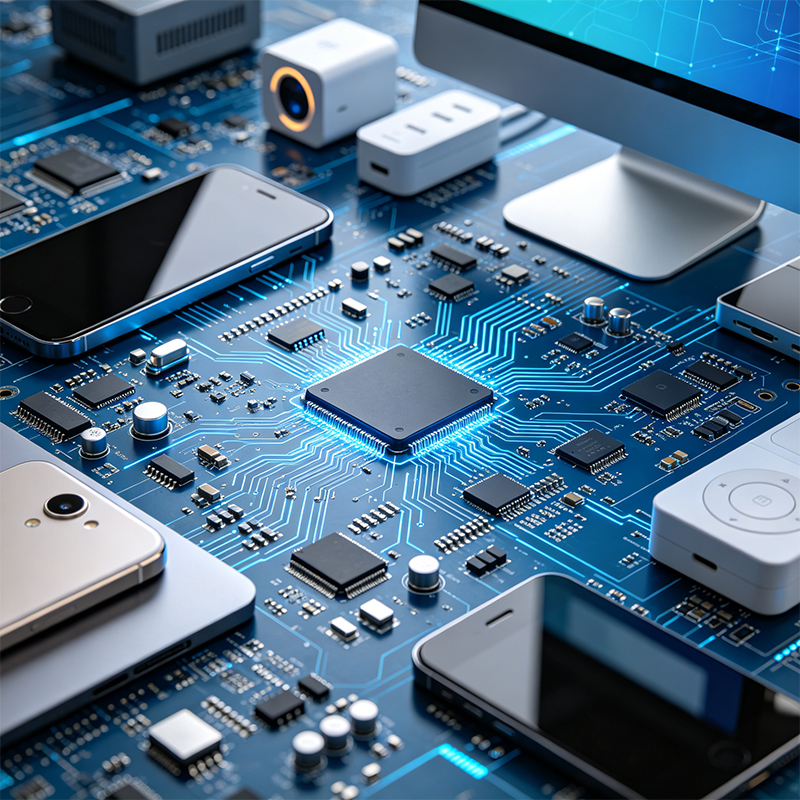
Modern cars are basically giant computers on wheels. Between self-driving sensors, infotainment screens, and engine control units, the uses of circuit boards in vehicles have exploded. For high-speed radar and LIDAR systems, manufacturers use high-frequency and high-speed PCBs. These boards ensure that data moves between the car’s "eyes" and its "brain" without even a millisecond of lag. In this environment, reliability isn't just a feature—it's a safety requirement.
In an MRI machine or a factory robot, failure isn't an option. These devices often use Rigid-Flex PCBs. This hybrid design combines the stability of a hard board with the space-saving benefits of a flexible one. It eliminates the need for bulky connectors and wires, which are often the first things to break under constant vibration or heat.
Choosing the right board for the right application is a fine art. A circuit board producer doesn't just print green plates; they balance thermal management, signal integrity, and mechanical durability.
Next time you use your smart home assistant or check your smartwatch, remember the complex "city" of circuits inside. Whether it's the high-speed pathways of an HDI board or the flexible durability of a custom flex circuit, these boards are the reason our digital lives never skip a beat.

Kaboer manufacturing PCBs since 2009. Professional technology and high-precision Printed Circuit Boards involved in Medical, IOT, UAV, Aviation, Automotive, Aerospace, Industrial Control, Artificial Intelligence, Consumer Electronics etc..


 English



 Wechat
 +86 13670210335
 +86 13670210335
 E-mail