
Date: 2026-03-13
If you’ve ever opened up a smartphone, a laptop, or even a simple remote control, you’ve seen one. That flat piece of fiberglass covered in squiggly copper lines and tiny silver components is the heart of every electronic device we use today. But if you're not an engineer who designs them every day, the ins and outs of circuit boards can still feel a bit like a mystery.
Maybe you're sourcing components for a new product, or perhaps you're just curious about how the devices you build actually work. Whatever the reason, understanding the basics of circuit boards—what they are, the different types, and how they come to life—is a huge advantage.
Think of this as a friendly, no-nonsense guide to the backbone of modern electronics.
At its simplest, a circuit board (often called a PCB, or Printed Circuit Board) is a flat board that mechanically supports and electrically connects electronic components using conductive pathways . These pathways, usually made of copper, are etched or "printed" onto a non-conductive base material .
Imagine a complex highway system. The roads are the copper traces, and the cars are the electrical signals traveling between components like microcontrollers, resistors, and sensors. The ground beneath the roads is the insulating base that keeps everything structured and prevents traffic (electricity) from going where it shouldn't.
This simple concept is what allows us to build incredibly complex systems—from a simple LED flasher to a powerful AI server—in a reliable and compact way.
A circuit board isn't just a single piece of plastic. It's a carefully engineered stack of materials. Here are the key layers you should know about:
Substrate (The Foundation): This is the base material, usually made of fiberglass (FR-4) or flexible polyimide . It gives the board its strength and rigidity (or flexibility) and acts as an insulator.
Copper (The Roads): Thin layers of copper are laminated onto the substrate. These are chemically etched away to leave behind the traces—the pathways for electricity .
Solder Mask (The Protective Layer): That familiar green (or red, blue, black) coating you see on most boards. It covers the copper traces to protect them from short circuits, dust, and corrosion .
Silkscreen (The Labels): The white letters and symbols printed on the board. This layer shows you where components go (R1 for a resistor, C5 for a capacitor) and helps with assembly and troubleshooting .
Vias (The Elevators): Tiny holes drilled through the board and plated with copper. They allow signals to travel from one layer to another in a multi-layer board .
Not all circuit boards are the same. Choosing the right type is a critical decision that depends on your product's needs. Here are the most common categories you'll encounter:
Single-Sided: The simplest and most cost-effective. They have just one layer of copper on one side of the substrate. You'll find these in basic electronics like power supplies, calculators, and toys .
Double-Sided: With copper on both sides, these boards offer much more routing space. Holes called vias connect the circuits on the top and bottom. They are common in audio equipment, industrial controls, and automotive dashboards .
Multi-Layer: These boards have three or more copper layers stacked together. They are essential for complex, high-density devices like smartphones, computers, and medical equipment . A modern smartphone, for instance, relies on an 8‑layer HDI board to pack immense processing power into a tiny space .
Rigid Boards: The standard, sturdy boards made from FR-4 fiberglass. They are the workhorses of the industry, used in everything from TVs to industrial machinery .
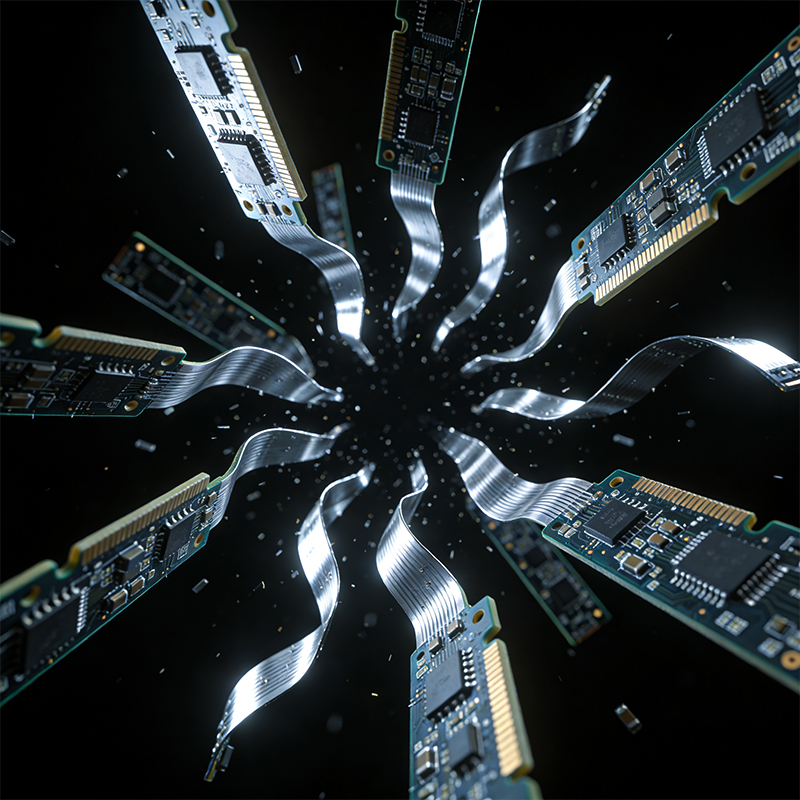
Flexible Boards (FPC): Made from thin, bendable plastic materials like polyimide. They can be twisted, folded, and fit into tight spaces where rigid boards can't go. You'll find them in wearables, foldable phones, and medical implants .
Rigid-Flex Boards: As the name suggests, these boards combine rigid and flexible sections into one unit. This design is perfect for applications that require both stability for components and flexibility for movement, such as camera modules, military gear, and aerospace systems .
HDI (High-Density Interconnect) Boards: These are advanced boards with ultra-fine lines and microvias, allowing for maximum component density. They are necessary for routing high-speed signals from modern chips like BGAs with fine pitches .
High-Frequency Boards: Using special low-loss materials like Rogers or PTFE, these boards are designed for RF applications, 5G, and radar systems where signal integrity is paramount .
Metal-Core Boards (MCPCB): With a base made of aluminum or copper, these boards excel at dissipating heat. They are the go-to choice for high-power LED lighting and power electronics .
When you're building products that need to last, quality is non-negotiable. The industry uses standards like IPC to define levels of reliability.
IPC Class 2 is for dedicated service electronics like computers and industrial gear, where minor imperfections are acceptable .
IPC Class 3 is the highest standard, for high-performance electronics where failure is not an option. Think aerospace, medical life support, and critical automotive safety systems. The manufacturing tolerances and inspections are far stricter .
Turning a design file into a physical circuit board is a fascinating, multi-step process. It involves:
Design Handoff: You send your Gerber files to the manufacturer, who reviews them for manufacturability (a DFM check) .
Material Prep & Imaging: The base copper-clad material is cut, and the circuit pattern is transferred onto it using laser direct imaging .
Etching & Lamination: Unwanted copper is chemically removed, and for multi-layer boards, the layers are stacked and bonded under high heat and pressure .
Drilling & Plating: Holes are drilled and plated with copper to connect the different layers .
Protection & Finish: A solder mask is applied to protect the copper, and a surface finish (like HASL or ENIG) is added to ensure pads are solderable .
Testing: Every board is electrically tested to ensure there are no shorts or opens .
Navigating the world of circuit boards can be complex, but it doesn't have to be a solo journey. At Kaboer, we've been helping manufacturers turn their designs into reality since 2009. Located in Shenzhen, we specialize in custom flexible PCBs, rigid-flex boards, HDI high-frequency boards, and PCBA one-stop services. With our own factory, we offer fast prototyping and rigorous quality control.
If you have a project in the works and want to talk it through with someone who understands the details, we're here to help.
Send us your requirements or design files for a free quote, and you're always welcome to visit our Shenzhen factory to see our process firsthand.

Kaboer manufacturing PCBs since 2009. Professional technology and high-precision Printed Circuit Boards involved in Medical, IOT, UAV, Aviation, Automotive, Aerospace, Industrial Control, Artificial Intelligence, Consumer Electronics etc..


 English



 Wechat
 +86 13670210335
 +86 13670210335
 E-mail