
Date: 2026-03-04
You hear the term "PCB" all the time. But what does it actually mean? If you're in the business of making electronic products, this is one definition you need to understand—not just as a word, but as the foundation of everything you build.
Let's start with the basics and build from there.
PCB stands for Printed Circuit Board.
The name tells you exactly what it is:
Printed – The circuit pattern is created using a printing-like process (photographic or laser imaging)
Circuit – It's designed to conduct electricity in a specific pattern
Board – It's a flat, rigid (or sometimes flexible) physical platform
Simple, right? But there's more to it than just the name.
A Printed Circuit Board (PCB) is a flat board made of insulating material with conductive pathways etched onto its surface. These pathways—called "traces" or "tracks"—connect different electronic components to form a working circuit .
Think of it like this: if your electronic device is a body, the PCB is the skeleton and nervous system combined. It holds everything in place (skeleton) and carries signals between all the parts (nervous system).
Without PCBs, your smartphone would be a tangled mess of wires the size of a suitcase. Every component would need to be connected by hand, one wire at a time. PCBs changed all that by making connections automated, reliable, and incredibly compact.
For those who want a bit more detail, here's how the industry defines a PCB:
A PCB is a structure consisting of:
A dielectric (insulating) base material – Usually fiberglass-reinforced epoxy (FR-4), but can be flexible plastic, metal-core, or ceramic for special applications
One or more conductive layers – Typically copper foil laminated onto the base
A protective coating – Called solder mask, which covers the copper to prevent shorts and corrosion
Legends and markings – Silkscreen printing that shows component locations and identifiers
These elements work together to:
Provide mechanical support for components
Create electrical connections between components
Dissipate heat from power-hungry parts
Provide a platform for automated assembly
According to IPC standards (the electronics industry's quality authority), a PCB consists of alternating layers of dielectric material and copper foil, laminated together under heat and pressure to form a complete electrical circuit .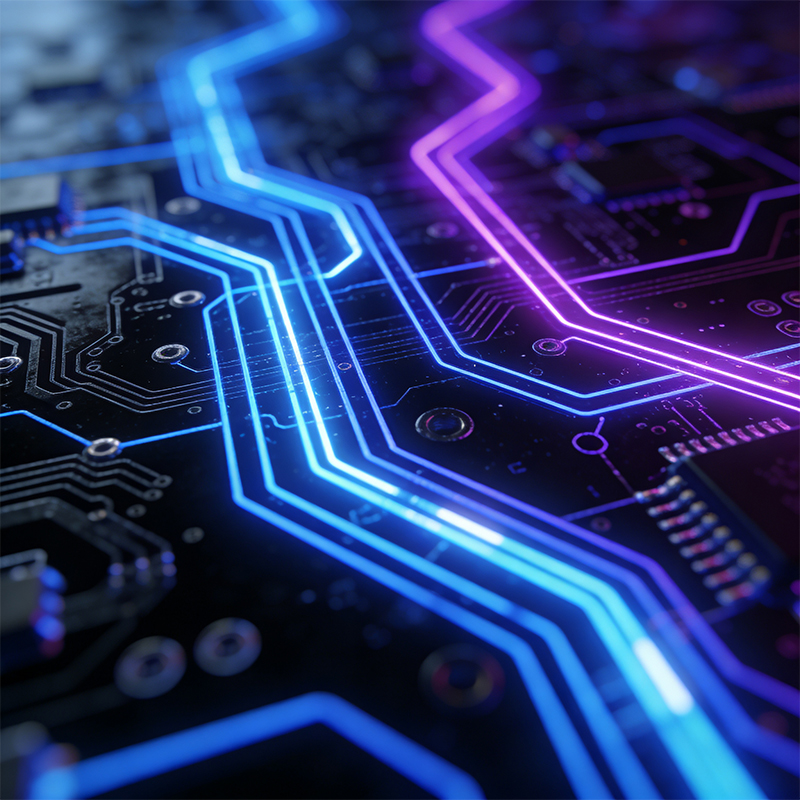
The PCB wasn't invented overnight. It evolved over decades:
1903: German inventor Albert Hanson filed a patent for "printed" wires on flat, insulated boards—the first concept of a PCB .
1920s-1940s: Radio manufacturers started using metal strips on insulating boards to eliminate messy point-to-point wiring.
1943: Paul Eisler, an Austrian engineer, developed the first PCB that closely resembles what we use today . His invention was used in radio sets for the British military during World War II.
1950s: With the transistor revolution, PCBs became essential. The US military demanded reliable, compact electronics, and PCBs delivered.
1960s-1980s: Multi-layer PCBs emerged, allowing even more complexity in smaller spaces. Through-hole components gave way to surface-mount technology.
1990s-present: PCBs got smaller, faster, and more specialized. HDI (High-Density Interconnect), flex circuits, and rigid-flex designs pushed the limits of what's possible.
Today, PCBs are everywhere—from the simplest calculator to the most advanced AI supercomputer.
Every PCB, no matter how complex, has four basic elements :
This is the board's foundation. It provides mechanical strength and electrical insulation. Most PCBs use FR-4, a flame-retardant composite of fiberglass cloth and epoxy resin . It's strong, stable, and cost-effective.
For special needs, other materials come into play:
Polyimide – Flexible, high-temperature resistance (for flex circuits)
Aluminum or copper – Metal-core boards for heat dissipation (LED lighting, power electronics)
Ceramic – Extreme temperature and high-frequency applications
PTFE (Teflon) – Low-loss material for RF and microwave circuits
Thin sheets of copper are laminated onto the substrate. The thickness is measured in ounces per square foot:
1 oz copper ≈ 35 micrometers thick – Standard for most applications
2 oz copper ≈ 70 micrometers – For higher current
0.5 oz copper ≈ 17 micrometers – For fine-pitch, high-density designs
Through a chemical process called etching, unwanted copper is removed, leaving only the traces that connect components.
That green (or red, blue, black, white) coating you see on boards? That's solder mask. It protects the copper traces from oxidation, prevents accidental solder bridges during assembly, and gives the board its characteristic color.
The white lettering and symbols on the board. This shows component outlines, reference designators (R1, C5), logos, test points, and polarity indicators. It's the map that guides assembly and troubleshooting.
The principle is simple: electricity follows the path of least resistance.
The copper traces on a PCB provide carefully designed paths for electricity to flow between components. When you apply power, electrons travel from the source, through traces, into components, and back to ground—all following the routes the designer created.
In more advanced boards, the traces aren't just simple wires. They're engineered to:
Maintain specific impedance for high-speed signals (like in 5G or PCIe)
Minimize crosstalk between adjacent traces
Control signal reflections that can corrupt data
Manage heat through thermal vias and copper planes
But at its core, a PCB is still just a board that connects things in the right pattern.
PCBs come in many flavors, each suited to different applications :
By layer count:
Single-sided – One copper layer. Simple, cheap. Used in calculators, power supplies.
Double-sided – Copper on both sides, connected by vias. Common in audio gear, industrial controls.
Multi-layer – 3 to 30+ layers. Used in smartphones, computers, advanced electronics.
By flexibility:
Rigid – Standard solid boards (FR-4). Most common.
Flexible (FPC) – Bendable plastic substrate. Used in wearables, foldable phones.
Rigid-Flex – Rigid and flexible sections combined. Used in camera modules, medical devices.
By special properties:
HDI – High-Density Interconnect with microvias and fine lines. For compact, high-performance designs.
High-Frequency – Low-loss materials for RF and microwave.
Metal-Core – Aluminum or copper base for heat dissipation.
PCB vs. PWB (Printed Wiring Board)
Technically, PWB is an older term that refers specifically to the bare board with traces. PCB is broader, implying that the board's design also affects electrical performance . Today, they're used interchangeably, though "PCB" is far more common.
PCB vs. PCBA (Printed Circuit Board Assembly)
PCB – The bare board itself (just the base, copper, solder mask, silkscreen)
PCBA – The board after components are soldered onto it
Think of it like a house: PCB is the framing and wiring; PCBA is the finished home with furniture installed.
PCB vs. Circuit Board
They mean the same thing. "Circuit board" is the everyday term; "PCB" is the technical term.
If you're manufacturing electronic devices, PCBs aren't just a detail—they're the core. Here's why :
Reliability: A well-made PCB will last for decades. Poor-quality boards fail in months. The difference is in materials, process control, and testing.
Consistency: Hand-wired circuits vary from one unit to the next. PCBs are identical, every time. That's essential for quality control.
Scalability: You can make 10 boards or 10 million with the same design. PCBs are built for automation.
Performance: For high-speed signals, controlled impedance isn't optional. Only properly designed PCBs can deliver the performance modern electronics demand.
Cost: At scale, PCBs are incredibly cost-effective. Automated assembly, standardized materials, and efficient processes keep prices down.
A PCB is the foundation of every electronic device. It's the platform that holds components, connects them electrically, and makes modern technology possible.
Whether you call it a printed circuit board, a PCB, or just a circuit board, understanding what it is and how it works helps you make better decisions for your products.
The details matter—layer counts, materials, tolerances, surface finishes—but the basic concept is simple: a board that connects things in the right way.
At Kaboer, we've been manufacturing PCBs since 2009. Based in Shenzhen, China, we combine 16 years of experience with state-of-the-art facilities to deliver boards you can count on.
What we make:
Flexible PCBs (FPC) : 1-20 layers, 0.075mm to 0.4mm thick
Rigid-Flex Boards: 2-30 layers, rigid and flexible combined
Rigid PCBs: 1-30 layers, standard FR-4 to high-performance materials
HDI High-Density Boards: Microvias, fine lines, advanced stackups
High-Frequency Boards: Low-loss materials for 5G, radar, RF
Metal-Core Boards: Aluminum or copper base for heat dissipation
What sets us apart:
In-house PCBA – We assemble your boards too. One partner, one quality standard.
Quality certifications – ISO 9001, IATF 16949, ISO 14001, UL, RoHS
IPC Class 2 & 3 – For applications that demand the highest reliability
Scale flexibility – From quick-turn prototypes to high-volume production
Factory visits – We welcome clients to see our Shenzhen facility firsthand
Ready to work with a PCB partner who delivers? Contact Kaboer today. Better yet—come visit us in Shenzhen and see for yourself.

Kaboer manufacturing PCBs since 2009. Professional technology and high-precision Printed Circuit Boards involved in Medical, IOT, UAV, Aviation, Automotive, Aerospace, Industrial Control, Artificial Intelligence, Consumer Electronics etc..


 English



 Wechat
 +86 13670210335
 +86 13670210335
 E-mail