
Date: 2026-03-12
If you've ever designed an electronic product, you know the feeling. You've selected the perfect components—the microcontroller with just the right processing power, the sensors that capture exactly what you need, the power management IC that keeps everything running smoothly. You've got your electron devices and circuits figured out.
But then comes the hard part: turning that schematic into a physical reality. Because here's the thing—those electron devices and circuits you carefully selected? They're only as good as the PCB they're mounted on.
I've worked with dozens of manufacturers who learned this lesson the hard way. A beautiful circuit design, ruined by a PCB that couldn't handle the signal speeds, or didn't dissipate heat properly, or just wasn't manufactured with enough precision. The mismatch between electron devices, circuits, and the PCB itself is one of the most common—and most expensive—mistakes in product development.
Let's talk about how to get it right.
Before we dive into the matching game, let's make sure we're speaking the same language.
Electron devices are the active components that make electronics work. Think transistors, diodes, integrated circuits, sensors, power modules—anything that actively controls or responds to electrical signals. These are the "brains" and "muscles" of your product .
Circuits are the pathways that connect these devices—the carefully designed networks of traces, components, and connections that let signals flow where they need to go. A circuit might be simple, like a voltage divider, or complex, like a multi-stage amplifier or a microcontroller system with memory and peripherals.
Together, electron devices and circuits form the functional heart of your product. But they don't exist in a vacuum. They need a physical home—a PCB that provides mechanical support, electrical connections, thermal management, and signal integrity .
Think of it this way:
Electron devices are the organs
Circuits are the nervous system
PCB is the skeleton that holds everything together
Get the skeleton wrong, and the organs don't work right. Simple as that.
Here's where things get tricky. Different electron devices have different requirements. A simple resistor might be happy on almost any PCB. But a high-speed FPGA? A power MOSFET? A sensitive analog sensor? They demand specific PCB characteristics.
If your circuit includes high-speed digital interfaces—think DDR memory, PCIe, USB 3.0, or gigabit Ethernet—the PCB traces themselves become part of the circuit. They're no longer just wires; they're transmission lines with specific impedance characteristics .
The goal is impedance matching: making sure the characteristic impedance of your PCB traces matches the impedance of your devices and circuits. Mismatches cause signal reflections, which degrade signal quality and can even damage sensitive components .
Common impedance targets:
50Ω single-ended for RF, high-speed digital, and many general-purpose signals
90-100Ω differential for USB, HDMI, Ethernet, and other differential pairs
Achieving these targets requires careful control of trace width, trace thickness, distance to reference planes, and the dielectric constant of the PCB material . That's not something a generic board can guarantee.
Power devices—voltage regulators, power amplifiers, motor drivers—generate heat. Lots of it. If your PCB can't get that heat out, your electron devices will overheat, performance will degrade, and eventually, they'll fail.
Different devices need different thermal solutions:
Standard ICs might be fine with basic copper planes and thermal vias
Power LEDs often need metal-core PCBs (aluminum or copper) to conduct heat away
High-power modules might require thick copper (2oz, 3oz, or more) to carry current and spread heat
The right PCB choice here isn't optional—it's essential for reliability.
Some products need PCBs that bend. Wearables, medical implants, foldable devices—they demand flexible circuits that can conform to tight spaces and withstand thousands of flex cycles .
Others need a combination of rigid and flexible sections. Rigid-flex boards give you the stability of rigid PCBs where components mount, with flexible interconnects where the design requires movement .
If your electron devices live in a space-constrained or moving environment, standard rigid boards won't work. You need a PCB that matches the mechanical requirements of your application.
For RF and microwave circuits—5G, radar, satellite communications—standard FR-4 isn't good enough. Its dielectric properties change with frequency and temperature, and its loss tangent is too high .
You need high-frequency materials like Rogers or PTFE (Teflon), engineered for stable dielectric constant and low loss at GHz frequencies . These materials are more expensive and harder to work with, but for high-frequency electron devices, they're the only choice.
Modern electron devices—especially advanced BGAs and CSPs—have hundreds of connections in a tiny area. Routing all those signals on a standard PCB is impossible. You need HDI (High-Density Interconnect) technology: microvias, fine lines, and advanced stackups that let you escape dense packages .
Without HDI, you simply can't use many of today's most powerful components.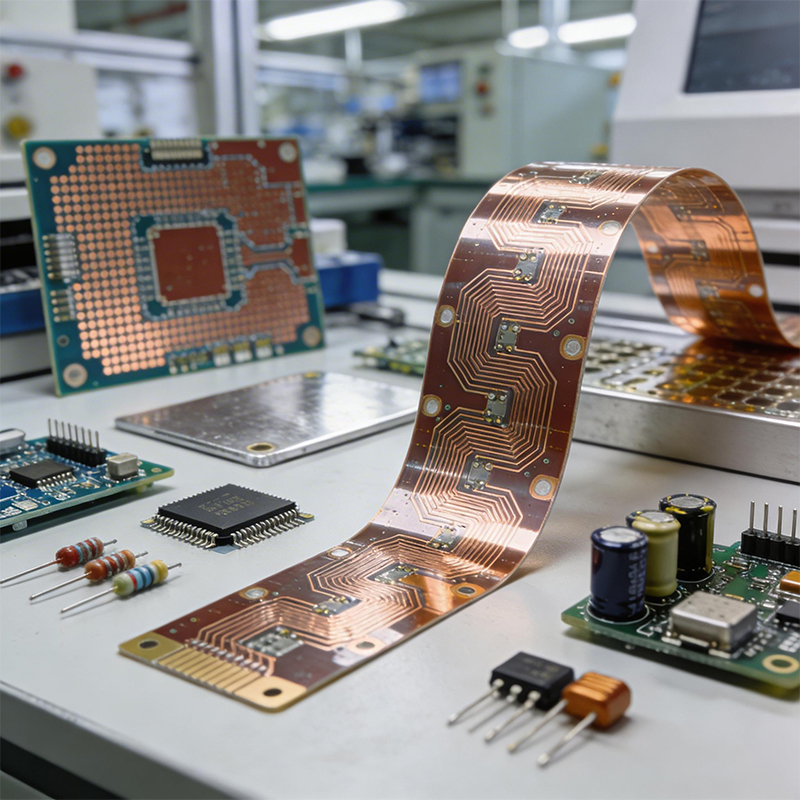
After years in this industry, I've seen the same issues crop up again and again:
What happens: Signals reflect, data gets corrupted, intermittent errors appear at high temperatures or after burn-in.
Why it happens: The PCB traces weren't designed with controlled impedance. Maybe the trace width was wrong, or the stackup wasn't symmetrical, or the dielectric material wasn't specified correctly.
How to avoid: Work with your PCB manufacturer early. Specify impedance requirements in your fabrication notes. Ask for impedance test reports on your prototypes .
What happens: Power devices run hot, efficiency drops, and eventually—sometimes months later—they fail.
Why it happens: The PCB couldn't conduct heat away fast enough. Standard FR-4 is a thermal insulator, not a conductor .
How to avoid: For high-power devices, consider metal-core PCBs, thick copper, or thermal vias under hot components. Simulate thermal performance before you build.
What happens: Traces crack after a few hundred flex cycles. Connections fail at the junction between rigid and flexible sections.
Why it happens: The flexible circuit wasn't designed for dynamic flexing. Maybe the bend radius was too tight, or the copper was too thick, or the transition wasn't properly supported.
How to avoid: Use flexible polyimide substrates with appropriate copper weight. Follow bend radius guidelines (typically 10-20× material thickness for dynamic flex). Add stiffeners where components mount .
What happens: RF power doesn't reach the antenna. High-speed signals attenuate before they arrive.
Why it happens: Standard FR-4 has high loss at GHz frequencies. The dielectric absorbs signal energy and turns it into heat .
How to avoid: Specify low-loss materials (Rogers, PTFE) for high-frequency sections. Control impedance carefully. Keep signal paths short.
What happens: You can't escape all the balls on your BGA. The design becomes unmanufacturable or requires more layers than planned.
Why it happens: The pitch is too fine for standard PCB technology. You need microvias and fine lines.
How to avoid: For BGAs below 0.8mm pitch, plan on HDI technology. Work with your manufacturer early to understand their capabilities .
At Kaboer, we've been matching PCBs to electron devices and circuits since 2009. Based in Shenzhen, we've helped thousands of manufacturers—across automotive, medical, industrial, and consumer electronics—get the right board for their specific components.
We understand the relationship. We don't just build PCBs—we understand how they interact with your electron devices and circuits. When you tell us about your application, we know what questions to ask. High-speed? We'll talk impedance and materials. High-power? We'll discuss thermal management and copper weight. Flexing? We'll cover bend radius and stiffeners.
We offer a full spectrum of technologies. Whatever your electron devices need, we can match it:
Flexible PCBs (FPC) : 1-20 layers, 0.075mm to 0.4mm thick—for wearables, medical devices, and tight spaces
Rigid-Flex Boards: 2-30 layers—rigid where you need stability, flexible where you need movement
Rigid PCBs: 1-30 layers, from standard FR-4 to high-performance materials
HDI High-Density Boards: Microvias, fine lines down to 2mil—for BGAs and high-speed designs
High-Frequency Boards: Rogers, PTFE, other low-loss materials—for 5G, radar, RF
Metal-Core Boards: Aluminum or copper base—for power electronics and LED lighting
Thick-Copper Boards: 3oz to 20oz—for high-current applications
We review every design. Before we build, our engineers check your design against the requirements of your electron devices and circuits. Impedance targets? Verified. Thermal paths? Checked. Material selection? Confirmed. This DFM review catches mismatches before they cost you time and money.
We prototype fast. Need to validate that your electron devices and circuits work with the PCB? Our fast prototyping service turns your files into boards in days, not weeks. Test, iterate, refine—without delaying your timeline.
We're certified where it matters. ISO 9001, IATF 16949 (automotive), ISO 13485 (medical), UL, RoHS. Our processes are documented, repeatable, and audited.
We're transparent. Our Shenzhen factory is open to clients. If you want to see how we match PCBs to your electron devices and circuits, you're welcome to visit. Walk the floor, meet the team, ask whatever you want.
Your electron devices and circuits deserve a PCB that lets them perform at their best. Not one that holds them back.
If you need reliable PCB/PCBA solutions that perfectly match your electron devices and circuits, send us your requirements. We'll provide a free quote and technical guidance within 2 hours, deliver fast prototypes, and welcome you to visit our factory in Shenzhen to see our matching and production process in person.
Because when the skeleton fits the organs, the whole product works better.

Kaboer manufacturing PCBs since 2009. Professional technology and high-precision Printed Circuit Boards involved in Medical, IOT, UAV, Aviation, Automotive, Aerospace, Industrial Control, Artificial Intelligence, Consumer Electronics etc..


 English



 Wechat
 +86 13670210335
 +86 13670210335
 E-mail