
Date: 2026-05-26
If you’ve ever opened up a laptop, a printer, or a smartphone, you’ve seen those flat, ribbon‑like cables that connect different parts of the device. They look similar: thin, flexible, with silver or gold contacts. But there are actually two different technologies: FFC (Flexible Flat Cable) and FPC (Flexible Printed Circuit). They serve similar purposes but are made differently, cost different amounts, and are suited for different jobs.
Let’s break down what FFC and FPC are, how they compare, and when you should choose one over the other.
What Is an FFC (Flexible Flat Cable)?
An FFC is a simple, flat cable made of several parallel copper conductors sandwiched between two layers of insulating plastic (usually PET or polyimide). The conductors are evenly spaced, and the ends are stripped and sometimes stiffened with a plastic shim to make insertion into a connector easier.
Think of an FFC as a “ribbon cable” that’s been flattened and made very thin. It’s designed for one job: to connect two boards or modules with a straight, simple electrical path.
Construction – Conductors are just straight, parallel wires. No complex routing, no crossovers, no extra components.
Customization – Length, number of pins (pitch typically 0.5mm, 1.0mm, or 1.25mm), and type of connector termination can be customized, but the cable itself is simple.
Cost – Very low, especially in high volume.
What Is an FPC (Flexible Printed Circuit)?
An FPC is a flexible printed circuit board. It’s made by etching copper traces onto a polyimide film (like a rigid PCB but bendable). The copper can be routed in any pattern – it can turn corners, split, go to different pins, and even include components (resistors, capacitors, connectors) soldered onto it.
Think of an FPC as a mini, flexible circuit board. It can do almost anything a rigid PCB can do, but it bends.
Construction – Copper traces are chemically etched into the desired pattern. Layers can be single, double, or even multi‑layer.
Customization – Almost unlimited. You can design any trace routing, add stiffeners, include gold‑plated contacts, mount components, and even create rigid‑flex hybrids.
Cost – Higher than FFC (more steps, more expensive materials), but still affordable for many applications.
FFC vs FPC – A Side‑by‑Side Comparison
| Feature | FFC (Flexible Flat Cable) | FPC (Flexible Printed Circuit) |
|---|---|---|
| Construction | Parallel straight conductors laminated in insulating film | Etched copper on polyimide film, can have complex patterns |
| Conductors | Only straight, parallel lines | Any routing (curves, branches, loops) |
| Components | None – just wires | Can have resistors, capacitors, connectors, ICs |
| Layers | Single layer only | Single, double, or multi‑layer |
| Stiffeners | Sometimes (plastic shims at ends) | Often (FR4 or polyimide stiffeners under connectors) |
| Typical length | Up to several meters | Usually shorter (a few cm to 30 cm) |
| Flexibility | Very good (uniform bending) | Good, but trace routing can affect bend radius |
| Cost | Very low | Medium to high (depending on complexity) |
| Lead time | Short (days) | Longer (weeks for prototypes) |
| Best for | Simple board‑to‑board or board‑to‑display connections | Complex interconnects, components on flex, dynamic bending |
Where Do You Use an FFC?
FFCs are everywhere in simple, high‑volume consumer electronics:
Printers – Connecting the print head to the main board (the cable that moves back and forth).
Laptops – Connecting the keyboard, touchpad, or small LCD to the motherboard.
Flat‑panel TVs – Connecting the driver board to the LCD panel.
DVD/Blu‑ray drives – Inside the drive mechanism.
Digital cameras – Connecting the lens module to the main board.
Any time you need a cheap, reliable, flexible connection that doesn’t require complex routing, an FFC is a great choice.
Where Do You Use an FPC?
FPCs shine when the connection needs more than just straight wires:
Smartphones – The main flexible circuit that connects the display, buttons, and camera modules often includes components like resistors and capacitors directly on the flex.
Wearables – A fitness tracker might have an FPC with a heart‑rate sensor, LEDs, and a connector – all on the same flexible circuit.
Medical devices – Endoscope cameras use FPCs with tiny image sensors soldered directly to the circuit.
Automotive – Steering wheel controls use FPCs with buttons and LEDs mounted on a flexible tail that bends around the airbag.
Foldable phones – The hinge area uses complex multi‑layer FPCs that must survive thousands of folds.
The Big Difference: Components on Board
The most important difference is that an FPC can have electronic components (resistors, capacitors, connectors, even chips) soldered directly onto it. An FFC cannot – it’s just wires.
For example, a smartphone display flex might have a small driver chip and a few capacitors right on the FPC. That saves space and eliminates a separate rigid board. An FFC would just be wires – you’d need another board for the components.
Pitch and Pin Count
FFC – Common pitches: 0.5mm, 1.0mm, 1.25mm, 2.54mm. Pin count from 4 to 100+.
FPC – Can have the same pitches but also much finer (0.3mm, 0.2mm) because traces are etched, not mechanically laminated. FPCs can have very high pin density.
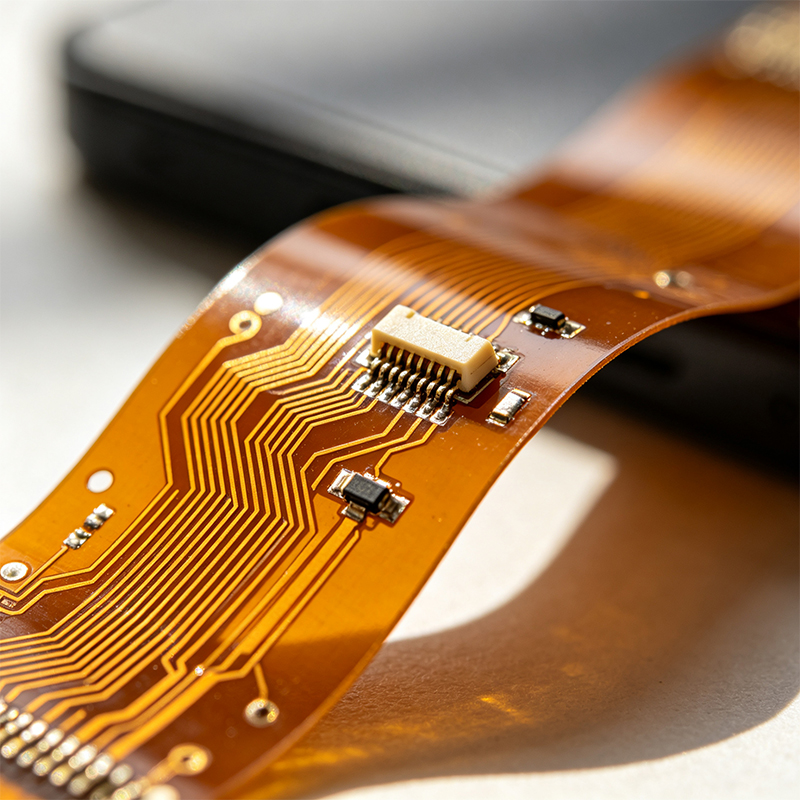
Connectors for FFC and FPC
Both FFC and FPC typically use the same type of connectors: ZIF (Zero Insertion Force) connectors. You open a small latch, slide the cable in, and close the latch. However, FFC ends are usually flat with exposed conductors on one side; FPC ends can have stiffeners and exposed pads on both sides.
Some connectors are designed specifically for FPC (with double‑sided contacts), but many work for both. Always check the connector datasheet.
Flexibility and Durability
FFC – Uniform thickness and uniform material. They bend consistently. For dynamic applications (moving back and forth, like a printer head), FFCs are reliable and cheap.
FPC – The bend zone can be engineered – you can route traces to reduce stress, and you can choose rolled‑annealed copper for better flex life. FPCs can survive tens of thousands of bends if designed correctly.
Cost Comparison – Why Does FPC Cost More?
Materials – Polyimide film and special copper foil cost more than PET and standard conductors.
Processing – FPCs require photolithography, etching, lamination, and often stiffener attachment – many steps. FFCs are made by laminating conductors between two films – fast and cheap.
Tooling – FFC tooling is simple; FPC tooling (photomasks, custom fixtures) is more expensive.
Volume – FFCs are typically made in huge rolls; FPCs are batch‑processed.
For simple, straight connections, an FFC might cost a few cents. A custom FPC of similar size could cost a few dollars.
When Should You Choose FFC?
Your connection is straight (no complex routing).
You don’t need components on the cable.
You need very low cost.
Length is more than 10‑15 cm.
Dynamic flex (moving cable) is required – FFCs are excellent for this.
When Should You Choose FPC?
You need complex trace routing (signals crossing, splitting, or going to different connectors).
You need components (resistors, capacitors, ICs) directly on the flexible circuit.
You need high pin density (fine pitch, many signals).
The bend area needs to be carefully engineered (dynamic flex with controlled bend radius).
You want a rigid‑flex hybrid (rigid board + flex tail).
Can You Use FFC in Place of FPC?
Sometimes yes, if all you need is a straight connection and you have a matching connector. But if your design requires any routing complexity or components, FFC won’t work. Conversely, you can often use an FPC as a “better” FFC – but it will cost more than necessary.
Real‑World Example: A Printer vs. A Smartwatch
Printer – The moving print head connects to the main board via an FFC. The cable is long (30‑50 cm), bends back and forth thousands of times, and carries simple signals. An FFC is perfect – cheap and durable.
Smartwatch – Inside a smartwatch, the tiny display, touch sensor, and buttons all need to connect to the main chip. The space is tiny, and the flex must fold precisely. Also, the flex may have a few passive components. An FPC is the only practical choice.
What About “FFC/FPC” Hybrids?
Some manufacturers label their products “FFC/FPC” because the same connector can accept both. But the cables themselves are different. When you order, be clear: do you need a simple laminated flat cable (FFC) or an etched flexible circuit (FPC)?
Future Trends
As devices get smaller, FPCs become more common because they can integrate components and complex routing in tight spaces. FFCs will remain popular for low‑cost, long, dynamic connections – especially in printers, appliances, and automotive harness replacements.
Final Answer – What Are FFC and FPC?
FFC (Flexible Flat Cable) – A simple, low‑cost cable with straight parallel conductors. Used for board‑to‑board or board‑to‑display connections where no complex routing or components are needed.
FPC (Flexible Printed Circuit) – A flexible circuit board with etched copper traces. Can include complex routing, components, and multiple layers. Used in smartphones, wearables, medical devices, and any application that needs more than just straight wires.
Choose FFC for cheap, long, straight connections. Choose FPC when you need routing complexity, components on flex, or high pin density. Both have their place – and now you know the difference.

Kaboer manufacturing PCBs since 2009. Professional technology and high-precision Printed Circuit Boards involved in Medical, IOT, UAV, Aviation, Automotive, Aerospace, Industrial Control, Artificial Intelligence, Consumer Electronics etc..


 English



 Wechat
 +86 13670210335
 +86 13670210335
 E-mail