
Date: 2026-05-09
If you’ve ever touched a circuit board, chances are you’ve held an FR4 PCB board. It’s the standard material for most rigid boards out there – green, flame-retardant, and reliable. But is it always the right choice for your product? And if not, what are your options?
Let’s break down FR4 in plain English, talk about what it’s good at, where it falls short, and when you might want to switch to something more specialized – like flexible circuits, rigid-flex, or HDI high-frequency boards.
FR4 stands for “Flame Retardant 4”. It’s a glass-reinforced epoxy laminate. In human terms: it’s a stiff, tough, and fire-resistant material that holds copper traces on its surface and between its layers.
Most standard PCBs you see – in power supplies, home appliances, industrial controllers – are FR4. It’s cheap, easy to manufacture, and works fine for a huge range of applications.
Let’s not pretend it’s bad. FR4 is popular for a reason:
Low cost – It’s the cheapest rigid PCB material you can get.
Good mechanical strength – It doesn’t bend easily, so components stay put.
Decent electrical insulation – Works well for most signals up to a few GHz.
Moisture resistant – Won’t soak up humidity like some other materials.
UL94-V0 rated – Self-extinguishing, which matters for safety.
For many products – a wall power supply, a dishwasher control board, an LED driver – FR4 is perfectly fine.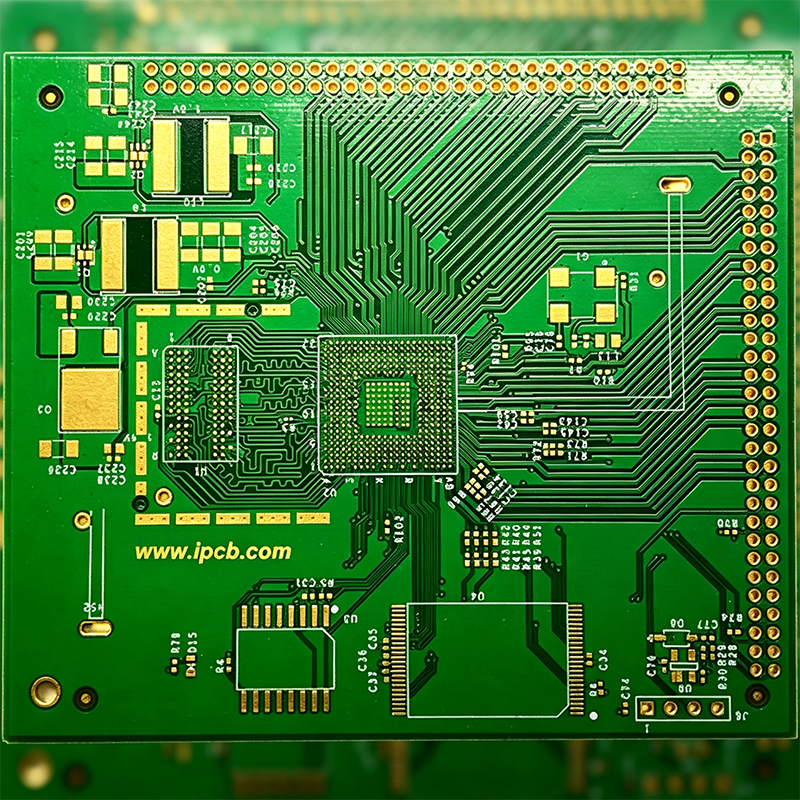
But not every product lives in a nice, static, room-temperature box. Here’s where FR4 becomes a problem:
1. You need bending or flexing – FR4 is rigid. If your device folds, rolls, or moves (think wearables, foldable phones, robotic arms), FR4 will crack. Not “maybe” – it will crack.
2. You’re working with very high frequencies – Above 5-10 GHz, FR4’s dielectric loss gets ugly. Signal integrity drops. Your 5G, radar, or millimeter-wave product won’t perform. That’s where high-frequency materials come in.
3. You need ultra-thin or dense designs – FR4 can only get so thin before it becomes brittle. For HDI boards with microvias and fine lines, FR4 can work, but often a more advanced laminate gives better reliability.
4. Weight is a killer – FR4 is heavy. If you’re building drones, satellites, or portable medical devices, every gram counts. Flexible PCBs or rigid-flex can cut weight dramatically.
We absolutely manufacture FR4 PCBs. But we also specialize in three areas that go beyond what standard FR4 can do.
Instead of a rigid board, imagine a circuit printed on a thin, bendable polyimide film. It folds, twists, and fits into tight spaces. Great for wearables, cameras with moving zoom, or any device where “flat and stiff” doesn’t work.
Part rigid, part flexible. The rigid sections hold heavy components; the flexible tails connect them like cables. One board replaces three connectors and a bundle of wires. You get reliability and space savings.
When FR4’s signal loss is too high, we move to low-loss materials (Rogers, Isola, Taconic) combined with HDI technology – microvias, fine lines, and controlled impedance. Perfect for 5G infrastructure, automotive radar, and aerospace.
We don’t just give you bare boards. We source components, assemble everything, run AOI and functional tests, and ship you ready-to-install boards. For FR4, flex, rigid-flex, or HDI – same high standard.
A few months ago, a customer came to us with a wearable medical patch. Their first prototype used a small FR4 board. It worked on the bench. But when a person wore it – bending, stretching, sleeping on it – the FR4 board cracked within two days.
We redesigned it as a flexible PCB. Same components, but on a thin polyimide substrate. The patch now bends with the skin. No cracks. They moved to production. That’s the difference.
Here’s a simple rule:
Static product, low frequency, low volume, tight budget – FR4 is fine.
Moving parts, high frequency, light weight, harsh environment – look at flex, rigid-flex, or HDI.
And remember: you don’t have to choose one for the whole device. Many products use a rigid-flex design – FR4-like rigid areas for processors, and flex areas for connectors or sensors.
We’re not a “one material fits all” shop. We build FR4, flexible, rigid-flex, and HDI high-frequency boards. We assemble them. We test them. And we help you pick the right technology – even if that means telling you FR4 is good enough.
That honesty is why customers stick with us.
Send us your requirements – a sketch, a BOM, or just an idea. We’ll tell you whether FR4 is the right call, or if a flexible or high-frequency board would work better. Either way, you get a quote and a clear path forward.

Kaboer manufacturing PCBs since 2009. Professional technology and high-precision Printed Circuit Boards involved in Medical, IOT, UAV, Aviation, Automotive, Aerospace, Industrial Control, Artificial Intelligence, Consumer Electronics etc..


 English



 Wechat
 +86 13670210335
 +86 13670210335
 E-mail