
Date: 2026-05-23
You’ve probably heard the terms “high frequency” and “low frequency” thrown around in electronics. But what do they actually mean? Is 60 Hz from your wall outlet “high” or “low”? What about the 2.4 GHz signal that carries your Wi‑Fi? And why does it even matter?
Let’s break down the difference between high frequency and low frequency in plain English – no complicated math, just practical understanding.
What Does “Frequency” Mean in Electronics?
Frequency is how many times an electrical signal repeats the same pattern in one second. The unit is hertz (Hz). One hertz means one cycle per second.
A 60 Hz signal (your wall power) repeats 60 times per second.
A 1 kHz (kilohertz) signal repeats 1,000 times per second.
A 1 MHz (megahertz) signal repeats 1,000,000 times per second.
A 1 GHz (gigahertz) signal repeats 1,000,000,000 times per second.
Low Frequency typically refers to signals below about 100 kHz. Think audio, power lines, and slow sensor readings.
High Frequency generally starts from about 1 MHz and goes up. That includes FM radio (around 100 MHz), Wi‑Fi (2.4 GHz), 5G (3–30 GHz), and radar.
A Simple Analogy: Speed Limits and Traffic
Imagine a road with cars. Low frequency is like a slow, steady stream – cars spaced far apart, easy to manage. High frequency is like a super‑fast highway – cars zip by so quickly that you need special lanes, smoother surfaces, and extra safety measures.
In electronics, low‑frequency signals are forgiving. You can use almost any wire, any circuit board material, and sloppy routing. High‑frequency signals are finicky. They need careful design, special materials, and precise dimensions.
How Do Low‑Frequency Signals Behave?
Low‑frequency signals are “well‑behaved” in most circuits. Here’s what you need to know:
They don’t radiate much – A 60 Hz power line emits very little electromagnetic energy. You can run it near other wires without much interference.
They treat wires as simple connections – At low frequencies, a piece of wire is just a wire. You don’t need to worry about its exact length or shape.
They ignore small capacitances – The natural capacitance between two nearby traces doesn’t affect a 1 kHz audio signal much.
They don’t bounce back – Low‑frequency signals don’t “reflect” from the end of a cable. You don’t need termination resistors.
This is why you can breadboard a low‑frequency circuit with jumper wires and it usually works.
How Do High‑Frequency Signals Behave?
Above a few megahertz, things get weird. Here’s what changes:
They radiate – A high‑frequency signal turns any wire into an antenna. It can broadcast noise to nearby circuits and also pick up external interference.
Wires become transmission lines – At high frequencies, the length of a wire matters. If it’s longer than about 1/10th of the signal’s wavelength, it acts like a transmission line, not a simple wire.
Capacitance and inductance matter – Every trace has tiny parasitic capacitance and inductance. At low frequencies, you ignore them. At high frequencies, they cause signal distortion, delay, and loss.
Reflections happen – When a high‑frequency signal hits the end of a trace or cable that doesn’t match its impedance, part of the signal bounces back, interfering with the original signal.
Skin effect – At very high frequencies, current flows only on the surface of the copper, not through the whole cross‑section. This increases resistance.
Real‑World Examples
Low Frequency (you probably use it every day)
AC power (50/60 Hz)
Audio signals (20 Hz – 20 kHz)
Serial communications like UART (often 9600 baud – 115 kHz)
I²C and SPI (typically under 10 MHz)
Relays, switches, buttons
High Frequency (modern wireless and fast digital)
FM radio (88–108 MHz)
Wi‑Fi (2.4 GHz, 5 GHz, 6 GHz)
Bluetooth (2.4 GHz)
5G cellular (3–30 GHz)
GPS (1.5 GHz)
Radar (24 GHz, 77 GHz)
Fast digital buses like USB 3.0 (5 Gbit/s), HDMI ( >1 GHz)
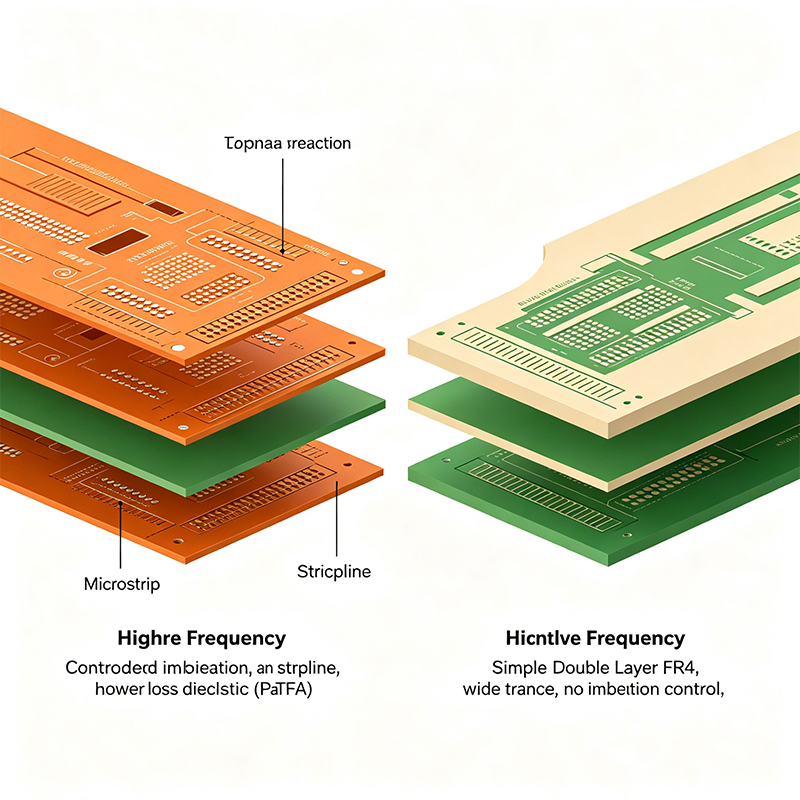
How Circuit Boards Differ for High vs Low Frequency
For low‑frequency PCBs, you can use:
Standard FR4 material
Any trace width and spacing (within manufacturer limits)
Simple 2‑layer boards
Through‑hole or SMD components – whatever fits
Don’t need impedance control
For high‑frequency PCBs, you need:
Low‑loss materials (Rogers, Isola, PTFE) to avoid signal loss
Controlled impedance traces (e.g., 50‑ohm or 100‑ohm differential pairs)
Careful trace length matching (on fast parallel buses)
Minimal stubs and vias
Ground planes to provide a return path
Short, direct routing – no sharp corners
What Is Wavelength and Why Does It Matter?
Wavelength (λ) is the physical distance a signal travels during one cycle. You can calculate it as: λ = speed of light / frequency (approx 300,000,000 m/s).
For 60 Hz: λ ≈ 5,000 km. Your wire is never that long, so you never see wave effects.
For 1 MHz: λ ≈ 300 m. Still long compared to most boards.
For 1 GHz: λ ≈ 30 cm. Now, a 3‑inch trace is a significant fraction of the wavelength. Wave effects start to matter.
For 30 GHz: λ ≈ 1 cm. Even the thickness of the board matters.
Rule of thumb: when your trace length exceeds about 1/10th of the wavelength, you need to treat it as a transmission line (high‑frequency design rules).
How Do Components Behave Differently?
Resistors – At high frequencies, every resistor has small parasitic capacitance and inductance. A “wirewound” resistor behaves like an inductor at RF. You need thin‑film or carbon composition resistors.
Capacitors – At high frequencies, capacitors have self‑resonant frequency. Above that frequency, they stop acting like capacitors and become inductive. You need RF‑specific capacitors (like C0G/NP0).
Inductors – At high frequencies, they have parasitic capacitance, which creates a self‑resonant frequency as well.
Transistors and ICs – They have internal capacitance that limits how fast they can switch. High‑frequency chips are designed with very small geometry and special packaging.
Why You Can’t Use a Multimeter on a High‑Frequency Signal
A standard multimeter measures average voltage (DC) or RMS voltage for low frequencies (like 50/60 Hz). It can’t measure a 2.4 GHz signal – the meter’s internal capacitance and inductance will completely distort the reading. You need an oscilloscope with high bandwidth ( ≥ 1 GHz) or a spectrum analyzer.
Interference: Low Frequency vs High Frequency
Low‑frequency interference – Usually conducted through power lines or ground loops. Filters use big inductors and capacitors (line filters).
High‑frequency interference – Radiated like radio waves. It can jump through the air. Shielding (metal enclosures, copper tape) and ferrite beads are common countermeasures.
When Do You Need to Care About High‑Frequency Design?
You don’t need to worry about high‑frequency effects for:
Simple LED flashers
Arduino projects with low‑speed sensors (temperature, humidity)
Audio amplifiers (unless you’re doing radio)
Power supplies (the switching frequency is usually under 1 MHz; but the sharp edges can cause some RF noise)
You do need to care for:
Wireless modules (Wi‑Fi, Bluetooth, LoRa, ZigBee)
High‑speed digital (Ethernet, USB 3.0, HDMI, DDR memory)
Radio circuits (FM transmitters, receivers, GPS)
Anything above about 10 MHz – and even then, it depends on trace length.
A Real‑World Example: Why Your Breadboard Fails at High Frequency
You can build a 1 kHz oscillator on a breadboard with jumper wires – it works fine. Try the same circuit for a 100 MHz FM transmitter – it will almost certainly fail. The long, loose wires act as antennas and create unwanted capacitance. The signal will leak away or oscillate at the wrong frequency. High‑frequency circuits must be built on properly designed PCBs with short, controlled traces.
Final Answer – High Frequency vs Low Frequency
Low‑frequency signals (typically below about 100 kHz) are easy to work with. Wires are just wires, routing isn’t critical, and you can use cheap materials. High‑frequency signals (above a few MHz) behave differently – they radiate, reflect, and interact with parasitic capacitance and inductance. You need special PCB materials, controlled impedance, careful layout, and components designed for RF.
If your product has wireless, high‑speed data, or fast clocks, you’re in the high‑frequency world. If it’s just power, audio, or slow sensors, low‑frequency rules apply. Understand the difference, and you’ll save yourself a lot of troubleshooting.

Kaboer manufacturing PCBs since 2009. Professional technology and high-precision Printed Circuit Boards involved in Medical, IOT, UAV, Aviation, Automotive, Aerospace, Industrial Control, Artificial Intelligence, Consumer Electronics etc..


 English



 Wechat
 +86 13670210335
 +86 13670210335
 E-mail