
Date: 2026-06-04
You’ve probably heard that old circuit boards contain gold. It sounds like a modern‑day treasure hunt – and in a way, it is. But the gold isn’t lying around as shiny nuggets. It’s chemically bonded in tiny amounts. And getting it out involves some fascinating chemistry.
Let’s explore where the gold hides, how professional recyclers recover it, and what happens if someone tries to do it at home.
Where Is the Gold in a Circuit Board?
Circuit boards use gold for one simple reason: gold doesn’t corrode or oxidize. When you need a reliable electrical connection that lasts for years, gold is the best choice.
You’ll find gold in three main places:
Connector pins (gold fingers) – Those shiny gold edges on RAM sticks, graphics cards, and some cables.
Component leads – The legs of some chips and connectors are gold‑plated.
Surface pads – On high‑reliability boards (like aerospace or medical), the pads where components sit may be gold‑plated.
The amount is very small. A typical smartphone contains about 0.034 grams of gold – less than the weight of a grain of rice. A ton of old phones (roughly 6,000 devices) contains around 300 grams of gold.
Why Is Gold There Instead of Copper?
Copper is cheap and conducts electricity well, but it tarnishes. When copper oxidizes, it forms a non‑conductive layer that can make connections fail. Gold doesn’t tarnish, so it’s perfect for connectors that get plugged and unplugged, and for high‑reliability circuits.
How Do Professional Recyclers Extract Gold?
Large‑scale recycling is an industrial process. Here’s how it works in simple steps:
1. Collection and shredding – Old electronics are collected, and the circuit boards are removed and shredded into small chips.
2. Separation – The shredded material passes through magnets (to remove steel), eddy currents (to remove aluminum), and density separators (to remove plastics). What’s left is a mixture of metals, including copper, tin, lead, and gold.
3. Smelting or chemical leaching – The metal concentrate is either melted in a furnace at very high temperatures (smelting) or treated with chemical solutions that dissolve the gold (leaching). Cyanide is one of the most common leaching chemicals in industry – it’s very effective and, when managed properly, safe.
4. Refining – The gold‑rich solution or crude gold from smelting is further purified using electrolysis or other chemical methods to reach 99.9% purity.
This process works best when you have tons of boards, not just a few.
What About DIY Methods?
Some people try to extract gold at home using strong acids like aqua regia (a mix of nitric and hydrochloric acids). Here’s the chemical principle:
Aqua regia is one of the few substances that can dissolve gold.
When you soak gold‑plated parts in aqua regia, the gold goes into solution as gold chloride.
You can then add a reducing agent (like sodium metabisulfite) to turn the dissolved gold back into metallic gold powder.
Finally, you melt the powder into a small gold nugget.
In theory, it works. In practice, it’s risky because the acids produce toxic fumes, and the waste liquid contains heavy metals that are harmful to the environment. That’s why serious hobbyists use fume hoods and follow strict waste disposal rules – or simply sell their boards to recyclers instead.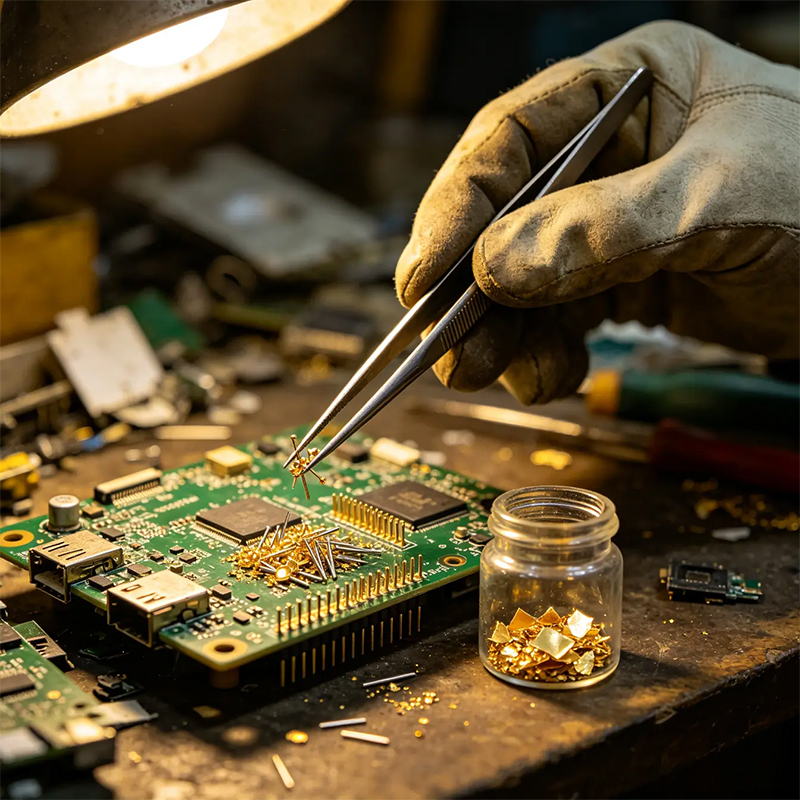
Why Isn’t Gold Extraction More Common?
Three reasons:
Low concentration – You need a huge number of boards to get a meaningful amount of gold.
Chemical costs and safety – The chemicals needed are expensive, dangerous, and require special handling.
Environmental regulations – Proper disposal of toxic waste is costly. Cutting corners is illegal and harmful.
That’s why recycling gold from circuit boards is only profitable at industrial scale.
The Fun Science: How Aqua Regia Dissolves Gold
Here’s a bit of chemistry that might surprise you. Neither nitric acid nor hydrochloric acid alone can dissolve gold. But when you mix them, they form a powerful combination. Nitric acid oxidizes the gold (turns it into gold ions), and hydrochloric acid provides chloride ions that help keep the gold in solution. The result is a yellow liquid containing gold chloride – a compound that looks like liquid gold.
A Quick Myth Buster
Some internet videos claim you can use salt water and electricity to “extract” gold. Those videos usually show gold already dissolved, or they’re plating gold onto a surface – not extracting it from circuit boards. Real extraction requires strong chemistry.
Final Answer – How Do You Get Gold from Circuit Boards?
Professionally, circuit board gold is recovered through industrial shredding, separation, smelting or chemical leaching, and refining. The process is economical only at large scale. Chemically, gold can be dissolved using aqua regia or cyanide solutions, and then precipitated back as metal.
If you’re curious about the science, learning about aqua regia and metal precipitation is a great start. If you have old circuit boards and want to make some money, selling them to a recycler is much smarter than trying to extract the gold yourself.

Kaboer manufacturing PCBs since 2009. Professional technology and high-precision Printed Circuit Boards involved in Medical, IOT, UAV, Aviation, Automotive, Aerospace, Industrial Control, Artificial Intelligence, Consumer Electronics etc..


 English



 Wechat
 +86 13670210335
 +86 13670210335
 E-mail