
Date: 2026-03-02
Ever wondered how your smartwatch bends with your wrist, or how a laptop's display connects to its motherboard through a hinge that opens and closes thousands of times? The answer is flexible circuits—and behind every reliable flex circuit is a manufacturer who knows what they're doing.
Choosing the right flex circuit manufacturer isn't like ordering standard rigid PCBs. Flex circuits bend, fold, and flex. They live in tight spaces, move with mechanical assemblies, and often carry critical signals where failure is not an option. Get the manufacturer wrong, and you'll deal with cracked traces, delamination, or circuits that fail after a few flex cycles.
This guide walks you through what you need to know to choose a flex circuit manufacturer you can trust—someone who understands the materials, the processes, and the importance of getting it right the first time.
Before we talk about choosing a manufacturer, let's understand what makes flex circuits special.
A flexible printed circuit is exactly what it sounds like—a circuit board that can bend. Instead of rigid FR-4 fiberglass, flex circuits use thin, flexible polyimide or polyester films as their base material . Copper traces are laminated onto this film, then covered with a protective coverlay instead of traditional solder mask.
The benefits are huge:
Space savings: Flex circuits can be folded into three-dimensional shapes, replacing bulky wire harnesses and connectors
Weight reduction: Polyimide is much lighter than rigid PCB materials—savings can reach 60% in the right applications
Reliability: Fewer connectors means fewer failure points
Thermal management: Thin polyimide dissipates heat better than thicker materials
Dynamic flexing: Some applications require millions of flex cycles—disk drives and laptop hinges are classic examples
But these benefits come with complexity. Flex circuits require specialized materials, precise process control, and design expertise that not every PCB manufacturer has .
Not all PCB manufacturers understand flex materials. Polyimide behaves differently than FR-4. It expands and contracts at different rates. It requires different etching parameters, different lamination pressures, and different handling throughout the process.
Look for a manufacturer who has been working with flex materials for years—not someone who offers them as an afterthought. Ask about their experience with different material types: adhesiveless vs. adhesive-based laminates, various polyimide thicknesses, and coverlay materials .、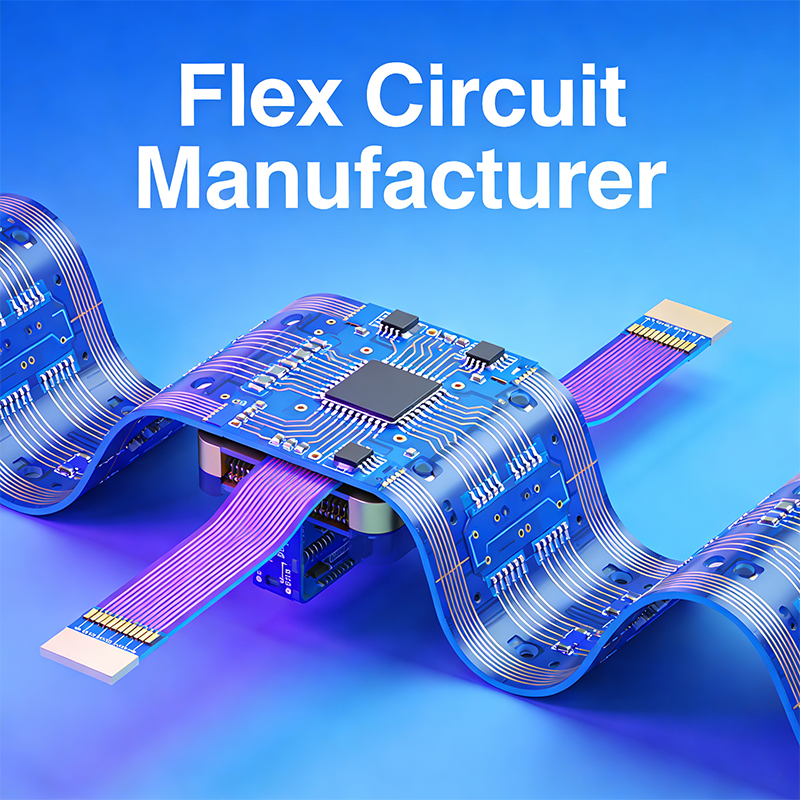
Flex circuits can be simple single-layer designs or complex multi-layer constructions. Depending on your needs, you might need:
Single-layer flex: Basic connections, simple bends
Double-layer flex: More routing density, crossovers possible
Multi-layer flex: 4, 6, 8 layers or more for complex designs
Rigid-flex: Rigid sections with flexible interconnects between them
Make sure your manufacturer can handle the layer count you need. A good flex manufacturer should offer up to at least 8-10 layers, with rigid-flex capabilities going even higher.
The right material choice makes or breaks a flex circuit. Your manufacturer should be able to guide you on:
Base material: Polyimide is standard, but thickness matters
Copper weight: Thicker copper handles more current but reduces flexibility
Coverlay vs. liquid photoimageable coverlay: Film-based for dynamic flexing, LPI for fine pitch openings
Stiffeners: FR-4, polyimide, or metal where components need extra support
Adhesives: Acrylic, epoxy, or adhesiveless constructions
If your manufacturer stocks commonly used materials, that's a good sign—it keeps costs down and lead times short .
Flex circuits are unforgiving of process variation. Small inconsistencies in etching, lamination, or plating can lead to failures that don't show up until the product is in the field.
Look for manufacturers with recognized quality certifications:
ISO 9001: Basic quality management
IATF 16949: Automotive-grade quality
ISO 13485: Medical device quality
UL recognition: Safety certification
IPC 6013: The specific standard for flex and rigid-flex boards
Ask about their inspection processes. Automated optical inspection (AOI) for inner layers, electrical testing, and microsection analysis are signs of a serious manufacturer.
The best time to catch flex circuit problems is before they're manufactured. A good manufacturer offers Design for Manufacturability (DFM) feedback early in the process .
They should review your stackup, check bend radius requirements, verify that trace routing works with their process capabilities, and suggest improvements. This collaboration can mean the difference between a circuit that works and one that fails after a few flex cycles .
Many flex circuits need components assembled. If your manufacturer offers PCBA (Printed Circuit Board Assembly) services in-house, that's a huge advantage .
One-stop service means:
No shipping bare boards to another facility
Single point of accountability for quality
Faster turnaround
Lower overall cost
Look for a manufacturer with both SMT and through-hole assembly capabilities, experience with fine-pitch components, and functional testing .
Your needs will change over time. Maybe you're prototyping now but planning production next year. A good manufacturer should be comfortable with:
Quick-turn prototypes: Small quantities, fast delivery
Low-to-medium volume production: Hundreds to thousands of units
High-volume production: Tens of thousands and up
Some manufacturers specialize only in high volume; others only in prototypes. Find one that can grow with you.
Flex circuits are sensitive to contamination. Dust particles that wouldn't matter on a rigid board can cause shorts or opens on fine-pitch flex designs. Ask about their production environment—cleanroom standards, handling procedures, and worker training.
When something goes wrong—and sometimes it does—you need a manufacturer who communicates clearly and works with you to solve problems. Look for:
English-speaking technical support
Quick response times
Willingness to explain technical details
Transparency about capabilities and limitations
There's no substitute for seeing a factory with your own eyes. A manufacturer who welcomes visitors and shows you their production lines is a manufacturer with nothing to hide. You'll see their equipment, their cleanliness, their process control, and their people. You'll leave with confidence—or you'll know to look elsewhere.
They offer flex circuits but specialize in rigid boards. Flex requires different expertise. If it's just a checkbox on their website, they may not have the experience you need.
They don't ask about your application. A good manufacturer wants to know how your circuit will be used—static bend, dynamic flex, temperature range, environment. If they don't ask, they can't help you avoid problems.
They promise everything with no questions. If it sounds too good to be true, it probably is. Flex circuits have real limitations. A knowledgeable manufacturer will tell you when something won't work.
No quality certifications. In medical, automotive, aerospace, or any critical application, certifications aren't optional. If they don't have them, move on.
They're hard to reach. Communication matters. If they don't respond promptly before you're a customer, they won't magically improve after you've paid them.
Flex circuits are everywhere in modern electronics. A capable manufacturer should have experience across multiple industries :
Smartphones: Display connections, battery interconnects, antenna circuits
Wearables and IoT: Fitness trackers, smartwatches, health monitors—where flexibility and small size matter most
Automotive: Battery management systems for EVs, infotainment displays, interior lighting, ADAS sensors
Medical devices: Patient monitors, diagnostic equipment, implantable devices where biocompatibility matters
Industrial: Robotics, control systems, sensors
Aerospace and defense: Avionics, guidance systems, communications gear
Printers and peripherals: Those ribbon cables you've seen for years
Each application has different requirements. Automotive needs vibration resistance and wide temperature range. Medical needs biocompatibility and reliability. Aerospace needs extreme reliability and traceability. Your manufacturer should understand your industry's demands.
Quality flex circuits aren't cheap. Here's what you're paying for:
Specialized materials: Polyimide costs more than FR-4
Process complexity: More steps, more care, more inspection
Expertise: Experienced engineers who know how to avoid problems
Testing: Flex circuits need thorough testing—visual, electrical, sometimes mechanical
The cheapest quote is rarely the best value. A failed flex circuit in the field costs far more than the few dollars you saved upfront. Pay for quality, reliability, and expertise.
At Kaboer, we've specialized in flexible circuits since 2009. Based in Shenzhen, China, we've spent over 16 years perfecting the processes that turn flexible circuit designs into reliable, high-performance reality.
Comprehensive Flex Capabilities
We manufacture flexible circuits from 1 to 16 layers, with thicknesses from 0.075mm to 0.4mm. Whether you need simple single-layer flex or complex multi-layer constructions, we have the expertise to deliver.
Rigid-Flex Expertise
When your design needs the stability of rigid sections with the flexibility of interconnects, our rigid-flex boards deliver. We offer 2-16 layer rigid-flex, combining the best of both worlds.
HDI and High-Frequency Flex
For demanding applications, we manufacture flex circuits with line widths and spacing down to 2mil, and microvias down to 2mil. Our multi-order HDI technology supports complex routing and fine-pitch component escape.
Integrated PCBA Services
We don't just make the boards—we populate them. Our in-house PCBA facility means you get fully assembled, tested modules ready for integration. One vendor, one quality standard, one point of accountability .
Quality You Can Trust
We're certified to international standards including ISO 9001:2015, IATF 16949:2016, ISO 14001:2015, and UL. Our products meet IPC standards for flex and rigid-flex.
Scale to Match Your Needs
With monthly capacity exceeding 15,000 square meters for flexible and rigid-flex boards, we handle everything from quick-turn prototypes to high-volume production.
We believe the best partnerships are built on transparency and trust. That's why we welcome our global clients to visit our factory in Shenzhen. Walk our production floors. Meet our engineering team. See firsthand how we bring flexible circuit designs to life.
From smartphones and wearables to automotive battery management and medical devices, we've helped companies around the world solve their toughest flex circuit challenges . We'd love to help you with yours.
Before you commit to a flex circuit manufacturer, ask them:
How many years have you manufactured flexible circuits?
What's your maximum layer count for flex? For rigid-flex?
What materials do you stock regularly?
Do you offer design for manufacturability (DFM) feedback?
What quality certifications do you hold?
Can you handle PCBA in-house?
What's your typical lead time for prototypes? For production?
Can I visit your factory?
The answers will tell you who's serious about flex circuits—and who's just going through the motions.
Choosing a flex circuit manufacturer is one of the most important decisions you'll make for your product. Flex circuits enable amazing designs—sleeker wearables, more reliable automotive electronics, life-saving medical devices. But they require expertise, precision, and partnership.
Look for experience. Look for process control. Look for communication and transparency. And when you find a manufacturer who checks all the boxes, treat them as the partner they are—because together, you'll build something great.
Ready to discuss your flex circuit project? Contact Kaboer today. Better yet, come visit us in Shenzhen and see for yourself how we turn flexible circuit designs into reality.

Kaboer manufacturing PCBs since 2009. Professional technology and high-precision Printed Circuit Boards involved in Medical, IOT, UAV, Aviation, Automotive, Aerospace, Industrial Control, Artificial Intelligence, Consumer Electronics etc..


 English



 Wechat
 +86 13670210335
 +86 13670210335
 E-mail