
Date: 2026-06-02
You’re using a device. Suddenly it stops working. No smoke, no funny smell – it just goes dead. Or maybe it works sometimes, but then cuts out when you wiggle it. Chances are, you’ve got an open circuit.
An open circuit is one of the most common electrical problems. It’s simple in theory, but can be frustrating to track down. Let’s break down what an open circuit actually is, what causes it, how to find it, and how to fix it – without getting lost in technical jargon.
What Is an Open Circuit?
Electricity needs a complete, unbroken loop to flow. That loop is called a circuit. If there’s a break anywhere in that loop – a cut wire, a loose connection, a cracked solder joint – electricity can’t get through. That break is an open circuit.
Think of it like a hose with water. If the hose is intact, water flows out the end. But if you cut the hose, water stops at the cut. The open circuit is the cut. No flow.
In electronics, an open circuit means there’s a gap where current should be flowing. The result: the circuit doesn’t work, or it works intermittently if the gap sometimes closes (like a loose wire that touches when you move it).
Open Circuit vs. Short Circuit – A Quick Comparison
People often mix up these two terms. They’re opposites:
| Open Circuit | Short Circuit | |
|---|---|---|
| What happens | Path is broken; current stops | Path is created where it shouldn’t be; too much current flows |
| Typical result | Device doesn’t work | Device may overheat, trip breaker, or catch fire |
| Detecting with a multimeter | Infinite resistance (OL) | Very low resistance (near zero) |
| Common cause | Broken wire, cracked solder joint, loose connector | Solder bridge, melted insulation, damaged component |
Both are bad, but an open circuit is usually less dramatic – no sparks, no heat – just silence.
What Causes an Open Circuit?
Opens don’t happen for no reason. Here are the usual suspects:
Broken or cut wire – Physical damage from bending, pulling, or cutting.
Cracked solder joint – Vibration or thermal cycling (heating and cooling) can crack the solder over time. This is very common in older electronics.
Loose connector – A plug or socket that’s not fully seated, or a connector with worn‑out locking tabs.
Burnt or blown component – A resistor that overheated and cracked, or a fuse that blew.
Corroded trace or pad – Moisture or chemicals eat away the copper on the circuit board.
Damaged via – The plated hole that connects two layers of a multi‑layer board can crack inside.
Switch in the “off” position – Technically an open circuit, but intentional!
How to Find an Open Circuit
You don’t need a lab. A basic multimeter is usually enough. Here’s a simple step‑by‑step.
Step 1: Visual inspection – Look for obvious damage. A burnt component, a disconnected wire, a cracked solder joint, or a broken trace. Use a magnifying glass for tiny cracks.
Step 2: Continuity test with a multimeter – Set your meter to continuity mode (the beeper symbol). Touch the probes to two points that should be connected. If it beeps, the path is good. If it doesn’t beep, there’s an open circuit between those points.
Step 3: Narrow down the break – Start from one end of the circuit and work toward the other. For example, test from the power input to the first component. If that’s good, test from the first component to the second. When the beep stops, the open is between the last good point and the next point.
Step 4: Wiggle test – For intermittent opens (works sometimes, then stops), gently wiggle wires, connectors, or the board while watching the multimeter. If the beep comes and goes, you’ve found a loose connection.
Real‑World Example: A Headphone That Cuts Out
Your headphones work fine, but when you move the cable near the plug, the sound cuts out. That’s an intermittent open circuit. Inside the cable, one of the tiny copper wires has broken, but the frayed ends still touch sometimes. Wiggling the cable separates them. The fix? Cut the cable at the break and solder on a new plug – or replace the whole cable.
How to Fix an Open Circuit
Once you’ve located the open, the fix depends on what’s broken.
Broken wire – Strip the insulation on both sides of the break, twist the ends together, and solder. Cover with heat shrink or electrical tape.
Cracked solder joint – Add a little flux, then re‑heat the joint with your soldering iron until the solder flows smoothly. If the joint looks bad, remove the old solder with desoldering wick and apply fresh solder.
Broken trace on a circuit board – Scrape off the green solder mask on both sides of the break (about 2‑3mm each side). Tin the exposed copper with solder. Then solder a short piece of thin wire (a jumper) across the gap.
Loose connector – Reseat the connector. If it’s still loose, tighten or replace it. For header connectors, a tiny drop of hot glue can hold it in place (but only if you won’t need to disconnect it often).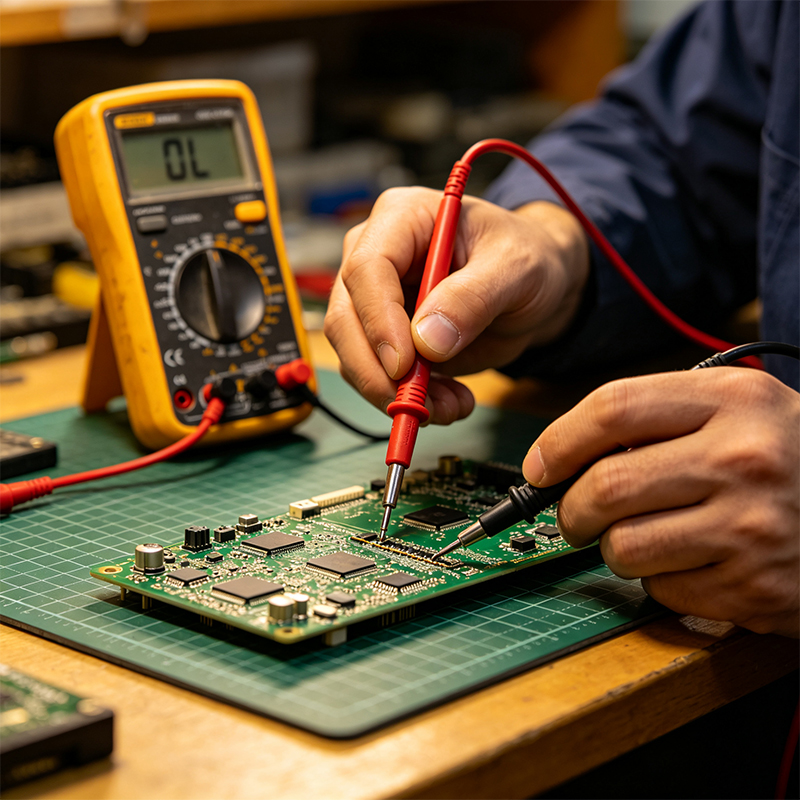
Blown fuse – Replace with the same rating. But first find out why it blew – otherwise the new fuse will blow too.
When You Should NOT Try to Fix It
The board is water‑damaged or badly corroded – Even if you fix one open, others will appear.
The open is inside a multi‑layer board – You can’t reach inner layers. You would need to bypass the entire section with an external wire, which is messy and not always possible.
The component is a large BGA or QFN chip – You can’t re‑solder a hidden joint under a BGA without professional rework equipment.
The device is very cheap – A new one costs less than your time.
Open Circuit in Flexible PCBs
Flexible circuits are more prone to opens because they bend. The copper traces can fatigue and crack over time, especially if the bend radius is too tight. To fix an open on a flex circuit:
Use a low‑temperature soldering iron (around 300°C) to avoid melting the polyimide.
Use stranded wire (not solid) for the jumper – it’s more flexible.
After repair, reinforce the area with a small piece of Kapton tape or a dab of flexible epoxy.
How to Prevent Open Circuits
Don’t bend cables sharply – Respect the minimum bend radius.
Use strain relief – Where cables exit a device, add a clamp or a rubber grommet so pulling doesn’t stress the internal connection.
Avoid over‑tightening screws on terminal blocks – You can break the wire or crack the terminal.
Store boards in anti‑static bags – To prevent corrosion.
Inspect solder joints – Especially after shipping or vibration.
Final Answer – What Is an Open Circuit?
An open circuit is a break in the electrical path that stops current from flowing. It can be caused by a broken wire, a cracked solder joint, a loose connector, or a damaged component. You can find an open circuit using a multimeter’s continuity test. Most opens are repairable with basic tools – re‑soldering, replacing a wire, or adding a jumper.
Next time your device dies without a spark or a smell, don’t throw it away. It might just be an open circuit – and that’s often an easy fix.

Kaboer manufacturing PCBs since 2009. Professional technology and high-precision Printed Circuit Boards involved in Medical, IOT, UAV, Aviation, Automotive, Aerospace, Industrial Control, Artificial Intelligence, Consumer Electronics etc..


 English



 Wechat
 +86 13670210335
 +86 13670210335
 E-mail