
Date: 2026-05-26
If you’ve ever seen a rugged electronic device – a waterproof connector, a car’s engine sensor, or a medical implant – chances are its circuit board isn’t just sitting naked inside a box. It’s probably been overmolded – encased in a protective layer of plastic that seals it from the outside world.
PCB overmolding is a manufacturing process that wraps a printed circuit board in a durable plastic shell. It turns a fragile assembly into something that can survive water, dust, shock, and vibration. Let’s explore what overmolding is, how it works, and when you might need it for your product.
What Is PCB Overmolding?
PCB overmolding is a specialized manufacturing process where a printed circuit board assembly (PCBA) is completely or partially encased in a plastic or polymer layer. The process uses injection molding techniques: the PCB is placed into a precisely designed mold cavity, then molten plastic (usually a thermoplastic or thermoset polymer) is injected around it under pressure. Once cooled and solidified, the PCB becomes a single, integrated, rugged component.
Think of it as giving your circuit board a custom‑made, perfectly fitting plastic suit of armor – no gaps, no weak spots.
Why Would You Overmold a PCB?
Electronics are fragile. They don’t like water, dust, vibration, or being dropped. Overmolding solves all those problems at once.
Waterproof and dustproof – An overmolded PCB can achieve high IP ratings like IP67 or IP68, meaning it can survive being submerged in water. The plastic seals every gap, preventing moisture and contaminants from reaching the sensitive circuitry.
Shock and vibration resistance – The hard plastic shell absorbs impacts and distributes mechanical stress evenly across the assembly. Components can’t wiggle loose, and solder joints won’t crack under repeated shaking.
Electrical insulation – The plastic layer adds an extra barrier against shorts and can even provide EMI/RFI shielding if special materials are used.
Chemical resistance – Overmolded boards resist oils, solvents, cleaning agents, and other harsh chemicals – perfect for automotive or industrial environments.
IP protection (intellectual property) – Once overmolded, the circuit is hidden inside a solid plastic block. Competitors can’t easily reverse‑engineer your design.
Simplified assembly – The overmold can replace a separate housing. Instead of putting your PCB into a box and sealing it with gaskets, you just injection‑mold the housing directly around the board. Fewer parts, fewer assembly steps.
How Does PCB Overmolding Work? (The Step‑by‑Step)
The process might sound complex, but it breaks down into a few key stages.
Mold design and fabrication – A precision mold is machined from hardened steel or aluminum, designed to perfectly match the shape of your PCB.
PCB preparation – The board is inspected, cleaned, and baked to remove any moisture (moisture trapped inside can cause bubbles during molding).
Insertion – The PCB is placed and secured inside one half of the mold cavity.
Mold closure – The mold is closed under high clamping force.
Injection – Molten plastic is injected into the closed mold, flowing around the PCB and into every crevice.
Cooling and solidification – The plastic cools and hardens into its final shape.
Ejection – The mold opens, and the overmolded PCB is pushed out.
Post‑processing – Excess material (flash) is trimmed, and the part undergoes visual and functional testing.
The entire cycle can take anywhere from 15 seconds to a couple of minutes, depending on the size and complexity.
Low‑Pressure Molding – A Gentler Alternative
Traditional injection molding uses very high pressure (hundreds or thousands of bar). That’s fine for molding plastic around nothing, but it can crush delicate electronic components. That’s where low‑pressure molding (LPM) comes in.
LPM uses pressures of only 2–20 bar and lower temperatures. It’s specifically designed for encapsulating sensitive electronics like PCBs, connectors, and sensors without damaging them.
The process is remarkably fast: typical cycle times are just 5–50 seconds. LPM materials are usually single‑component hot‑melt adhesives like polyamide or polyolefin, which come as solid pellets, are melted, and then injected. They solidify almost instantly upon cooling, so the part is ready for handling right away.
LPM offers several advantages over traditional potting (filling a housing with liquid resin):
Cycle times less than one‑tenth of epoxy potting
No messy mixing of two‑part resins
No masking required before molding
Lighter final product
Eliminates the need for a separate housing in some cases
Lower tooling costs (aluminum molds instead of steel)
What Materials Are Used for Overmolding?
The choice of material depends on your application. The most common are:
Polyamide (PA, Nylon) – Excellent adhesion, good flexibility, high temperature resistance, and chemical resistance. Widely used in automotive and industrial electronics.
Polyurethane (TPU) – Very flexible, excellent abrasion resistance, great for cables and connectors that need to bend. Can achieve IP68 waterproofing.
Polyolefin – Lower cost, good electrical insulation, often used in low‑pressure molding applications.
Thermoset polymers – Once cured, they cannot be remelted. Offer superior heat resistance but are less common in standard overmolding.
Liquid Silicone Rubber (LSR) – Extremely flexible, biocompatible, and can withstand very high and very low temperatures. Used in medical devices and seals.
Overmolding vs. Potting vs. Conformal Coating – What’s the Difference?
People often confuse these three protection methods. Here’s the simple version:
Conformal coating – A thin, paint‑like layer (25–75 microns) sprayed or brushed onto the board. Protects against moisture and dust but adds almost no mechanical strength. Best for indoor consumer electronics.
Potting – A liquid resin (epoxy, urethane, or silicone) is poured into a housing that contains the PCB. The resin cures into a solid block. Great for internal protection, but it doesn’t provide external strain relief and adds weight.
Overmolding – The PCB is placed directly into an injection mold, and molten plastic is injected around it. The result is a single, integrated part with built‑in housing, strain relief, and environmental sealing all in one. Higher upfront tooling cost, but lower per‑unit cost at volume.
Can You Overmold Flexible PCBs?
Yes, but it’s more challenging. Flexible circuits (FPCs) are thin and floppy, and they can shift or warp during injection. Successful overmolding requires:
Proper FPC positioning in the mold (precision fixtures).
Controlled low pressure to avoid damaging the delicate copper traces.
Careful design of the bend zones – the plastic will bond to the flex, changing how it bends.
Pre‑baking to remove moisture.
Suitable material combinations that bond well to the flexible substrate.
When done correctly, overmolded flexible circuits are used in wearable devices, medical sensors, smart cards, and automotive electronics where both flexibility and protection are needed.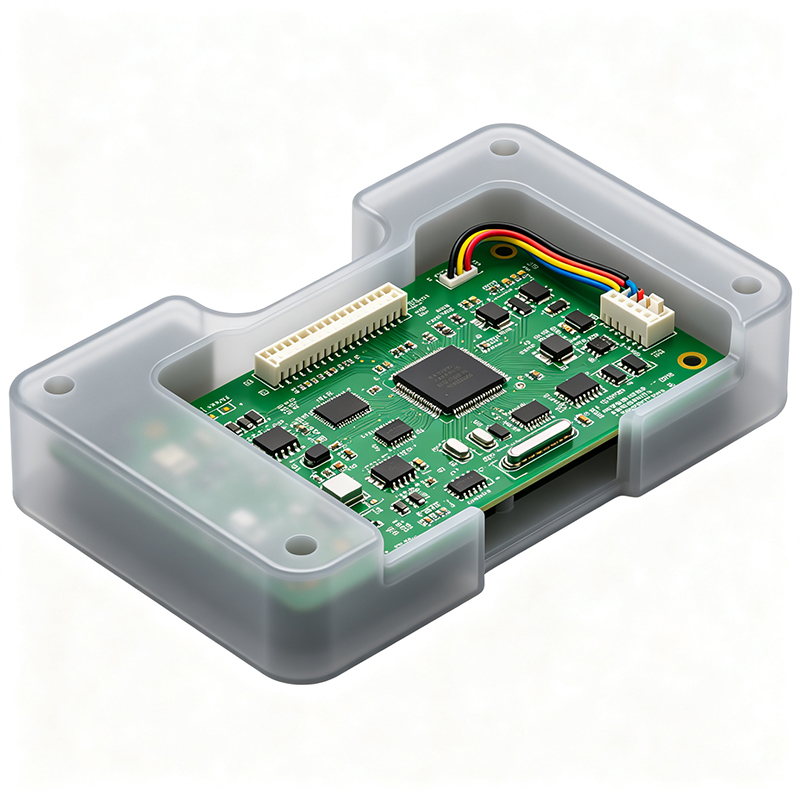
What Are the Limitations of Overmolding?
High initial tooling cost – The injection mold itself can cost thousands to tens of thousands of dollars, depending on complexity.
Not for small batches – Below a few hundred units, potting or conformal coating is often more economical.
Design lock – Once you build the mold, you can’t easily change the shape of the overmold. Design changes require a new mold – expensive and time‑consuming.
Heat stress – The molding process (150–200°C for a few seconds) can stress components if not carefully controlled. Low‑pressure molding reduces this risk.
No rework – Once overmolded, you can’t access the board for repairs. A failed board means the entire assembly is scrap.
Real‑World Applications of PCB Overmolding
You’ve probably used dozens of overmolded products without realizing it:
Waterproof connectors – The rugged, sealed plug at the end of a cable is almost always overmolded.
Automotive sensors – Engine sensors, ABS sensors, and TPMS modules are overmolded to survive heat, vibration, and road chemicals.
Medical devices – Implantable sensors and disposable patient monitors use overmolding for biocompatibility and sterilization resistance.
Industrial controls – Factory automation sensors, limit switches, and ruggedized controls are overmolded for dust and water resistance.
Wearable electronics – Fitness trackers and smartwatches often integrate the circuitry directly into an overmolded band or housing.
RFID tags – The tiny circuit inside an RFID tag is typically overmolded to protect it from physical damage.
How to Decide If Overmolding Is Right for Your Product
Ask yourself:
Will the product be exposed to water, dust, or chemicals? → Overmolding is a great solution.
Does it need to survive drops or vibration? → The integrated plastic shell provides excellent protection.
Are you making thousands of units? → Overmolding becomes very cost‑effective at higher volumes.
Is IP protection a concern? → The plastic hides your circuitry from competitors.
Is your board rigid or flexible? → Both can be overmolded, but flex requires extra care.
What We Can Do for You
We’re a custom circuit board manufacturer specializing in flexible PCBs, rigid‑flex boards, HDI high‑frequency boards, and PCBA. We understand that overmolding can add a whole new dimension of reliability to your product. Whether you’re looking to protect a rigid board, a flexible circuit, or a rigid‑flex assembly, we can help you with:
Material selection – We’ll recommend the right overmolding material (polyamide, TPU, etc.) for your environmental and mechanical requirements.
Design for overmolding – We’ll review your board layout and suggest modifications to ensure successful molding.
PCBA + overmolding – We can assemble your board, then coordinate with molding partners to deliver a fully overmolded, ready‑to‑use component.
Final Answer – What Is PCB Overmolding?
PCB overmolding is a manufacturing process that encases a printed circuit board in a protective plastic shell using injection molding. It provides waterproofing (IP67/IP68), shock and vibration resistance, electrical insulation, and chemical resistance in a single integrated part. The process works for both rigid and flexible PCBs, though flexible circuits require extra design care. Low‑pressure molding is a gentler variant designed specifically for sensitive electronics.
If your product needs to survive harsh environments – water, dust, vibration, or chemicals – overmolding might be the solution you’re looking for.

Kaboer manufacturing PCBs since 2009. Professional technology and high-precision Printed Circuit Boards involved in Medical, IOT, UAV, Aviation, Automotive, Aerospace, Industrial Control, Artificial Intelligence, Consumer Electronics etc..


 English



 Wechat
 +86 13670210335
 +86 13670210335
 E-mail