
Date: 2025-12-23
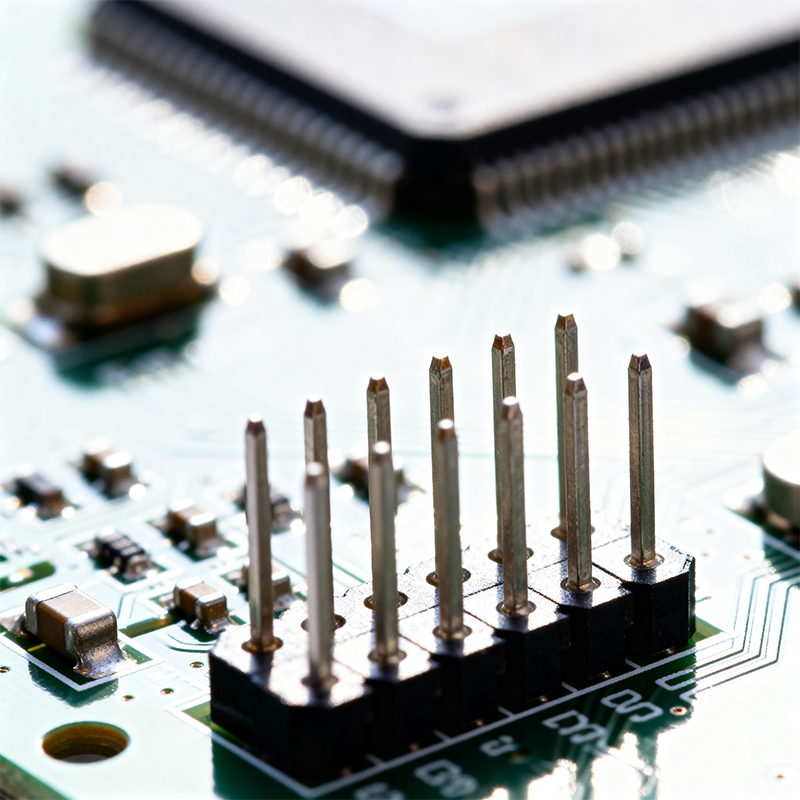
PCB pins are the physical interface points that extend from a printed circuit board, designed to create electrical connections between the board and external components, cables, or other circuit boards. These metallic protrusions serve as both electrical conductors and mechanical anchors, facilitating everything from power delivery to data transfer and physical mounting.
These pins establish electrical pathways:
Male Header Pins: Single or multi-row pins that insert into corresponding sockets
Female Sockets: Receptacles that receive male pins, commonly found on cables or daughter boards
Edge Connectors: Gold-plated contacts along the board's edge for slot-based connections
Test Points: Dedicated pads or raised pins for measurement equipment during debugging
These provide mechanical functions:
Standoffs: Raise the board above a surface for airflow or clearance
Alignment Pins: Ensure proper orientation during assembly
Mounting Pins: Secure the board to enclosures or chassis
Current Rating: Determined by pin cross-sectional area and material (typically 1-5A for standard pins)
Voltage Rating: Insulation and spacing requirements based on application
Contact Resistance: Quality pins maintain <20mΩ resistance per contact
Signal Integrity: Pin geometry affects impedance matching for high-speed signals
Insertion Force: The pressure required to mate pins (typically 0.5-2.5N per pin)
Durability: Rated mating cycles range from 50 (consumer) to 1000+ (military)
Retention Force: Resistance to accidental disconnection
Operating Temperature: Commercial (-10°C to +60°C) to industrial (-40°C to +85°C) ranges
Brass: Cost-effective with good spring properties
Phosphor Bronze: Better durability and conductivity
Beryllium Copper: High strength and excellent conductivity
Steel: Maximum mechanical strength
Tin Plating: Economical but prone to oxidation
Gold Over Nickel: Excellent corrosion resistance and conductivity
Selective Gold Plating: Gold only on contact areas to reduce cost
Silver: High conductivity but requires anti-tarnish treatment
Pin Spacing: Standard pitches include 2.54mm (0.1"), 2.00mm, and 1.27mm
Clearance Requirements: Space for mating connectors and hand access
Routing Priorities: Critical signals positioned near ground pins
Assembly Access: Ensuring pins don't block other components during manufacturing
Current Paths: Adequate pin count for power delivery to prevent overheating
Signal Integrity: Ground pins adjacent to high-speed signals to control impedance
Mechanical Stress: Reinforcement for pins experiencing frequent mating cycles
Thermal Management: Pin selection considering heat dissipation requirements
Pins inserted into drilled holes and soldered on the opposite side
Excellent mechanical strength
Requires wave or selective soldering
Additional drilling increases board cost
Pins soldered directly to surface pads
Enables automated assembly
Lower profile but reduced mechanical strength
Requires precise placement and reflow profiling
Pins pressed into plated through-holes with interference fit
No soldering required
Excellent reliability for high-vibration environments
Requires precise hole size control
Requirements: High current capacity, secure mechanical connection
Typical Pins: Heavy-duty terminals, multi-pin power connectors
Considerations: Voltage rating, insulation, thermal management
Requirements: Controlled impedance, shielding, precise alignment
Typical Pins: Multi-pin headers, edge connectors, coaxial pins
Considerations: Signal speed, crosstalk prevention, EMI shielding
Requirements: Reliable mating, space efficiency, proper alignment
Typical Pins: Stacking headers, mezzanine connectors
Considerations: Height restrictions, board spacing, thermal expansion
Continuity Verification: Ensures pins are properly connected to circuit traces
Insulation Resistance: Tests isolation between adjacent pins (>100MΩ typically)
Current Carrying Tests: Validates pins can handle rated current without overheating
Contact Resistance Measurement: Confirms low-resistance connections (<20mΩ)
Insertion/Extraction Force: Measured with calibrated force gauges
Durability Testing: Repeated mating cycles to verify pin longevity
Environmental Testing: Exposure to temperature cycles, humidity, and vibration
Retention Force Testing: Ensures pins remain connected under specified conditions
UL Certification: Safety requirements for electrical connections
IEC Specifications: International standards for connector performance
RoHS Compliance: Restrictions on hazardous substances
REACH Compliance: Chemical registration and usage regulations
Automotive: Vibration resistance, temperature extremes, moisture protection
Aerospace/Military: Extreme reliability, wide temperature ranges, shock resistance
Medical: Biocompatibility, sterilization compatibility, high reliability
Industrial: Durability, environmental sealing, maintenance accessibility
Define Electrical Requirements: Current, voltage, signal types
Determine Mechanical Needs: Mating cycles, environmental conditions
Evaluate Space Constraints: Board real estate, height restrictions
Consider Assembly Methods: Compatibility with manufacturing processes
Analyze Lifecycle Factors: Availability, cost, replacement needs
Undersizing Power Pins: Leads to overheating and connection failure
Ignoring Mating Cycles: Using consumer-grade pins in industrial applications
Poor Pin Layout: Creating assembly difficulties or signal interference
Material Incompatibility: Galvanic corrosion from dissimilar metals
Inadequate Strain Relief: Cable connections that damage board traces
Ultra-fine pitch pins (<0.5mm spacing)
Micro-pins for high-density interconnects
Board-embedded pin structures
High-temperature plastics for housings
Improved contact coatings for durability
Sustainable and recyclable materials
Pins with embedded sensing capabilities
Self-diagnosing connection systems
Integrated signal conditioning
PCB pins represent a critical interface between electronic circuits and the physical world. Their proper selection and implementation require balancing electrical requirements, mechanical demands, manufacturing considerations, and cost constraints. While often considered simple components, pins significantly impact product reliability, performance, and manufacturability.
Successful pin implementation begins with understanding application requirements and continues through careful design, material selection, and verification testing. As electronic systems continue evolving toward higher density and greater complexity, pin technology must advance accordingly, maintaining the essential connection between innovation and practical implementation.

Kaboer manufacturing PCBs since 2009. Professional technology and high-precision Printed Circuit Boards involved in Medical, IOT, UAV, Aviation, Automotive, Aerospace, Industrial Control, Artificial Intelligence, Consumer Electronics etc..


 English



 Wechat
 +86 13670210335
 +86 13670210335
 E-mail