
Date: 2026-05-16
You’ve designed a circuit. You have the bare board. Now you need to get all the tiny parts – resistors, capacitors, chips, connectors – soldered onto it. That’s not a trivial task. It’s also not something you want to do by hand for a hundred boards.
A PCB with components is simply a printed circuit board that already has its electronic components assembled. In industry terms, that’s called PCBA (printed circuit board assembly). But let’s forget the jargon. What you really want is a board that works when you plug it in – no extra soldering, no hunting for parts, no guessing.
Let’s talk about what a fully populated PCB looks like, why you might want one, and how to get it right for your product.
What Is a PCB with Components?
A PCB with components is a board that has undergone the assembly process. Every component that belongs on the board – from a tiny 0402 resistor to a large BGA chip – has been placed and soldered onto its designated pads. The board may also have been tested, cleaned, and maybe even coated with a protective layer.
In short: it’s a circuit board that’s ready to go into your product. No further work needed.
Why Would You Buy a PCB with Components Instead of Doing It Yourself?
Three big reasons: speed, quality, and cost.
Speed – A professional assembly line can place thousands of components per hour. Doing it by hand, you’d spend hours or days on a single board.
Quality – Automated pick‑and‑place machines are incredibly precise. They don’t get tired, and they don’t create cold solder joints. You get consistent, reliable results.
Cost – For any quantity above a handful, professional assembly is actually cheaper than hand‑soldering. The machine works fast, and you don’t have to pay someone to sit there for hours.
What Does a PCB with Components Look Like?
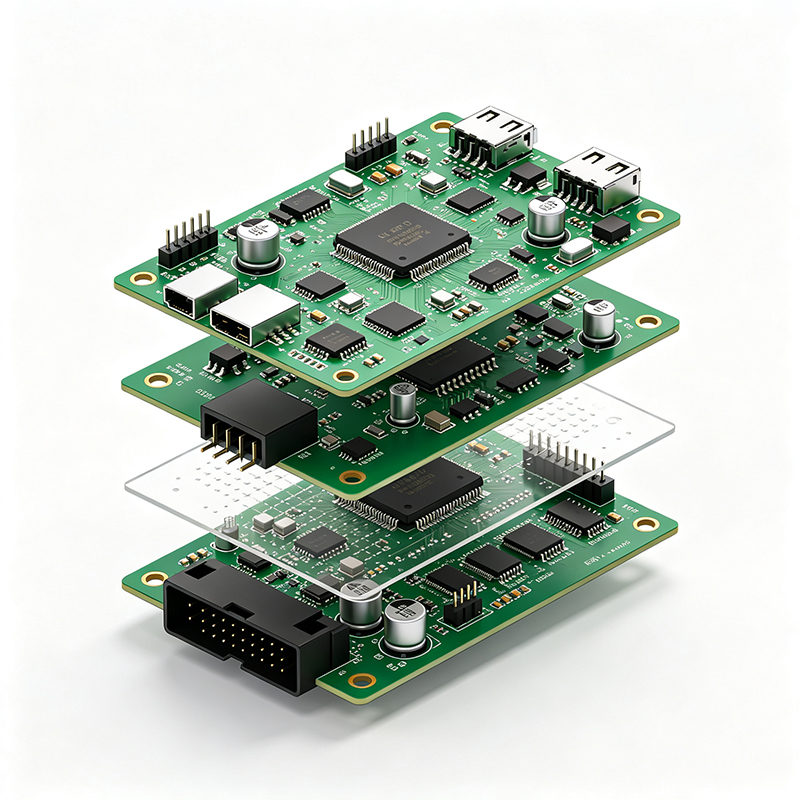
It depends on the board. But a typical assembled board includes:
Solder joints – Shiny, smooth connections between component leads and pads.
Resistors and capacitors – Tiny rectangular or cylindrical parts, often black or brown with markings.
Diodes and LEDs – Small parts with polarity markings (a band or a flat side).
Transistors and ICs – Chips with multiple legs, usually black plastic.
Connectors – For plugging in cables, batteries, or other boards.
Crystals or oscillators – Silver or gray components that provide timing signals.
Possibly – A conformal coating (a thin transparent or matte layer) for protection against moisture and dust.
How Is a PCB with Components Made? (Simple Version)
Solder paste printing – A stencil applies tiny dots of solder paste onto the bare board’s pads.
Pick and place – A machine picks components from reels or trays and puts them precisely onto the paste.
Reflow soldering – The board goes through a hot oven. The solder paste melts and solidifies, permanently attaching the components.
Inspection – Cameras (AOI) check for missing, misaligned, or poorly soldered parts. X‑ray may be used for hidden joints (like under BGAs).
Through‑hole assembly (if needed) – Components with long leads (large connectors, transformers) are inserted and wave‑soldered or hand‑soldered.
Testing – The board is powered up and tested to ensure it works (functional test) and that every connection is good (ICT).
Cleaning and coating – Flux residue is washed off, and a protective coating may be applied.
What About Flexible and Rigid‑Flex Boards with Components?
Absolutely. Flexible PCBs can be assembled just like rigid ones – but with special care. The flexible material can warp during soldering if not properly supported. We use custom fixtures to hold flex boards flat during printing and placement.
For rigid‑flex boards, the assembly process is more complex because the board has both rigid sections and flexible tails. The rigid sections are processed normally, while the flexible tails are kept flat with vacuum or mechanical clamps. The result is a board that can bend, fold, or fit into weird shapes – with all components already attached.
HDI High‑Frequency Boards with Components
If your product needs high‑speed signals (5G, radar, etc.), you’ll want an HDI high‑frequency board with components assembled. HDI boards have microvias and fine traces. Assembling them requires even higher placement precision (often ±0.025mm) and special solder paste for fine‑pitch parts. We do that too.
What’s the Difference Between a “PCB with Components” and “PCBA”?
Nothing. They’re the same thing. PCBA just stands for “Printed Circuit Board Assembly”. Some people say “populated board” or “assembled board”. The idea is the same: you get a board that’s ready to use.
Common Mistakes When Ordering a PCB with Components
Not providing a complete BOM (Bill of Materials) – You need to list every component, its value, package, and manufacturer part number. Missing info causes delays or wrong parts.
Forgetting about component availability – Some chips have long lead times. We can help you find alternatives or plan ahead.
Ignoring polarity – Diodes, LEDs, capacitors, and some ICs must be placed in the correct orientation. If your design doesn’t clearly mark polarity, mistakes happen.
No testing specification – How do you know the board works? You need to tell us what tests to run (or we can recommend a standard test).
Not planning for flex or rigid‑flex – Flexible boards need special fixtures and handling. If you just send a rigid‑board design to a standard assembler, you’ll get warped boards or damaged flex tails.
Benefits of Ordering a Fully Assembled PCB from a Single Source
When you get both the bare board fabrication and the component assembly from the same company, you avoid many headaches:
No mismatch between board and assembly – The same team that made the board knows its tolerances.
One point of contact – You don’t have to talk to a board fab in one place and an assembler in another.
Faster turnaround – No shipping bare boards to a second location.
Better quality control – The assembler can test the board immediately after assembly, and any issues are caught early.
Cost savings – Combining fabrication and assembly often reduces overall price.
What We Offer – Custom PCBs with Components, Assembled Right
We’re a custom circuit board manufacturer that builds and assembles boards in‑house. We don’t outsource your assembly to a third party. That means we have full control over quality, timing, and cost.
Our capabilities:
Flexible PCBs – Single‑, double‑sided, multi‑layer polyimide circuits. We assemble them with standard SMT parts, using flex‑specific fixtures.
Rigid‑flex boards – Rigid sections with integral flex tails. We assemble components on the rigid areas, while the flex parts remain clean and ready to bend.
HDI high‑frequency boards – Microvias, fine lines, Rogers or low‑loss materials. We assemble high‑pin‑count BGAs and fine‑pitch components with precision.
PCBA – Full turnkey assembly: we source components, fabricate the board, assemble, test, and ship.
How We Test Your Assembled Boards
We don’t just solder parts and hope. Every board goes through:
AOI (Automated Optical Inspection) – Cameras check every component and solder joint.
X‑ray inspection – For BGAs, QFNs, and other hidden joints.
ICT (In‑Circuit Test) – Probes touch test points to verify each component’s value and connection.
Functional test – We power up the board and simulate real‑world operation, according to your test plan.
For flexible boards, we also test after bending (if your application requires the board to be flexed during use).
A Real‑World Example: A Medical Sensor Customer
A customer needed a small wearable patch to monitor heart rate. The design included a flexible PCB (to conform to the body), a Bluetooth chip, sensors, and a tiny battery connector. They initially planned to have one company make the bare flex board and another assemble it. The two companies didn’t communicate well – the assembler didn’t have fixtures for the flex material, causing misalignment. We took over: we fabricated the flexible PCB, built custom assembly fixtures, placed all components, tested the boards, and delivered 500 assembled units in two weeks. The customer saved two months of back‑and‑forth.
Ready to Get Your PCB with Components?
Whether you need a rigid board, a flexible circuit, a rigid‑flex hybrid, or an HDI high‑frequency board – and you want it fully assembled with components – we can help. Send us your Gerber files, BOM, and any special instructions (test points, polarity notes, etc.). We’ll send you a clear quote and a realistic timeline.

Kaboer manufacturing PCBs since 2009. Professional technology and high-precision Printed Circuit Boards involved in Medical, IOT, UAV, Aviation, Automotive, Aerospace, Industrial Control, Artificial Intelligence, Consumer Electronics etc..


 English



 Wechat
 +86 13670210335
 +86 13670210335
 E-mail