
Date: 2026-03-12
If you've ever stared at a page filled with lines, symbols, and numbers and wondered what it all means, you're not alone. Schematics can look like a foreign language at first—all those squiggly lines, triangles, and weird symbols. But here's the thing: once you learn a few basic rules, they start to make sense.
I remember when I first started working with electronics. I'd open a schematic and feel completely lost. What was that triangle? Why were there dots in some places but not others? It took time, but eventually it clicked. And once it did, I realized schematics are actually the simplest way to understand how a circuit works.
Let's break down what schematics are and how you can learn to read them without getting overwhelmed.
A schematic (sometimes called a schematic diagram) is a visual representation of an electrical circuit. It uses standardized symbols to show how components are connected, without worrying about their physical layout .
Think of it like a recipe for your circuit. Just as a recipe tells you what ingredients you need and how to combine them, a schematic tells you what electronic components you need and how they should be connected.
The beauty of schematics is that they focus on how components connect, not what they look like physically. A tiny 0402 resistor and a giant through-hole resistor use the exact same symbol. That means you can design a circuit without worrying about physical dimensions—that comes later when you design the PCB layout.
You might wonder: why not just draw a picture of the actual components and wires? That would be a wiring diagram, and those exist. But schematics are different—and more useful.
Schematics emphasize function over form. They arrange components in a way that makes the circuit's operation clear, not necessarily how they'll be arranged on a board. Power might flow from top to bottom, signals from left to right. This logical arrangement makes it much easier to understand what the circuit does.
They're universal. An engineer in Germany and a technician in Japan can both read the same schematic because the symbols are standardized (mostly). There are variations, but the basics are consistent worldwide.
They're essential for troubleshooting. When something doesn't work, a schematic is your roadmap. You can trace signals, check voltages, and figure out where things go wrong.
They're the first step in PCB design. Before you can lay out a circuit board, you need a schematic. It defines every connection that the PCB layout must implement.
Let's start with the most common symbols. Once you know these, you can read most basic circuits.
Wires are shown as straight lines connecting components. Pretty straightforward.
Connected wires get a dot at the junction. If you see a dot where two lines cross, they're connected electrically. If there's no dot, they just cross without connecting (like an overpass).
Net labels are a clever trick. Instead of drawing long wires everywhere, schematics use labels. Anywhere you see the same label—like "VCC" or "GND"—those points are connected even if they're far apart on the page. This keeps schematics clean and readable.
VCC / VDD indicates positive supply voltage. It might be +5V, +3.3V, +12V—whatever your circuit needs.
VEE / VSS is negative supply voltage, less common in single-supply circuits.
GND is ground, the reference point for all voltages. Usually shown as a triangle or three horizontal lines.
Battery is a series of alternating long and short lines, representing cells.
Resistor is a zigzag line (or a rectangle in some standards). The value is usually written nearby, like "10k" for 10,000 ohms.
Capacitor is two parallel lines. If one line is curved, it's polarized (usually electrolytic). The value is written in farads, like "10µF".
Inductor looks like a coil or a series of bumps, like a spring. Value in henries, like "10µH".
Diode is a triangle pointing to a line. Current flows from triangle to line. LEDs add arrows showing light.
Transistor (BJT) has three layers—emitter, base, collector. Arrows show direction. NPN and PNP look slightly different.
Transistor (MOSFET) has a more complex symbol with source, gate, drain. Often has a built-in diode symbol.
Operational Amplifier (op-amp) is a triangle with (+) and (-) inputs and an output.
ICs are shown as rectangles with pin numbers and names. Pin 1 is usually marked with a dot or notch. Important: pins are arranged for clarity, not physical position. Don't assume pin 1 is top-left on the actual chip.
Switch is a break in the line with a moving contact. There are many types: SPST (single-pole single-throw), SPDT (single-pole double-throw), and so on.
Connector is often shown as a row of pins with a bracket. Headers, USB ports, audio jacks all have their own symbols.
Crystal / Oscillator is a rectangle with "XTAL" or a frequency value.
Fuse is a line with a curve or an "S" shape.
Test point is a circle with "TP" and a number—used for probing during debugging.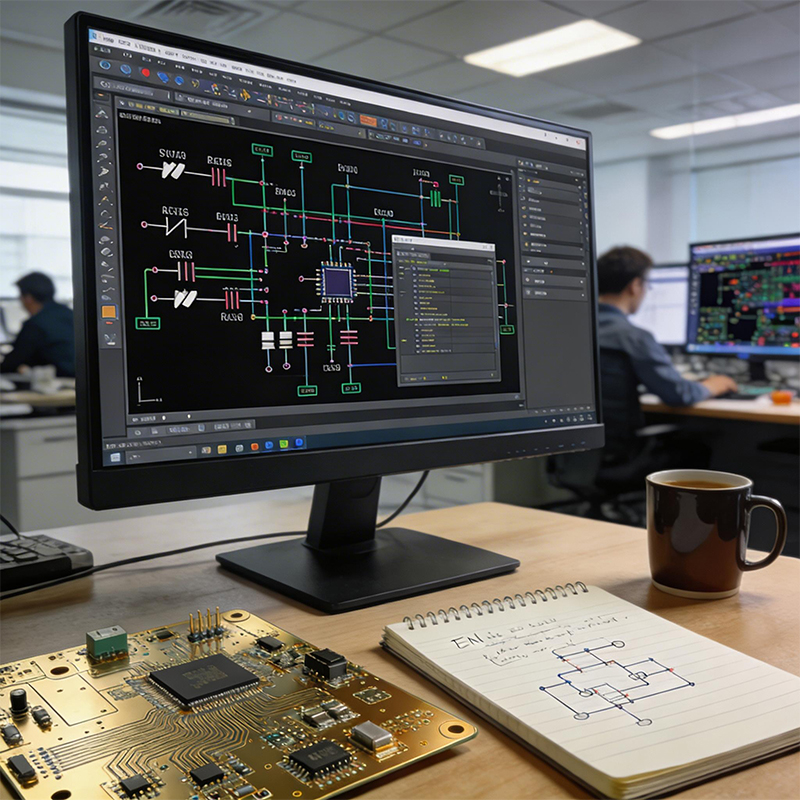
Now that you know the symbols, let's walk through how to actually read a schematic.
Start by locating power symbols. Where does voltage enter the circuit? Is it battery-powered? USB? External supply? Identify VCC and GND—everything else connects to these.
Most circuits process signals from left to right. Inputs (sensors, connectors, etc.) are usually on the left. Outputs (LEDs, speakers, data lines) are on the right. Follow the path from input to output, seeing how the signal gets transformed.
Complex schematics group related components together. You might see a "power supply" section, a "microcontroller" section, and a "driver" section. These groupings tell you what the circuit does.
Smart schematics use net labels extensively. Instead of drawing a wire from a microcontroller pin to five different places, the designer just labels that net "I2C_SCL" everywhere it appears. Find all instances of that label—they're connected.
Follow important signals: clock lines, data buses, power routes. See what components they touch and in what order. This helps you understand timing and dependencies.
When you see an IC, look up its datasheet. The schematic symbol tells you the pin names, but the datasheet tells you what those pins actually do. This is essential for understanding the circuit's function.
New readers focus on signal paths and forget that every chip needs power. Always check that all ICs have their power pins connected. Floating power pins mean dead circuits.
Remember: same label = same connection. "VCC" in the top-left and "VCC" in the bottom-right are connected, even if no line joins them on paper.
IC symbols often rearrange pins for schematic clarity. Pin 1 might be drawn in the middle. Always trust the pin number, not the position on the page.
Digital inputs often need resistors to keep them at a known state when nothing's driving them. Missing these can cause erratic behavior. Look for resistors connected to VCC or GND near input pins.
Every IC should have a small capacitor (usually 0.1µF) near its power pins. If you see an IC without one, that's suspicious. These caps filter noise and keep the chip stable.
Start simple. Don't jump into a complex motherboard schematic. Begin with basic circuits—an LED flasher, a voltage regulator, a simple amplifier. Build up gradually.
Print it out. For complex schematics, having a paper copy lets you mark things up. Highlight power rails, circle important components, draw arrows for signal flow.
Use colors. Color-code your print: red for power, black for ground, blue for signals, green for test points. This makes the circuit much easier to follow.
Read in layers. Start with the big picture: what does this board do? Then zoom in on individual sections. Then examine specific component connections. Three levels of detail help you build understanding without getting overwhelmed.
Ask "why?" Every component has a purpose. If you don't understand why something is there, ask—or look it up. Understanding the reason behind a component teaches you more than just recognizing it.
Let's walk through a typical schematic for an Arduino-style board:
1. Power section: USB input goes to a voltage regulator, which outputs 5V and 3.3V. Capacitors smooth the output. A power LED shows it's on.
2. Microcontroller: The main chip with dozens of pins. VCC and AVCC pins connect to power. GND pins connect to ground. A crystal connects to XTAL pins for timing.
3. Programming header: Six pins in a row, connected to specific microcontroller pins (RESET, VCC, GND, MOSI, MISO, SCK). This is how you upload code.
4. Input/Output: Headers bring out all the I/O pins to the edges. Each pin might have a small resistor for protection.
5. Reset circuit: A button connected to the RESET pin, with a pull-up resistor to keep it high normally. Pressing it pulls the pin low, resetting the chip.
6. Status LED: Connected to one I/O pin through a current-limiting resistor. When the pin goes high, the LED lights.
See how each section has a clear purpose? That's good schematic design.
Digital schematics focus on logic levels and data flow. You'll see lots of ICs, buses, and control signals. Power and ground are everywhere. The main concern is making sure all chips talk to each other correctly.
Analog schematics care about voltages and currents. You'll see more resistors, capacitors, and transistors. Component values matter a lot. Noise and interference are big concerns.
Mixed-signal schematics combine both. You'll see analog front ends feeding into ADCs, then digital processing. These require careful separation of analog and digital grounds.
Some signals are active when low, not high. They're marked with a bar over the name or a # after it (RESET, or RESET#). When you see a bar, remember: 0V = active, 5V = inactive.
When many signals travel together (like an 8-bit data bus), schematics show them as a thick line with a label like "D[0..7]" or "DATA_BUS". Individual wires branch off to specific pins.
Complex schematics span multiple pages. Port symbols (like triangles or arrows) show connections to other sheets. "Off-sheet" connectors have matching labels across pages.
Circles labeled "TP1", "TP2", etc. These are places you can probe during debugging. Smart designers put test points on important signals.
A schematic is just the first step. Once the circuit is designed, engineers use software to turn it into a physical board:
Create a netlist: A list of all connections extracted from the schematic.
Place components: Arrange physical parts on a virtual board.
Route traces: Draw copper connections between components according to the netlist.
Generate Gerbers: Manufacturing files that PCB fabs use to make the actual board.
The schematic ensures the logic is right. The PCB layout ensures the physical implementation works.
Like any skill, reading schematics improves with practice. Start with simple circuits—an LED flasher, a voltage regulator, a basic amplifier. Work your way up to microcontroller boards, power supplies, and communication interfaces.
Download schematics for open-source hardware. Arduino, Raspberry Pi Pico, and many other projects publish full schematics. Study them. See how professionals lay out their designs.
Before long, you'll look at a schematic and see not just symbols, but the circuit itself—how it works, why it's built that way, and where to look when something's wrong.
Schematics are the language of electronics. They're how engineers communicate designs, how technicians troubleshoot problems, and how students learn to build circuits.
Start with the basics: learn the symbols, follow the power, trace the signals. With practice, schematics will go from confusing drawings to clear roadmaps that guide you through any circuit.
Remember: every expert was once a beginner. The schematic that looks confusing today will be second nature tomorrow. Keep studying, keep practicing, and soon you'll be reading circuits like a pro.

Kaboer manufacturing PCBs since 2009. Professional technology and high-precision Printed Circuit Boards involved in Medical, IOT, UAV, Aviation, Automotive, Aerospace, Industrial Control, Artificial Intelligence, Consumer Electronics etc..


 English



 Wechat
 +86 13670210335
 +86 13670210335
 E-mail