
Date: 2026-05-21
You’ve seen a modern circuit board – packed with hundreds of tiny resistors, capacitors, and chips, all sitting perfectly on the surface. How do they get there? It’s not done by hand (that would take days). It’s done by SMT mounting – short for Surface Mount Technology assembly.
SMT is the standard way electronics are made today. It’s fast, precise, and reliable. If you’re a manufacturer making any kind of electronic product – from a smartwatch to a car’s engine computer – you need to understand how SMT mounting works and why it matters.
Let’s walk through what SMT mounting is, how it works step by step, and what you should know if you’re having boards assembled for your product.
What Is SMT Mounting?
SMT mounting is the process of placing and soldering surface‑mount components (SMDs) onto a printed circuit board. Unlike old‑school “through‑hole” components that had long leads poked through holes, SMDs sit flat on the surface of the board. They’re smaller, lighter, and can be placed by machines at incredible speed.
Think of it like this: if through‑hole assembly is hand‑stitching a quilt, SMT mounting is a high‑speed embroidery machine. It’s faster, more precise, and perfect for modern, compact electronics.
SMT vs. Through‑Hole – A Quick Comparison
| SMT | Through‑Hole | |
|---|---|---|
| Components | Small, no long leads | Larger, with pins through holes |
| Soldering | Reflow soldering (whole board heated) | Wave soldering or hand soldering |
| Speed | Very fast (20,000+ parts per hour) | Slower |
| Board space | Components on both sides possible | Mostly one side |
| Best for | High volume, compact designs | Large connectors, heavy parts, prototypes |
Today, the vast majority of components on any PCB are surface‑mount. Through‑hole is only used for connectors, transformers, and parts that need extra mechanical strength.
The SMT Mounting Process – Step by Step
Let’s go through what happens in a professional SMT assembly line.
Step 1: Solder Paste Printing
The board starts completely bare. A stainless steel stencil (like a very thin sheet with cutouts) is placed over the board. A squeegee spreads solder paste – a grey, sticky mixture of tiny solder balls and flux – across the stencil. The paste squeezes through the openings exactly onto the copper pads where components will sit.
For flexible PCBs, this step is tricky because the board isn’t stiff. We use vacuum fixtures to hold the flex board perfectly flat, otherwise the paste smears.
Step 2: Solder Paste Inspection (SPI)
Before any components are placed, a machine checks the paste. It uses a laser or a structured light to measure the height, volume, and position of every paste dot. If there’s too little, too much, or it’s misaligned, the board is flagged for rework. This step is critical – bad paste leads to bad solder joints.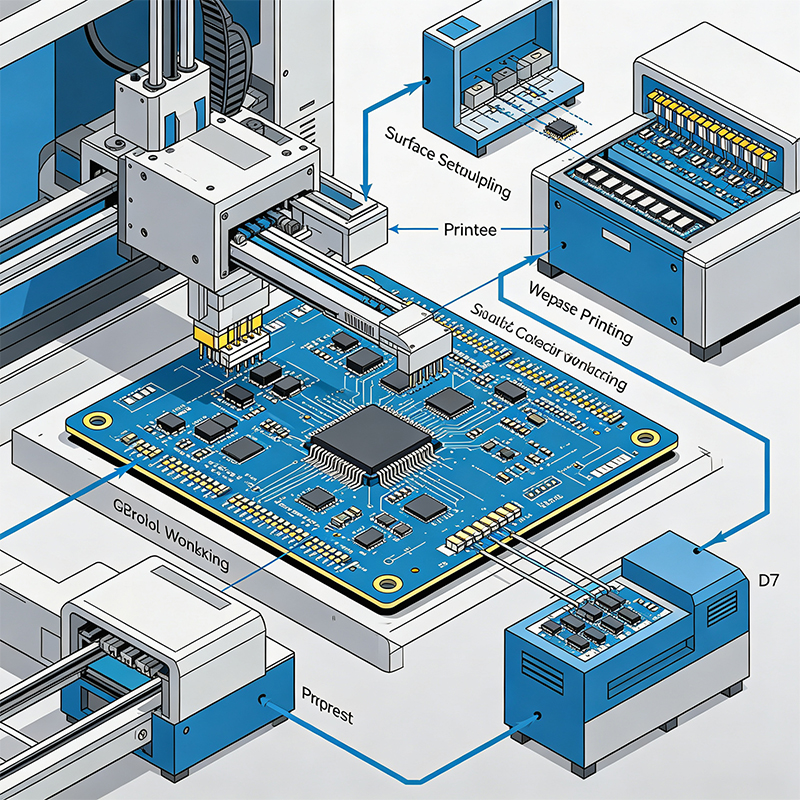
Step 3: Pick and Place (The “Mounting” Step)
This is where the magic happens. A high‑speed pick‑and‑place machine uses vacuum nozzles to pick components from reels, tubes, or trays, and places them onto the solder paste with incredible accuracy – often within ±0.025mm (that’s thinner than a human hair).
The machine can place 20,000 to 50,000 components per hour. For large chips like BGAs or QFNs, slower but more precise placement is used.
For rigid‑flex boards, we use custom fixtures to support the flexible tails so they don’t wobble during placement.
Step 4: Reflow Soldering
After all components are placed, the board travels through a reflow oven – a long, heated tunnel with several temperature zones (pre‑heat, soak, reflow, cooling). The solder paste melts (typically around 217–230°C for lead‑free solder), then solidifies, forming a permanent, shiny solder joint.
The board comes out the other end with all components firmly attached.
For high‑frequency materials (like Rogers), the reflow profile must be carefully tuned to avoid damaging the substrate.
Step 5: Automated Optical Inspection (AOI)
The board is then photographed by high‑resolution cameras. The AOI machine checks:
Missing components
Polarity (did the diode go in backwards?)
Solder bridges (two pads accidentally connected)
Insufficient solder
Tombstoned components (standing on end)
For flexible PCBs, we adjust lighting angles to avoid glare from the polyimide coverlay. For HDI boards with fine‑pitch ICs, we use higher resolution cameras.
Step 6: X‑Ray Inspection (for hidden joints)
Some components – like BGAs (Ball Grid Arrays) and QFNs (Quad Flat No‑leads) – have solder joints hidden underneath the part body. You can’t see them with a regular camera. An X‑ray machine looks through the component to check for voids, shorts, and poor wetting.
Step 7: Through‑hole Assembly (if needed)
Not everything can be surface‑mounted. Large connectors, transformers, and relays often need through‑hole soldering. For these, a wave soldering machine (or selective soldering) is used after SMT. Sometimes hand soldering is used for small batches or rework.
Step 8: Functional Test (FCT) & In‑Circuit Test (ICT)
The board is powered up and tested. In‑circuit test (ICT) uses a bed‑of‑nails fixture to probe test points and verify each component’s value and connection. Functional test (FCT) simulates real operation – for a motor driver, it spins a motor; for a Bluetooth module, it checks that it can pair.
For flexible and rigid‑flex boards, we often test after bending (if the final application involves flexing).
Why SMT Mounting Is Better Than Hand Soldering for Production
Speed – A machine can place thousands of parts in minutes. Hand soldering the same board would take hours.
Consistency – Every joint is identical. No shaky hands, no cold joints.
Miniaturization – You can place components as small as 01005 (0.4mm × 0.2mm) – impossible to hand solder reliably.
Double‑sided assembly – SMT allows components on both sides of the board, saving space.
Cost – For any volume above a few boards, SMT is cheaper per board than hand assembly.
Special Considerations for Different Board Types
Rigid FR4 boards – Standard SMT works well. The boards are stiff, so no special fixturing needed.
Flexible PCBs – Flex boards are floppy. They must be held perfectly flat during printing and placement. We use vacuum pallets or adhesive‑backed carriers. The reflow profile may need to be adjusted because polyimide heats differently than FR4.
Rigid‑flex boards – These have both rigid sections and flexible tails. The rigid sections are processed normally, while the flexible tails are supported with custom carriers to keep them from moving. Vias and components are only allowed on rigid areas.
HDI high‑frequency boards – These have very fine traces (0.05mm) and microvias. SMT mounting requires ultra‑precise placement (often ±0.025mm) and fine‑pitch stencils. We use 3D SPI and high‑resolution AOI to catch defects.
What Can Go Wrong in SMT Mounting?
Even with machines, problems happen. Here are common ones:
Solder bridges – Too much paste or misalignment causes two pads to connect. Fix: adjust stencil or reduce paste volume.
Tombstoning – A small component stands up on one end. Cause: uneven heating or pad size mismatch.
Missing components – The pick‑and‑place machine ran out of parts or the nozzle didn’t pick correctly.
Insufficient solder – Not enough paste, or the stencil was clogged.
Component shift – Parts move during reflow. Cause: too much vibration or poor paste tackiness.
Why Use a Professional SMT Assembly Service?
If you’re making more than a handful of boards, you don’t want to hand solder. You want a turnkey PCBA provider who can:
Source components – We buy the parts for you, often at better prices than you can get.
Fabricate the bare board – We make the PCB (rigid, flex, rigid‑flex, HDI) to your design.
Assemble with SMT – We run your boards through our SMT line.
Test – We do AOI, X‑ray, ICT, and functional test.
Ship ready‑to‑use boards – You receive fully assembled, tested PCBs.
What We Offer
We’re a custom circuit board manufacturer that also does full SMT mounting and PCBA. We specialize in:
Flexible PCBs – Polyimide flex circuits, single‑sided to multi‑layer.
Rigid‑flex boards – Rigid sections with integral flex tails.
HDI high‑frequency boards – Microvias, fine traces, low‑loss materials for RF and high‑speed digital.
PCBA – Full turnkey assembly, including component sourcing, SMT mounting, through‑hole, and testing.
We have custom fixtures for flex and rigid‑flex boards, 3D SPI, high‑speed placement machines, ten‑zone reflow ovens, AOI, X‑ray, and ICT. Every board is tested – no sampling.
Ready to Get Your Boards Assembled?
Whether you have a rigid board, a flexible circuit, a rigid‑flex hybrid, or an HDI high‑frequency design – we can mount all the components for you. Send us your Gerber files and BOM. We’ll give you a clear quote and lead time.

Kaboer manufacturing PCBs since 2009. Professional technology and high-precision Printed Circuit Boards involved in Medical, IOT, UAV, Aviation, Automotive, Aerospace, Industrial Control, Artificial Intelligence, Consumer Electronics etc..


 English



 Wechat
 +86 13670210335
 +86 13670210335
 E-mail