
Date: 2026-04-09
Let’s be real: an open circuit is the most frustrating "invisible" enemy in electronics. One minute your prototype is working perfectly on the bench, and the next, after a few heat cycles or a simple vibration test, your million-dollar project goes dark.
If you are a manufacturer dealing with High Density Interconnect (HDI) or custom Flexible PCBs, you know that a "break" isn't always as obvious as a snapped wire. In 2026, as traces get thinner and vias get smaller, the battle against open circuits is won or lost on the factory floor. Here is the unvarnished truth about why your boards are failing and how we ensure they don't.
When you search for open circuit, you’ll find plenty of basic definitions. But for a pro, the real killers are much more subtle.
The Microvia Trap: In high-speed HDI boards, we rely on laser-drilled microvias. If the plating process is even slightly off, the copper wall inside that tiny hole can be too thin. During reflow, the board expands, the thin copper cracks, and boom—you have a "latent" open circuit that only shows up when the device gets hot.
Flex PCB Fatigue: Flexible PCBs are designed to bend, but they aren't invincible. We often see "intermittent opens" caused by micro-fractures in the copper traces. This usually happens because the manufacturer didn't account for the neutral axis during the stack-up design.
We get it—everyone wants to save on the BOM. But cutting corners on the bare board fabrication is a gamble you’ll likely lose.
Low-end factories often skip the expensive chemistry needed for reliable electroless copper plating. This leads to poor adhesion. When your PCBA goes through the oven at $260°C$ (to be compliant with RoHS directive), those weak bonds snap. You end up with a board that looks perfect to the naked eye but has zero internal connectivity.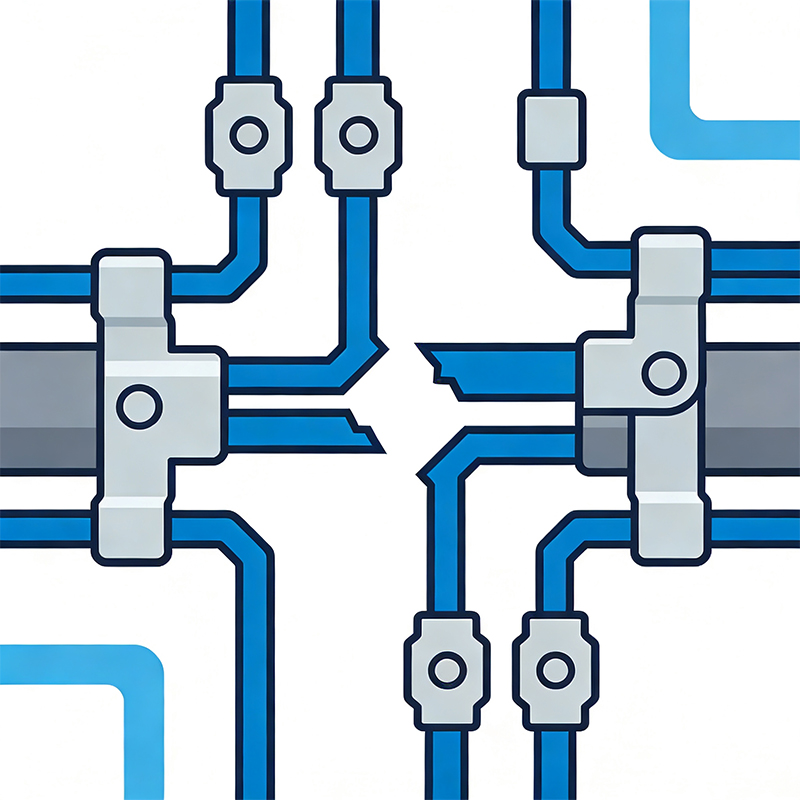
At our facility, we treat an open circuit as a personal insult to our engineering. We don't just "hope" the boards work; we prove they do.
Vacuum Etching: To prevent "over-etching" (which makes traces so thin they eventually snap), we use vacuum etching technology. This ensures the trace profile is a perfect rectangle, not a fragile triangle.
4-Wire Kelvin Testing: For high-reliability sectors like medical or aerospace, standard E-testing isn't enough. We use 4-wire Kelvin probes to measure resistance down to the milliohm. If a trace is even slightly thinner than it should be, we catch it.
Automated Optical Inspection (AOI) with AI: Our 2026-gen AOI doesn't just look for breaks; it predicts them. It scans for "near-opens"—places where a trace is nicked or narrowed—and flags them for rejection before they can fail in the field.
The best way to fix an open circuit is to design it out of existence. When you send us your Gerber files, our engineers perform a brutal DFM (Design for Manufacturing) review.
If we see a Rigid-Flex transition zone that’s too sharp, or an HDI via stack that’s prone to delamination, we’ll tell you. We don’t just take orders; we audit your design to ensure that "open" is a word you never have to hear from your customers.
Reliability is the only currency that matters in 2026. Whether you are building 5G infrastructure or a wearable heart monitor, an open circuit is a failure of trust.
Ready to stop guessing? Send us your most "difficult" design today. Let our team run a full connectivity audit on your files and provide a technical quote for boards that stay connected, no matter the environment.

Kaboer manufacturing PCBs since 2009. Professional technology and high-precision Printed Circuit Boards involved in Medical, IOT, UAV, Aviation, Automotive, Aerospace, Industrial Control, Artificial Intelligence, Consumer Electronics etc..


 English



 Wechat
 +86 13670210335
 +86 13670210335
 E-mail