
Date: 2026-05-12
You’re trying to solder two wires together. You touch the soldering iron tip to the joint, feed a little solder… and nothing. The solder just balls up and rolls away. It won’t stick. You get frustrated, turn up the heat, and end up with a burnt, crusty mess.
Sound familiar? The problem isn’t your technique or your iron. It’s that you’re missing flux.
Let’s talk about what flux is, why it’s the unsung hero of soldering, and how to use it without making a sticky disaster.
What Is Flux, Really?
Flux is a chemical cleaning agent that removes oxidation from metal surfaces and helps solder flow smoothly. In plain English: it’s the stuff that makes solder “wet” the metal instead of beading up like water on a greasy pan.
When metal is exposed to air, it forms a thin layer of oxide. That oxide is like invisible rust. Solder hates oxide – it won’t stick to it. Flux dissolves that oxide on contact, giving you a clean, shiny metal surface that solder loves to bond with.
Why Do You Need Flux?
Three big reasons:
Removes oxidation – Cleans the metal so solder can actually stick.
Improves wetting – Makes solder flow like water instead of forming blobs.
Prevents re-oxidation during heating – As you heat the joint, flux forms a protective layer that stops oxygen from reaching the hot metal.
Without flux, you can still solder, but you’ll need a much hotter iron and you’ll fight every joint. With flux, soldering becomes smooth, fast, and reliable.
The Main Types of Flux
Not all flux is the same. There are three common types, each with its own personality.
1. Rosin Flux (also called colophony)
This is made from pine tree resin. Yes, the same sticky stuff that comes out of pine trees. It’s natural, non-corrosive, and works great for electronics. Rosin flux leaves a brownish residue that’s usually harmless. You can leave it on the board or clean it with isopropyl alcohol.
Rosin flux comes in different activity levels:
Rosin (R) – Mild, for clean, new components.
Rosin mildly activated (RMA) – A little stronger, for slightly tarnished parts.
Rosin activated (RA) – Very aggressive, for tough oxidation. But the residue can cause corrosion, so you must clean it off.
For most hobby electronics, RMA or non-activated rosin flux is perfect.
2. Water-Soluble Flux (Organic acid flux)
This flux is much more aggressive than rosin. It cleans oxidation very well, but the residue is conductive and corrosive. You absolutely must wash it off after soldering – usually with hot water and a brush. It’s great for production lines where boards go through a washing machine, but not great for quick repairs because cleaning is a hassle.
3. No-Clean Flux
The name says it all. This flux leaves a residue that’s non-conductive and non-corrosive, so you don’t have to clean it off. It’s mild and works well for surface-mount components and fine-pitch work. Most solder wire you buy today has no-clean flux inside the core. The residue looks like a clear or amber dry film. It’s not pretty, but it’s safe to leave it.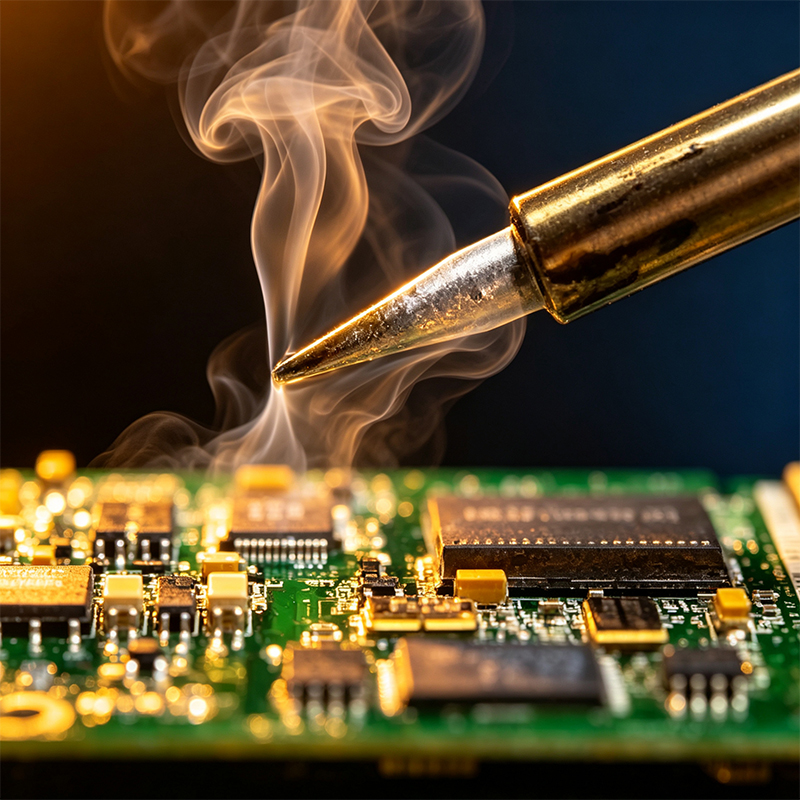
How Does Flux Come? (Forms of Flux)
You’ll find flux in several forms:
Flux-core solder wire – The most common. The solder wire has a hollow core filled with flux. When you melt the solder, the flux releases and cleans the joint. For basic soldering, this is all you need.
Liquid flux – Comes in a bottle with a brush or a needle dispenser. You apply it separately. Great for small SMD work or rework.
Paste flux (gel flux) – Thick, like toothpaste. Stays where you put it. Excellent for surface-mount soldering and drag soldering of IC pins.
Flux pen – A convenient marker-like pen with liquid flux. Good for applying tiny amounts exactly where you need it.
How to Use Flux (The Right Way)
If you’re using flux-core solder:
Just solder normally. The flux comes out automatically when the solder melts. You’ll see a little puff of smoke and maybe a bit of brown liquid. That’s the flux doing its job. No extra steps needed.
If you’re using additional flux (liquid, paste, or pen):
Clean the joint area with alcohol if it’s very dirty.
Apply a small amount of flux to the joint. You don’t need much – a tiny drop or a thin smear.
Heat the joint with your soldering iron. You’ll see the flux bubble and turn brownish.
Feed solder onto the joint (if you’re using separate solder). The solder will flow beautifully.
Clean up if necessary (depending on flux type).
Do You Need Extra Flux if You Use Flux-Core Solder?
Usually not for simple through-hole joints. The flux inside the solder wire is enough. But for difficult joints – like old, corroded metal, big ground planes that suck heat, or surface-mount work – extra flux makes a huge difference.
The Smoke – What Is It?
When flux heats up, it vaporizes and creates smoke. That smoke is mostly rosin or organic chemical vapors. It’s not good to breathe. Always solder in a well-ventilated area, and ideally use a fume extractor or at least a small fan blowing the smoke away from your face.
Some people say rosin smoke is harmless – it’s not. It can cause respiratory irritation over time. Don’t be a hero. Ventilate.
Do You Have to Clean Flux Residue?
It depends on the flux type:
Rosin (R) or RMA – You can leave it or clean it. It won’t hurt the circuit. But it looks ugly and can be sticky. Most hobbyists leave it.
Rosin activated (RA) – Must be cleaned. It can corrode over time.
Water-soluble – Must be cleaned. It’s corrosive and conductive.
No-clean – Can be left. That’s the point.
To clean rosin or no-clean residue, use isopropyl alcohol (90% or higher) and a soft brush (like an old toothbrush). For water-soluble, use hot water and a brush, then dry thoroughly.
A Common Mistake: Too Much Flux
More flux is not always better. If you dump a ton of liquid flux on a joint, it can boil and splatter, leaving a messy residue. It can also cause “flux blow” – tiny balls of solder flying around. A small drop is usually enough.
What Happens If You Don’t Use Flux?
You can solder without extra flux if your solder has a flux core. But if you use bare solder wire (plumbing solder) or if the flux core is old and dried out, you’ll get:
Solder that balls up and won’t stick
Dull, grainy joints
Cold solder joints that fail over time
Lots of frustration
The right amount of flux is the difference between a professional-looking joint and a mess.
Flux vs. Solder Paste – Don’t Confuse Them
Solder paste is a mixture of tiny solder balls and flux. You use it for surface-mount reflow soldering. Flux alone is just the cleaning agent, no metal. So don’t try to use flux to make electrical connections – it won’t work.
A Quick Story: The Day Flux Saved a Repair
A friend was repairing an old guitar amplifier. The solder joints on the tube sockets looked dull and cracked – classic oxidation. He tried to re-solder them with plain flux-core wire, but the solder just sat there like tiny balls on glass. Then he brushed on some liquid rosin flux. The moment he touched the iron, the old solder re-flowed, the new solder wetted beautifully, and the joint looked like new. That’s the power of flux.
How to Store Flux
Flux (especially liquid) can dry out or absorb moisture. Keep it in a sealed container, away from heat and sunlight. If your liquid flux gets thick or stringy, it might be time to replace it.
Final Answer – So, What Is Flux in Soldering?
Flux is a chemical cleaner that removes oxidation, helps solder wet the metal, and prevents new oxidation during heating. It comes inside most solder wire, but you can also buy it separately as liquid, paste, or in a pen. Without flux, soldering is a struggle. With flux, it’s a pleasure.
Next time you solder, take a moment to thank that little puff of smoke. It’s doing the hard work so you don’t have to.

Kaboer manufacturing PCBs since 2009. Professional technology and high-precision Printed Circuit Boards involved in Medical, IOT, UAV, Aviation, Automotive, Aerospace, Industrial Control, Artificial Intelligence, Consumer Electronics etc..


 English



 Wechat
 +86 13670210335
 +86 13670210335
 E-mail