
Date: 2026-06-09
You've seen chips – those little black rectangles on your phone's motherboard, your computer, or inside an LED bulb. But have you ever wondered how the tiny transistors inside the chip actually talk to the outside world? The answer is an extremely thin metal wire, and the process is called wire bonding.
In plain English: it's using a wire thinner than a hair to connect the chip's internal pads to the external pins. Let me walk you through what it is, how it works, and why it's still everywhere – no engineering degree needed.
Imagine a tiny island (the chip) that needs to send messages to the mainland (the circuit board). You can't build a bridge, so you tie a super‑strong, super‑thin rope from the island to the shore. Messages travel along that rope.
That's exactly what wire bonding does. The chip has tiny metal pads on its surface. The outside package or board has matching pads. A machine takes a hair‑thin gold, copper, or aluminum wire and welds it from one pad to the other. Once the wires are attached, electrical signals can flow from the chip to the outside – lighting up your screen, playing music, or sensing your heartbeat.
A human hair is about 75 micrometers (0.075mm) thick. Wire bonding wire is typically 18, 25, or 32 micrometers. That's two to three times thinner than a hair.
And the machine that attaches this wire has to do it in a split second – melting, pressing, pulling, and cutting – without crushing the fragile chip. That machine is called a wire bonder.
There are two common ways to do wire bonding.
Type 1: Ball Bonding (Thermosonic)
This is the most popular method – over 80% of chips use it. It usually uses gold or copper wire. Here's what happens:
The machine melts the tip of the wire with an electric spark to form a tiny ball.
It presses that ball onto the chip's pad using ultrasonic vibration and heat – that's the first bond.
The machine lifts the wire to form a loop.
It presses the other end onto the substrate pad – the second bond.
Then it breaks the wire and starts over.
The whole cycle takes less than 40 milliseconds. One machine can bond 25 wires per second. Your phone's processor and memory chips are all ball‑bonded.
Type 2: Wedge Bonding
Wedge bonding usually uses aluminum wire (sometimes gold). The wire is square, not round. Instead of making a ball, it simply presses the wire onto the pad with ultrasonic energy, forming a "wedge".
The advantages: wedge bonds are smaller, and the wire loop can be much lower. That's great for high‑frequency circuits (like 5G chips) because shorter wires mean less signal loss. The downside? Wedge bonding is slower, and the wire can only feed from one direction.
Wedge bonding is common in power amplifiers, microwave chips, and stacked multi‑chip packages.
No long table – here's the summary:
Gold wire – Most reliable. Doesn't oxidize, easy to bond. Expensive (it's gold). Used in high‑end chips, medical, aerospace.
Copper wire – Cheap, better conductivity than gold. But it oxidizes quickly, so bonding needs a nitrogen‑hydrogen gas shield. Used in consumer electronics (LEDs, power chips).
Aluminum wire – Cheap, works well for wedge bonding. Softer and can break easier. Used in high‑power devices, sensors.
Because gold prices have skyrocketed, many manufacturers have switched to copper or palladium‑coated copper wire.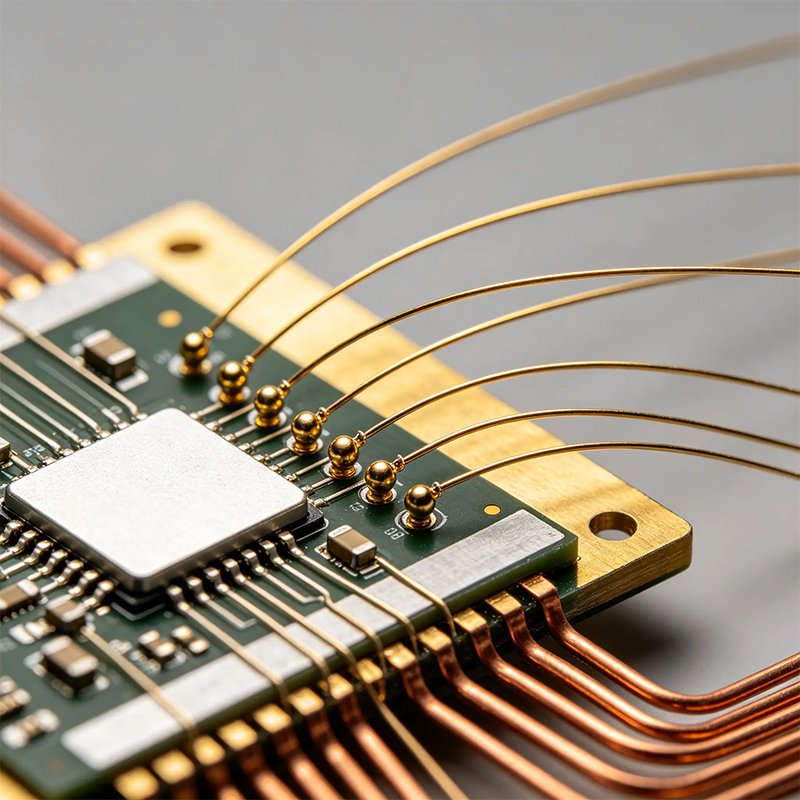
A modern high‑speed wire bonder runs like a sewing machine on caffeine. For ball bonding:
Align – The camera finds the chip pads and substrate pads.
Ball formation – Electric spark melts the wire tip into a ball.
First bond – The ball is pressed onto the chip pad.
Looping – The bond head moves up and across, pulling the wire into a pre‑programmed arc.
Second bond – The wire is pressed onto the substrate pad.
Wire break – The wire is torn, leaving a small tail.
The entire cycle takes less than 40 milliseconds. A typical chip with 200 pads is fully bonded in about 8 seconds.
Phones & computers – CPU, memory, power management ICs – all wire‑bonded.
LED bulbs – The LED chip inside each bulb is wire‑bonded to its metal frame.
Cars – Engine control units, airbag sensors, tire pressure monitors.
Medical devices – Pacemakers, hearing aids, glucose meters (gold wire for reliability).
RF modules – The power amplifier in your phone, WiFi and Bluetooth chips – often wedge‑bonded.
Some people say wire bonding is old, and it will be replaced by "flip chip" or "through‑silicon vias". But the reality is: wire bonding is still the workhorse of chip packaging, used in over 80% of all chips.
Three reasons why it's still here:
Low cost – Mature equipment, stable process, cheap for high volume.
Flexible – Can connect chips of different sizes, heights, and materials.
Good for stacking – You can stack several chips on top of each other and bond wires from different levels to different pads.
Flip chip is used in high‑end CPUs and GPUs, but that's a tiny fraction of all chips. For sensors, power ICs, LEDs, microcontrollers – the chips you use by the billions – wire bonding remains the king.
Wire bonding is the process of using a hair‑thin metal wire to connect a chip's internal pads to the outside world. It comes in two main flavors – ball bonding (gold/copper) and wedge bonding (aluminum). Despite being decades old, it's still alive inside every chip you own.
Next time you crack open an old phone or an LED bulb, take a close look at the black chip. You might see a ring of shiny, ultra‑fine wires around its edges. That's wire bonding at work – thinner than a hair, but holding the whole digital world together.

Kaboer manufacturing PCBs since 2009. Professional technology and high-precision Printed Circuit Boards involved in Medical, IOT, UAV, Aviation, Automotive, Aerospace, Industrial Control, Artificial Intelligence, Consumer Electronics etc..


 English



 Wechat
 +86 13670210335
 +86 13670210335
 E-mail