
Date: 2026-05-07
If you’ve been working with 4-layer boards and started noticing weird signal glitches or EMI "noise" that just won't go away, you’ve hit the limit. Welcome to the world of the 6 layer pcb stackup.
In 2026, where even basic smart home devices are running high-speed data for AI, the 6-layer board has become the industry's "Goldilocks" solution: it’s not as crazy expensive as 12-layer HDI boards, but it offers way more "breathing room" for your signals than a cramped 4-layer design.
Think of a PCB like a multi-story sandwich. A 6 layer pcb stackup adds two extra internal layers to the traditional 4-layer mix. Usually, this means you get four signal routing layers and two internal planes (one for Ground, one for Power).
But here’s the real talk: you can’t just throw layers together and hope for the best. The arrangement is what makes or breaks your product.
The most common way to arrange these layers is:
Top Layer (Signal)
Internal Layer 1 (Ground Plane)
Internal Layer 2 (Signal)
Internal Layer 3 (Signal)
Internal Layer 4 (Power Plane)
Bottom Layer (Signal)
Why this layout? It’s all about the "Shielding." By placing the Ground plane right under the Top signal layer, you’re basically creating a highway with high-quality pavement. It minimizes EMI and keeps your high-speed signals clean.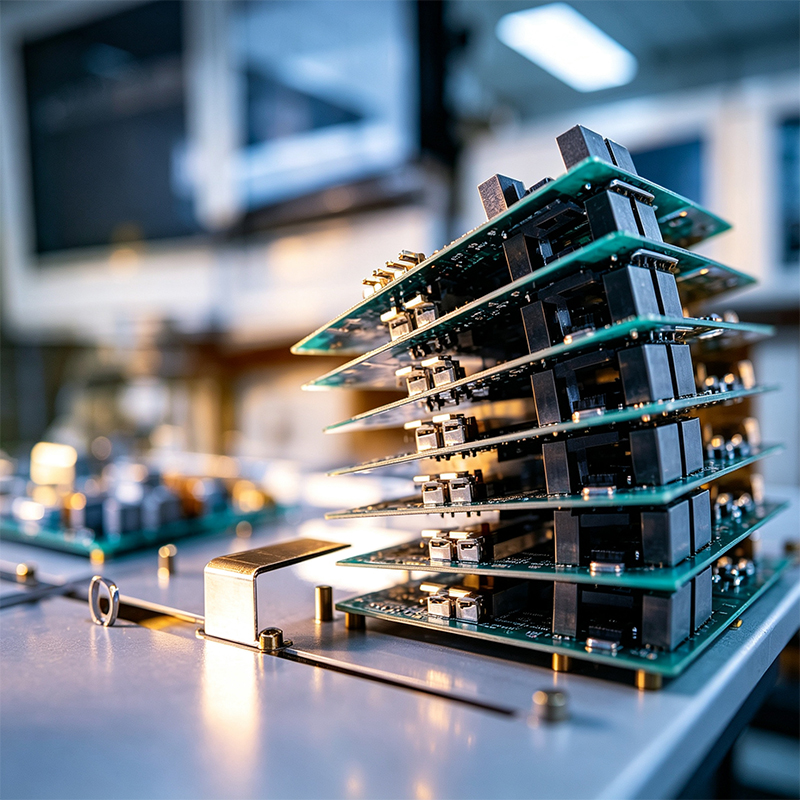
One of the biggest headaches in 2026 hardware is crosstalk—where signals "leak" into each other. In a 6 layer pcb stackup, we have a secret weapon: the orthogonal routing. By routing Layer 3 horizontally and Layer 4 vertically (or vice versa), we minimize the overlap. Combine this with dedicated Ground planes, and you’ve got a board that can handle high-speed USB-C, 5G modules, or even entry-level AI processors without breaking a sweat.
Most people forget that a 6-layer board is a physical object. If you’re designing for a sleek wearable, you have to balance the dielectric thickness between the layers. If the layers are too close, you get heat issues; too far, and your impedance control goes out the window.
A 6 layer pcb stackup is the perfect upgrade when your design gets "crowded." It gives you the space to separate analog from digital, the power to manage heat, and the stability to pass your FCC/CE certifications on the first try.

Kaboer manufacturing PCBs since 2009. Professional technology and high-precision Printed Circuit Boards involved in Medical, IOT, UAV, Aviation, Automotive, Aerospace, Industrial Control, Artificial Intelligence, Consumer Electronics etc..


 English



 Wechat
 +86 13670210335
 +86 13670210335
 E-mail