
Date: 2026-05-07
Imagine you’ve just designed a high-end, complex HDI board or a delicate Rigid-Flex circuit. You’ve spent weeks on the layout. Now, the big question: Does it actually work? Before you commit to a massive production run, you need to be 100% sure there are no hidden shorts or open circuits.
In the old days, you’d have to build a "Bed of Nails" (a custom test fixture) just to check the board. It was expensive, slow, and a nightmare if you decided to change the design. Enter Flying Probe Testing (FPT)—the agile, high-tech solution that has changed the game for electronic manufacturers worldwide.
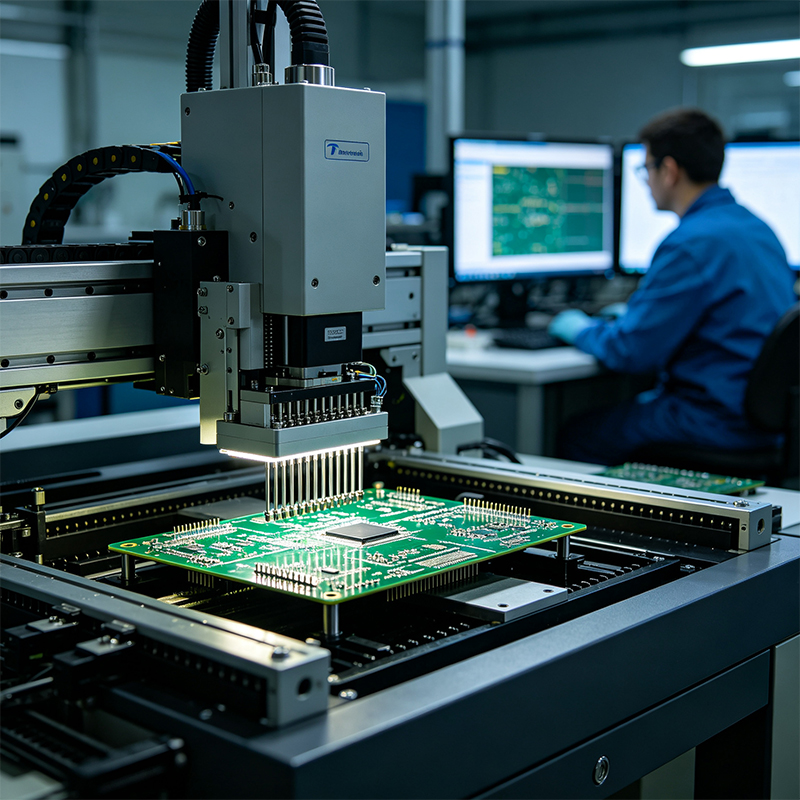
Think of it like a group of highly coordinated, robotic "needles" performing a high-speed dance on your circuit board. Unlike traditional testing that uses a static bed of pins, a flying probe tester uses 4 to 8 independent probes that move (or "fly") across the board at lightning speed.
These probes touch specific test points, vias, and component pads based on your software instructions. They measure resistance, capacitance, inductance, and even check for shorts or opens—all without needing a single custom fixture.
If you are an engineer working on a custom Flex PCB or a small run of prototypes, flying probe testing is your best friend. Here’s why:
Zero Fixture Costs: You don't need to spend $3,000 on a test jig that only works for one specific design. FPT is all software-driven.
Flexibility (Literally): Changed your mind and moved a resistor? No problem. Just update the software, and the probes will adapt instantly.
Precision for HDI: As components get smaller (looking at you, 01005s), traditional pins are too bulky. Flying probes can hit tiny targets that a "Bed of Nails" simply can't reach.
Let’s be candid—nothing is perfect. Because the probes have to physically travel from point A to point B, FPT is slower than a bed-of-nails tester that hits all points at once.
The Verdict: If you’re making 10,000 identical simple boards, FPT might not be the most efficient. But if you’re doing high-complexity, low-to-medium volume work (like medical devices or aerospace electronics), it is the gold standard.
Think of ICT (In-Circuit Test) as a massive, high-speed printing press—great for high volume but expensive to set up. Think of Flying Probe Testing as a high-end 3D printer—versatile, precise, and perfect for iterative designs. For most modern, high-density PCBA projects, the lack of setup time makes FPT the winner for speed-to-market.
At the end of the day, quality control shouldn't be a bottleneck. Whether you are dealing with a high-frequency HDI board or a multilayer rigid-flex assembly, flying probe testing ensures that your "brainchild" works exactly as intended before it ever reaches your customer.

Kaboer manufacturing PCBs since 2009. Professional technology and high-precision Printed Circuit Boards involved in Medical, IOT, UAV, Aviation, Automotive, Aerospace, Industrial Control, Artificial Intelligence, Consumer Electronics etc..


 English



 Wechat
 +86 13670210335
 +86 13670210335
 E-mail