
Date: 2026-05-29
Every time you press the power button on your remote, set the temperature, or switch modes, you rely on a small but mighty air conditioner circuit board. It’s the brain inside your AC unit that controls everything – from the compressor and fan to the temperature sensors and display.
If you’re a manufacturer of air conditioners, or you’re building custom cooling systems, you know that the circuit board is the most critical component. A poorly designed or unreliable board means unhappy customers and expensive warranty returns.
Let’s break down what an air conditioner circuit board does, the different types available, common problems, and what to look for when sourcing these boards for your products.
What Is an Air Conditioner Circuit Board?
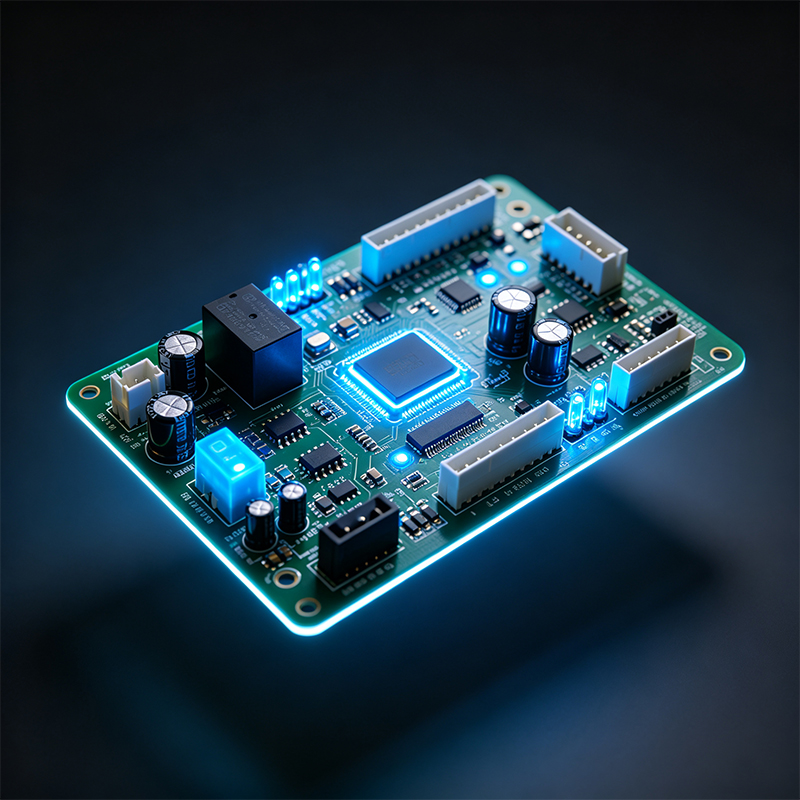
An air conditioner circuit board (often called the AC control board or PCB) is a printed circuit board that manages the operation of an air conditioning unit. It receives input from the remote control, wall thermostat, or onboard buttons, processes that information, and then sends commands to the compressor, fan motor, louver movement, and other components.
In simple terms: it’s the brain that tells every other part what to do and when to do it.
What Does an AC Control Board Do?
The main functions of an AC circuit board include:
Receive user input – From the remote control, control panel, or thermostat.
Read sensors – Room temperature, evaporator temperature, condenser temperature, and sometimes humidity or air quality sensors.
Control the compressor – Turns it on and off based on cooling demand. In inverter ACs, it also controls the compressor speed.
Control fans – Indoor fan speed (low, medium, high, auto) and outdoor fan operation.
Drive the louver motor – Moves the horizontal and vertical air direction vanes.
Display status – Shows set temperature, current mode, error codes, and other information on an LED or LCD screen.
Protect the system – Monitors for abnormal conditions (overcurrent, overheat, sensor failure) and shuts down or displays error codes before damage occurs.
Communication – In multi‑split or centralized systems, the board communicates with other indoor units and the outdoor unit.
Types of AC Circuit Boards
Not all air conditioner PCBs are the same. Here are the common types you’ll encounter:
1. Main Control Board (Motherboard) – The primary board that contains the microcontroller (CPU), sensor inputs, and outputs for relays. Found in every AC unit – window units, split systems, portable ACs, and central air handlers.
2. Display Board – A smaller board that mounts behind the front panel. It has LEDs, a screen, and touch or button inputs. Connected to the main board by a cable (often a flexible FPC).
3. Inverter Control Board – Found in inverter air conditioners (variable speed). This board uses a more complex design with power transistors (IGBTs), a rectifier, and a microcontroller to vary the compressor and fan speeds. These boards operate at high voltages and generate significant heat. Many inverter boards use aluminum‑core PCBs or thicker copper to dissipate heat.
4. Remote Control Board – The handheld remote itself contains a small PCB with an IR LED, buttons, and a small microcontroller. This is a low‑power, low‑cost board.
5. Wi‑Fi / Smart Module – A small board that adds wireless connectivity (2.4GHz Wi‑Fi, sometimes Bluetooth). Allows users to control the AC from a smartphone app, via voice assistant (Alexa, Google Home), or on a schedule. Often sold as an add‑on.
6. Power Supply Board – In some designs, the power supply is on a separate board, especially in larger systems. It converts mains AC (110‑240V) to the low voltages (5V, 12V) needed by the control circuitry.
Why Quality Matters: Common PCB Failures in Air Conditioners
Air conditioners operate in tough environments: high heat, humidity, voltage fluctuations, and sometimes dust or insects. Here are the most common failures:
Burnt relays – The relay that switches the compressor on and off handles high current. Over time, the contacts can weld shut or burn open.
Capacitor failure – Electrolytic capacitors on the power supply dry out, causing erratic behavior or complete failure.
Cracked solder joints – Vibration from the compressor and fans can crack solder joints, especially on large components like relays and transformers.
Corrosion – In humid or coastal environments, copper traces can corrode. Conformal coating helps prevent this.
Sensor failure – The thermistor (temperature sensor) itself fails or develops poor connection at the connector.
Inverter IGBT failure – In inverter boards, the power transistors can overheat and short, often causing visible burn marks.
What to Look for in a Quality AC Circuit Board
If you’re sourcing PCBs for your air conditioner products, here’s what to prioritize:
1. Reliable design – Use proper trace widths for current‑carrying paths. Include protection circuits (fuses, varistors, TVS diodes). Separate high‑voltage and low‑voltage sections.
2. High‑quality components – Use automotive‑grade or industrial‑grade capacitors and relays, not the cheapest consumer parts. Use relays rated for the full compressor current with margin.
3. Conformal coating – This thin protective layer prevents corrosion from humidity. For outdoor units or coastal installations, it’s essential.
4. Robust connectors – FPC connectors, terminal blocks, and wire‑to‑board connectors must withstand vibration. Use locking types when possible.
5. Thermal management – For inverter boards, use aluminum‑core PCBs or thermal vias to pull heat away from power components. Add heatsinks where needed.
6. Flexible options – If your design requires space‑saving connections, consider using flexible PCBs or rigid‑flex boards for the display or sensor interfaces.
Where Do Flexible and Rigid‑Flex PCBs Fit in Air Conditioners?
You might think air conditioners only use rigid boards. That’s mostly true for the main control board. But there are places where flexible or rigid‑flex PCBs are very useful:
Display panels – The board behind the front panel often needs to fit into a curved or tight space. A flexible PCB with an FPC connector to the main board works perfectly.
Louver motor connections – The small motor that moves the air vanes can be connected via a flexible tail instead of a bundle of wires.
Sensor connections – Temperature sensors mounted in remote locations (like the evaporator fins) can use small flexible circuits.
Foldable or portable AC designs – Some portable or window units have folding control panels. Rigid‑flex boards allow the circuit to bend at the hinge.
As a manufacturer of custom flexible and rigid‑flex PCBs, we see growing demand from AC manufacturers who want thinner, lighter, and more reliable internal connections.
PCBA (Assembly) – Why It Matters
A bare PCB is just half the story. The board needs components soldered on, tested, and shipped ready to install. That’s where PCBA (printed circuit board assembly) comes in. When sourcing from a PCBA provider, look for:
SMT and through‑hole capability – AC boards often have a mix of fine‑pitch SMD chips and large through‑hole relays and capacitors.
In‑circuit test (ICT) – Probes verify each component’s value and connection.
Functional test – The assembled board is powered up and tested in a simulated AC environment (with dummy loads for compressor and fans).
Conformal coating application – Spray or dip coating to protect against humidity.
A Real‑World Example: Inverter AC Board Redesign
A customer was manufacturing inverter air conditioners for the Southeast Asian market. Their existing inverter board used a standard FR4 PCB with 2oz copper. Under high load, the IGBTs overheated and the board failed after 18 months. We redesigned the board using an aluminum‑core PCB (better heat spreading) and added thermal vias under the power components. We also upgraded the electrolytic capacitors to high‑temperature (125°C) rated parts. The failure rate dropped to near zero. The customer also switched to our PCBA service, so they received fully assembled, tested boards ready to install.
What We Offer – Custom Circuit Boards for Air Conditioners
We’re a custom circuit board manufacturer that specializes in exactly the technologies AC manufacturers need:
Rigid PCBs – Standard FR4, aluminum‑core (for inverter boards), high‑Tg for high‑temperature environments.
Flexible PCBs – For display panels, sensor tails, and tight spaces.
Rigid‑flex boards – Combines rigid and flexible sections in one board, ideal for foldable control panels or moving parts.
HDI high‑frequency boards – For Wi‑Fi modules and wireless communication (2.4GHz, 5GHz).
PCBA – Full assembly, testing, and conformal coating. We source the components, solder them, test every board, and ship ready‑to‑install assemblies.
Here’s how we help AC manufacturers:
Design review – We check your schematic and layout for AC‑specific issues (clearance, creepage, thermal management, relay driving).
Prototyping – Fast turnaround (7‑10 days for rigid, 10‑15 days for flex or rigid‑flex) so you can test real boards in your units.
Volume production – Competitive pricing for large batches.
Quality and testing – 100% electrical test + functional test (per your specifications) + conformal coating.
Ready to Upgrade Your AC Circuit Boards?
If you’re manufacturing air conditioners – window units, split systems, portable ACs, or central air handlers – we can build the circuit boards that make them work. Send us your design files or just a rough specification. We’ll recommend the best board type (rigid, aluminum‑core, flexible, rigid‑flex, or HDI) and provide a clear quote and timeline.
We also offer PCBA assembly, so you receive ready‑to‑install boards – no need to source components or manage assembly elsewhere.

Kaboer manufacturing PCBs since 2009. Professional technology and high-precision Printed Circuit Boards involved in Medical, IOT, UAV, Aviation, Automotive, Aerospace, Industrial Control, Artificial Intelligence, Consumer Electronics etc..


 English



 Wechat
 +86 13670210335
 +86 13670210335
 E-mail