
Date: 2026-04-14
Have you ever wondered how your smartphone stays so thin while being faster than a laptop from five years ago? A huge part of that magic comes down to the BGA package (Ball Grid Array). If the CPU is the brain of your device, the BGA is the nervous system that connects it to everything else with insane precision.
But what makes it so special, and why is it a bit of a "diva" during the manufacturing process? Let’s break it down in plain English.
In the old days, chips had tiny "legs" (pins) sticking out of the sides, like a centipede. These are called QFP or SOP packages. The problem? As chips got more powerful, they needed more legs. If you keep adding legs to the sides, the chip becomes massive.
The BGA package fixed this by moving the connections to the bottom. Instead of pins, it uses tiny solder balls arranged in a grid. This allows for hundreds, even thousands of connections in a tiny space. It’s like moving from a one-story sprawling house to a high-rise apartment complex—you fit way more "residents" in the same footprint.
Not all BGAs are created equal. Depending on your project, you might see:
PBGA (Plastic BGA): The all-rounder. It’s cost-effective and great for things like home routers.
CBGA (Ceramic BGA): The heavy-duty version. Used in space or high-end servers because ceramic handles extreme heat without warping.
Micro-BGA: The tiny ones found in smartwatches and phones where every millimeter of space is a luxury.
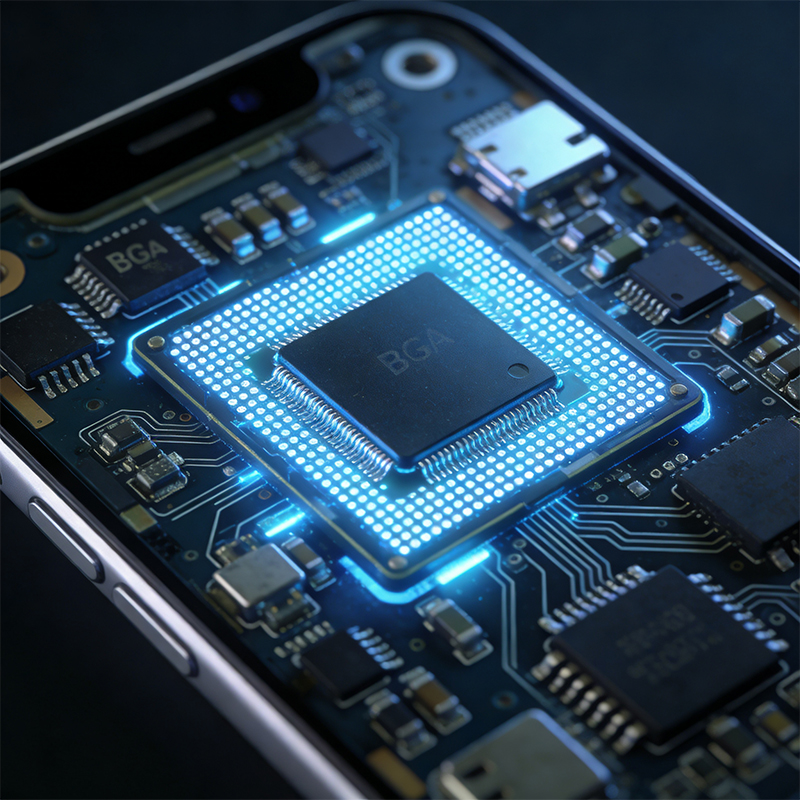
Why do engineers love BGA? First, Signal Integrity. Because the balls are directly under the chip, the path the electricity has to travel is much shorter than going through a long pin. This means less noise and faster speeds. Second, Heat Dissipation. Heat is the enemy of electronics. The BGA package allows heat to flow more efficiently from the chip into the PCB, preventing your device from turning into a hand warmer.
Here’s the catch: because the connections are under the chip, you can’t see them with your eyes once they are soldered. How do you know if there’s a circuit shorting or a "cold joint"?
You can't. That’s why in our PCBA facility, we use 3D X-Ray inspection. We literally look through the chip to see those tiny balls. If one ball is slightly off, the whole device might fail. This is why BGA assembly requires a high-end manufacturer with specialized reflow ovens that control temperature within a tiny margin.
If you’re designing a high-speed HDI (High Density Interconnect) board, BGA is your best friend. It allows for "via-in-pad" technology, where we drill holes directly into the BGA pads to save space.
Also, we’re seeing more Rigid-Flex designs using BGAs. Imagine a flexible board that folds inside a medical device, with a BGA-mounted chip at the center. It’s complex, it’s beautiful, and it requires a manufacturer who knows how to handle the "expansion and contraction" of different materials during soldering.
The BGA package is the cornerstone of modern, high-speed hardware. It’s compact, fast, and stays cool under pressure. However, it’s not something you want to "DIY" or leave to a budget shop. Success with BGA is 50% design and 50% manufacturing precision.

Kaboer manufacturing PCBs since 2009. Professional technology and high-precision Printed Circuit Boards involved in Medical, IOT, UAV, Aviation, Automotive, Aerospace, Industrial Control, Artificial Intelligence, Consumer Electronics etc..


 English



 Wechat
 +86 13670210335
 +86 13670210335
 E-mail