
Date: 2026-04-14
If you’ve ever cracked open a TV or a smartphone, you’ve seen that green (or blue, or black) board inside. That’s the PCB. But how do you design printed circuits that actually work? It’s not just about drawing lines; it’s about urban planning for electrons.
In this guide, we’ll walk through the process as if we’re building a miniature city.
Before you touch a single piece of copper, you need a plan. In the electronics world, this is the Schematic. Think of it as a logical map. It doesn't show where the parts live, but it shows who is talking to whom. If you miss a connection here, no amount of fancy layout work will save your board later.
Pro Tip: Always label your nets! "Net1" and "Net2" are recipes for disaster when you're troubleshooting at 2 AM.
Now comes the "Design Printed Circuit" phase that everyone visualizes: placing the components. This is pure urban planning. You don't want the noisy "industrial district" (the power supply) right next to the quiet "residential area" (the sensitive sensors).
Components need room to breathe. If you pack them too tightly, they might overheat or be impossible to solder. It's a balance of physics and aesthetics.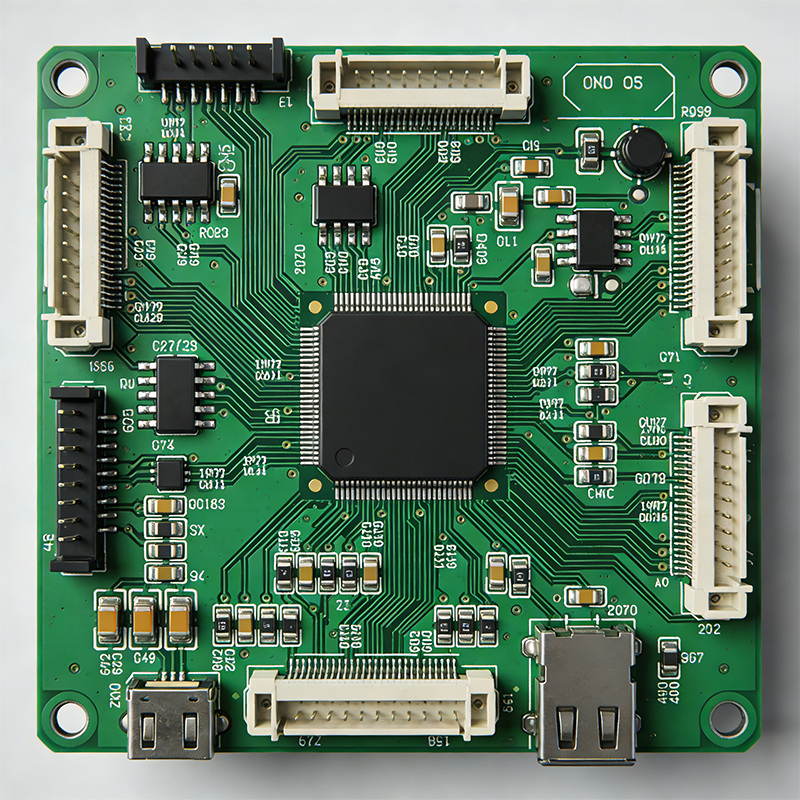
Once the components are placed, you have to connect them. These are the Traces.
Power Traces: Like multi-lane highways, they need to be wide to carry a lot of current.
Signal Traces: Like small backstreets, they can be thin, but they are sensitive to "noise" from the highways.
A common mistake? Sharp 90-degree turns. In high-speed designs, electrons hate sharp corners; they prefer smooth 45-degree angles or curves.
Most modern boards aren't just one layer. They are like a club sandwich. You have the top layer for parts, internal layers for ground and power (which act as a shield), and a bottom layer for more connections. Designing the Stack-up correctly is the secret to passing EMI (Electromagnetic Interference) tests.
"Design for Manufacturing" (DFM) is the difference between a hobby project and a professional product. You might design the perfect circuit, but if a robotic arm can’t pick up the parts, or if the drill bit is too small to make the holes, your board will never be built.
Always check your "Clearances." Give your manufacturer a little wiggle room, and they will reward you with a board that actually works the first time.

Kaboer manufacturing PCBs since 2009. Professional technology and high-precision Printed Circuit Boards involved in Medical, IOT, UAV, Aviation, Automotive, Aerospace, Industrial Control, Artificial Intelligence, Consumer Electronics etc..


 English



 Wechat
 +86 13670210335
 +86 13670210335
 E-mail