
Date: 2026-05-15
You've just bought a new laptop. You take it out of the box, turn it on, and… nothing. Dead on arrival. Or worse, it works for a week and then stops. That's the kind of failure every manufacturer fears.
That's where a burn-in tester comes in. It's like a stress test for electronics – a way to catch the weak ones before they ever reach your hands.
Let's break down what a burn-in tester is, how it works, and why it's a standard part of making reliable electronics.
What Is a Burn-In Tester?
A burn-in tester is a machine that runs electronic components or completed circuit boards at high stress levels – usually elevated temperature and sometimes higher voltage – for a period of time. The goal is to force early failures to happen in the factory, not in the field.
Think of it like this: if a product is going to fail early due to a manufacturing defect, it will usually fail within the first few hundred hours of use. That's the "infant mortality" phase of the bathtub curve. By running the product under stress for a short period (often 24 to 168 hours), you accelerate that aging process. The weak ones die in the tester. The survivors are much more likely to last.
The Bathtub Curve – Why Burn-In Works
Electronics follow a pattern called the bathtub curve. It has three stages:
Early life (infant mortality) – A small number of units fail quickly due to manufacturing defects, weak solder joints, or bad components.
Normal life – After the initial failures, the failure rate drops to a low, steady level. This is the useful life of the product.
Wear-out – After many years, components start to wear out and failures increase again.
Burn-in testing is designed to push units through the early life stage while they're still in the factory. You eliminate the weak ones before shipping. The customer receives a product that's already past its risky early period.
How Does a Burn-In Tester Work?
A basic burn-in tester is essentially an oven with electronic monitoring. Here's what typically happens:
Loading – The boards or components are placed into test sockets or connected to interface boards inside the chamber.
Stressing – The chamber heats up to a set temperature (often 85°C to 125°C). Power is applied, and sometimes signals are cycled.
Monitoring – Sensors track each unit's performance. If a unit fails, the tester logs it.
Duration – The test runs for a specified time, typically 24, 48, 96, or 168 hours.
Completion – Units that survive are considered "burned in" and ready for final test or shipping.
Some advanced burn-in testers also add voltage stress (slightly higher than normal) and temperature cycling (hot to cold and back) to catch a wider range of defects.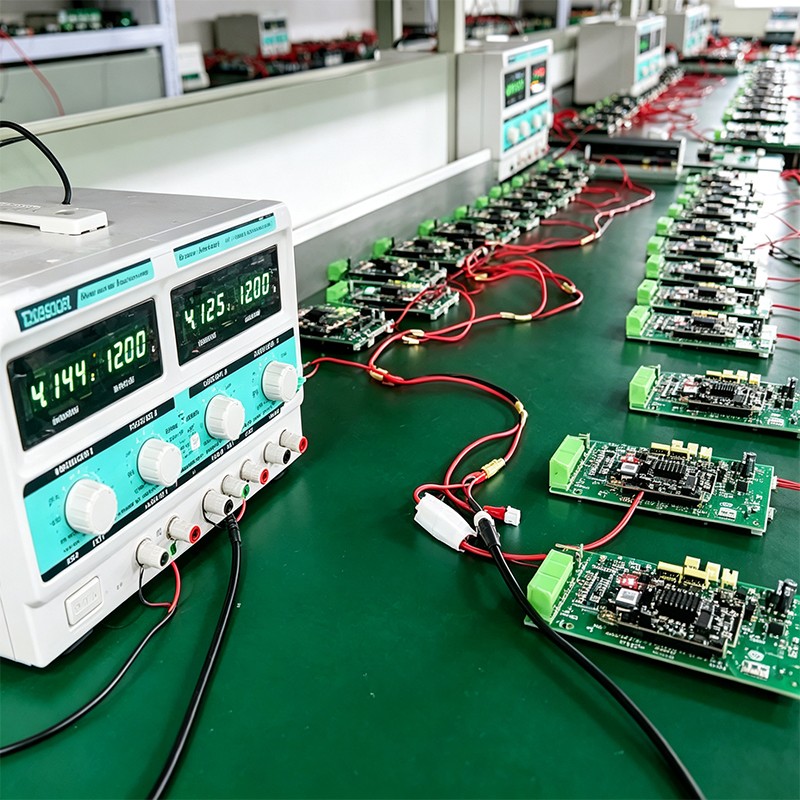
What Defects Does Burn-In Catch?
Burn-in testing is particularly good at finding:
Weak solder joints – A joint that looks fine under a microscope but has a micro-crack will often fail under thermal stress.
Semiconductor defects – Chips with contamination or process flaws can fail during burn-in.
Early life failures in capacitors and other passive components – Bad capacitors often die early.
Thermal issues – A component that overheats under normal load will reveal itself during high-temperature burn-in.
Intermittent faults – Problems that come and go (like a loose connection) are more likely to show up under stress.
What a Burn-In Tester Can't Catch
No test is perfect. Burn-in testing is not designed to find:
Design flaws – If the circuit is poorly designed, burn-in won't fix it. That's a design problem, not a manufacturing defect.
Software bugs – Burn-in tests run hardware, not software logic.
Long-term wear-out – Burn-in is meant to catch early failures, not to simulate 10 years of use.
Who Uses Burn-In Testers?
Burn-in testing is common in industries where reliability is critical:
Military and aerospace – A fighter jet's flight computer cannot fail mid-flight.
Medical devices – Life-support equipment has zero tolerance for early failure.
Automotive electronics – Engine control modules, ABS systems, and ADAS sensors must survive years of heat and vibration.
Telecom infrastructure – Base stations and network switches run 24/7 for years.
Data center servers – A server that fails early in a data center causes downtime and costs money.
High-end consumer electronics – Some premium brands use burn-in to ensure quality.
For cheap consumer products like a $10 calculator, burn-in is usually skipped. It adds cost, and the expectation is lower.
Burn-In for Bare Boards vs. Assembled Boards
Burn-in can be done at different stages:
Component burn-in – Individual chips (like microcontrollers or memory) are burned in before being soldered onto a board. This is common for high-reliability components.
PCB assembly burn-in – The entire board, with all components soldered, is burned in. This catches assembly defects like bad solder joints.
System burn-in – The complete product (e.g., a power supply or a server) is burned in.
Most manufacturers of custom PCBs and PCBA use board-level burn-in to verify assembly quality before shipping.
Burn-In vs. Other Types of Testing
People often confuse burn-in with other tests. Here's how they differ:
| Test Type | What It Does | Duration | Found |
|---|---|---|---|
| Burn-in | Runs at stress (heat, voltage) to fail weak units early | 24–168 hours | Infant mortality defects |
| Temperature cycling | Cycles between hot and cold to check for thermal expansion failures | Hours to days | Solder joint cracks, material mismatches |
| Highly accelerated life test (HALT) | Extreme stress (heat, cold, vibration, humidity) to find design weaknesses | Hours | Design margins |
| Functional test | Checks if the board works correctly at normal conditions | Minutes | Functional defects |
| In-circuit test (ICT) | Probes each component to verify placement and values | Seconds to minutes | Solder bridges, missing components |
What Happens to the Failed Units?
Units that fail during burn-in are typically marked and discarded. Some manufacturers will analyze the failure to improve their process – if multiple units fail the same way, it might indicate a recurring problem with a component or a soldering step.
Failed units generally do not go back to the customer. That's the whole point – catch them before shipment.
Do You Really Need Burn-In?
It depends on your product. Ask yourself:
What's the cost of a field failure? – If a failure means a recall, a lawsuit, or a damaged reputation, burn-in is cheap insurance.
What's your volume? – Burn-in adds time and cost. For high-volume, low-cost products, it might not make sense.
What's your reliability target? – If you need 99.9% reliability for the first year, burn-in helps you get there.
For custom boards going into industrial equipment, automotive, or medical devices, burn-in is often required by industry standards.
A Real-World Example – Server Motherboards
A company manufacturing server motherboards found that about 1% of their boards failed within the first three months of use. Most of those failures were from weak solder joints under large BGAs. They added a 48-hour burn-in at 85°C to their process. After burn-in, the early failure rate dropped to 0.1%. The cost of burn-in was far less than the cost of sending technicians to replace boards in live data centers.
What About Flexible PCBs and Rigid-Flex?
Burn-in works for flexible and rigid-flex boards too. But there's a catch – the flex material can warp under heat if not properly supported. For flex boards, burn-in fixtures must hold the board flat to prevent warping that could damage traces or solder joints. We use custom fixtures for flex and rigid-flex burn-in to ensure the stress is applied to the solder joints, not the flexible material.
Can You Do Burn-In at Home?
For hobbyists, not really. Professional burn-in chambers cost thousands of dollars and require precise temperature control. You could rig up an old oven with a temperature controller, but you'd lack proper monitoring and safety features. For serious electronics manufacturing, leave burn-in to the professionals.
Myths About Burn-In
"Burn-in fixes weak products." – No, it just identifies them. The weak ones still fail – you just catch them before shipping.
"Burn-in shortens product life." – Not in any meaningful way. The stress is within the component's rated limits.
"All electronics need burn-in." – Only high-reliability applications. For a toaster or a toy, skip it.
Final Answer – What Is a Burn-In Tester?
A burn-in tester is a machine that runs electronic components or assembled circuit boards under elevated temperature (and sometimes voltage) for a set period to force early failures to happen in the factory. It catches infant mortality defects like weak solder joints and bad components before products reach customers. Burn-in is common in military, medical, automotive, and data center applications where reliability is critical.
If you're designing a product that needs to be reliable – something that can't fail early without serious consequences – burn-in testing is a standard part of the manufacturing process.
Now you know why some products cost more – part of that cost is the hidden torture test that ensures they won't die on you next week.

Kaboer manufacturing PCBs since 2009. Professional technology and high-precision Printed Circuit Boards involved in Medical, IOT, UAV, Aviation, Automotive, Aerospace, Industrial Control, Artificial Intelligence, Consumer Electronics etc..


 English



 Wechat
 +86 13670210335
 +86 13670210335
 E-mail