
Date: 2026-05-13
You’ve probably seen those little black blobs on a circuit board. No wires, no plastic package – just a dark, shiny lump of epoxy sitting directly on the board. That’s not a mistake. That’s Chip on Board, or COB.
Let’s talk about this mysterious black blob – what it is, how it works, why manufacturers use it, and why you might want to avoid it (or love it) in your own projects.
What Is Chip on Board (COB)?
Chip on Board is a manufacturing technique where a bare silicon chip (also called a “die”) is glued directly onto a circuit board, wired up with tiny gold wires, and then covered with a drop of black epoxy. That epoxy blob protects the fragile chip and its delicate wires.
In plain English: instead of buying a chip in a plastic package with metal legs (like a typical DIP or SOIC chip), you take the raw silicon die and stick it straight to the board. Then you connect it to the board with hair-thin gold wires, and finally, you pour a protective blob over everything.
Why Would Anyone Skip the Plastic Package?
Good question. Chip packages (the black plastic things with legs) are convenient, but they add cost and size. The plastic body, the metal lead frame, and the assembly all cost money. With COB, you eliminate the package entirely. The raw die is cheaper, and the whole process can be automated very quickly.
The result: lower cost, smaller size, and sometimes better electrical performance (because the wires are extremely short).
How Is COB Made? Step by Step
Let’s walk through the process.
Die attach – A tiny drop of epoxy or solder paste is placed on the PCB. A machine picks the bare silicon die and places it onto that glue. Then the glue is cured (hardened) to hold the die firmly.
Wire bonding – This is the magic step. A machine uses a fine gold or aluminum wire (thinner than a human hair) and a combination of heat, pressure, and ultrasound to weld one end of the wire to a pad on the silicon die, and the other end to a copper pad on the PCB. This is done for every connection (power, ground, data lines). The wires form tiny loops.
Glob top – After all wires are bonded, a drop of black epoxy is dispensed over the chip and wires. The epoxy flows around everything, covering and protecting them. Then it’s cured into a hard, black dome – the “blob” you see.
Testing – The board is tested to make sure the COB works.
That’s it. The whole thing happens in seconds on automated machines.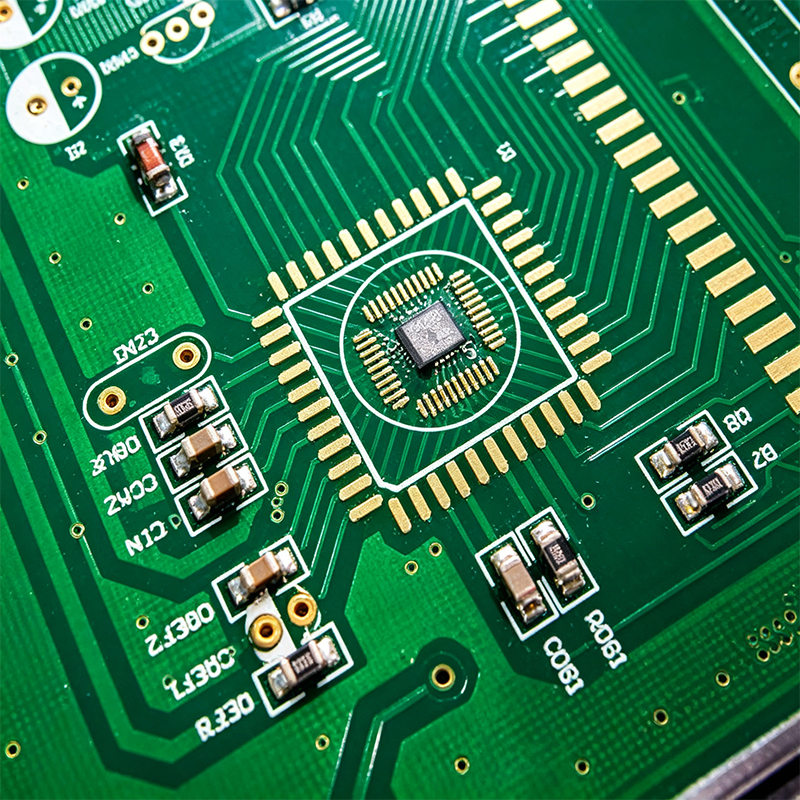
Where Do You Find COB?
Honestly, all over the place. If you open cheap electronic devices, you’ll see COB blobs everywhere.
Calculator – The main brain is almost always a COB blob.
Talking greeting card – The voice chip is a blob.
LED light strip – Many cheap LED strips use COB for the driver chip.
Toy with sound or lights – Often a blob.
Digital watch – Some use COB.
Remote control – Sometimes the encoder chip is a blob.
USB flash drive – The controller chip can be a blob (though less common now).
Basically, any product where price is king and you don’t need to replace the chip uses COB.
Why Do Manufacturers Love COB?
Low cost – No plastic package, no metal leads, less assembly labor. Can be 30-50% cheaper than packaged chips.
Small size – The die is tiny, and the blob adds very little height. Great for slim products like calculators or smart cards.
Good for high volume – Automated machines can bond hundreds of chips per hour.
Protection – The epoxy glob top seals the chip from moisture, dust, and light.
Tamper resistance – It’s hard to probe or reverse-engineer a blob without destroying it.
What Are the Downsides of COB?
Of course, there are trade-offs.
Not repairable – Once the blob is on, you can’t replace the chip. If the chip fails, you throw away the whole board (or the whole product).
Poor heat dissipation – The epoxy blob traps heat. For chips that run hot, COB is a bad idea.
Limited to simple chips – Very complex or high-speed chips often need better thermal and electrical environment than a blob can provide.
Messy rework – If you need to change a design, you can’t just swap the chip. You redesign the board.
Lower reliability in harsh conditions – While fine for consumer toys, COB may not meet automotive or medical reliability standards.
COB vs. Traditional Chip Packaging – A Quick Comparison
| Feature | COB (Chip on Board) | Packaged Chip (DIP, SOIC, QFP, etc.) |
|---|---|---|
| Cost | Very low | Higher |
| Size | Very small (die + blob) | Larger (package + leads) |
| Repairability | None – blob must be destroyed | Replaceable |
| Heat dissipation | Poor (epoxy is an insulator) | Better (package can have metal pad or heatsink) |
| Protection | Good (sealed from environment) | Moderate (package protects but not sealed) |
| Best for | High-volume, low-cost, disposable products | Prototypes, repairs, high-performance, harsh environments |
What About LEDs? COB LED is Different
You’ve heard of “COB LED” – those bright, flat light panels with many tiny yellow squares. That’s Chip on Board too, but for LEDs. Instead of one silicon chip, a COB LED has many LED chips mounted directly on a substrate and covered with phosphor. Same idea: no individual packages, just chips glued and wired, then covered with a protective layer.
COB LEDs are popular because they give a uniform light without multiple shadows, and they’re very bright for their size.
Is COB Only for Cheap Products?
Not always. Some specialized applications use COB for performance reasons:
High-frequency circuits – Extremely short wires reduce inductance, which is good for RF.
Miniature medical sensors – Size is critical.
Smart cards / SIM cards – The chip is embedded directly into the plastic card using a COB-like process.
But 90% of COB you’ll see is in cheap consumer goods.
Can You Repair a COB Blob?
Typically, no. If you suspect the blob is faulty, you can try to dissolve the epoxy with chemicals (like fuming nitric acid – dangerous!) or grind it away carefully. Then you’d see the tiny die and gold wires. But repairing it is next to impossible without specialized wire bonding equipment. For most people, a dead COB means a dead product.
How to Identify COB on a Board
Look for a black, shiny, rounded dome. Sometimes it’s a dark gray, sometimes it’s a rectangular shape if the epoxy didn’t flow evenly. It’s usually about 5-15mm across. You won’t see any pins or markings – just a blob.
A Quick Story: The Calculator That Lasted 20 Years
My first calculator from elementary school had a COB blob as its brain. It survived being dropped, stuffed in backpacks, and left in hot cars. After 20 years, it still works. That’s the thing – COB isn’t “bad” quality. For many low-power, non-harsh applications, it’s perfectly reliable. But if the blob died, there would be no fixing it. I’d just buy another $5 calculator.
When Should You NOT Use COB?
If you ever need to replace the chip – Repairs or upgrades are impossible.
If the chip gets hot – The epoxy blob traps heat and can shorten chip life.
If the board sees extreme temperatures or vibration – The gold wires can break, or the epoxy can crack.
If you’re prototyping – COB requires custom tooling and high volumes to make sense. For small runs, use packaged chips.
Is COB the Same as “Underfill”?
No. Underfill is a different process: a chip in a package (like a BGA) is soldered to the board, then a special epoxy is wicked under the chip to strengthen the solder joints. COB has no package at all. Different techniques for different needs.
Final Answer – What Is Chip on Board?
Chip on Board (COB) is a method where a bare silicon die is glued directly to a PCB, connected with gold wires, and covered with a protective black epoxy blob. It’s cheap, small, and great for high-volume consumer products like calculators, toys, and greeting cards. But it’s not repairable, handles heat poorly, and isn’t suitable for high-performance or harsh applications.
Next time you peel open a cheap electronic device and see that little black lump, you’ll know exactly what it is – and why it’s there.

Kaboer manufacturing PCBs since 2009. Professional technology and high-precision Printed Circuit Boards involved in Medical, IOT, UAV, Aviation, Automotive, Aerospace, Industrial Control, Artificial Intelligence, Consumer Electronics etc..


 English



 Wechat
 +86 13670210335
 +86 13670210335
 E-mail