
Date: 2026-02-05
Have you ever wondered how all those tiny, intricate components on a circuit board—the ones in your phone, laptop, or car—are actually attached? It’s not by hand with a tiny soldering iron. The real magic, the process that brings a bare board to life, is called reflow soldering. Think of it as the essential “baking” step in electronics manufacturing, where a precisely controlled oven melts solder to create permanent, reliable electrical connections. For anyone designing or building electronic devices, understanding reflow isn’t just technical jargon; it’s key to ensuring your product works perfectly every time.
Reflow soldering is the star act in a larger show called Surface Mount Technology (SMT). SMT is how almost all modern electronics are assembled, allowing components to be placed directly onto the board’s surface.
Here’s how the simple “dance” works:
Solder Paste Printing: First, a stencil is placed over the board, and a special, sticky mixture called solder paste (tiny balls of solder suspended in flux) is spread over the pads where components will sit.
Component Placement: A high-speed machine, like a robotic pick-and-place, then accurately positions all the surface-mount components onto the paste.
The Reflow Process: This is where the magic happens. The loaded board travels on a conveyor through a multi-zone reflow oven, undergoing a precise temperature journey.
Inspection & Cleaning: After cooling, the board is inspected and cleaned, resulting in a fully assembled PCBA.
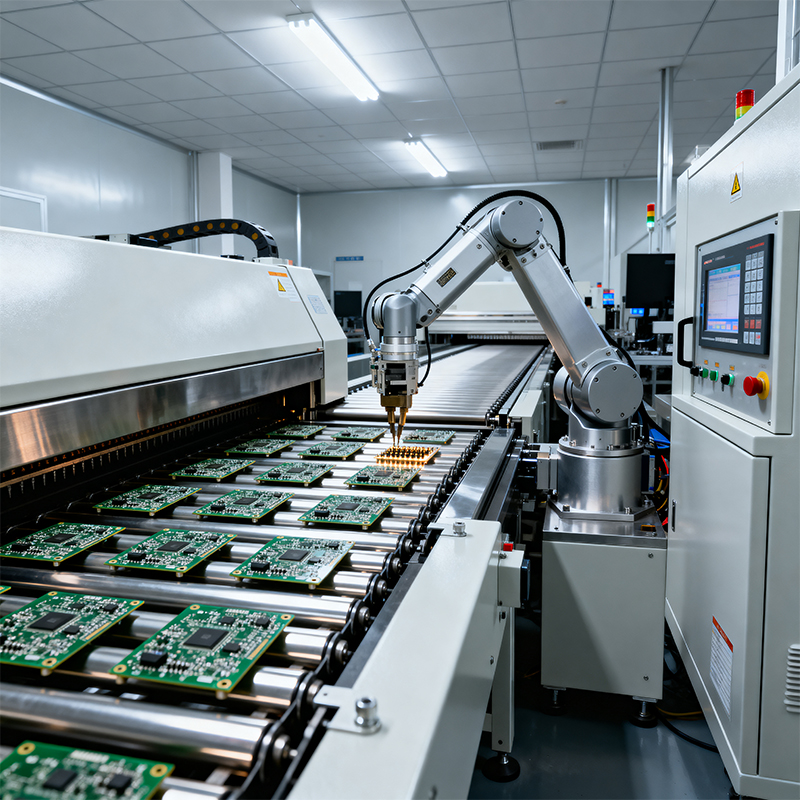
The core of reflow is the temperature profile—a carefully timed recipe of heat that every board must follow. Getting this profile wrong is like burning or undercooking food; it leads to defects. A standard profile has four critical stages:
Preheat/Ramp-Up: The board gradually heats to around 150-180°C. This prevents thermal shock to components, much like letting dough come to room temperature before baking.
Soak/Dwell: Temperature stabilizes for 60-90 seconds. This allows the flux in the paste to activate, cleaning the metal surfaces and preventing oxidation.
Reflow (Liquidus): The temperature rapidly peaks, typically between 230-250°C for lead-free solder. This is where the solder fully melts, becomes liquid, and forms a proper metallurgical bond with the component leads and board pads. This peak must be high enough and long enough (usually 45-90 seconds) for a good joint, but not so high or long that it damages parts.
Cooling: The board is cooled at a controlled rate. Proper cooling ensures the solder solidifies into a strong, shiny joint and doesn’t become brittle or grainy.
Even with automation, things can go wrong. Most manufacturing headaches stem from an incorrect temperature profile or poor solder paste application. Here are some frequent issues:
Tombstoning: A small component stands up on one end. This is often caused by uneven heating or unbalanced pad design, which makes one side of the component solder faster than the other, literally pulling it upright.
Solder Bridging: Solder forms an unintended short circuit between two pins or pads. Common causes are too much solder paste, a misaligned stencil, or a profile with insufficient heat that doesn’t allow the paste to fully “pull back” onto its own pad.
Cold Solder Joints: Dull, grainy, and weak connections. This is a classic sign the joint did not reach the proper peak temperature or time above liquidus, so the solder didn’t flow correctly.
Voiding: Tiny holes or bubbles trapped inside a solder joint, often under a component like a BGA. Voids can weaken the joint and hinder heat conduction. They are typically caused by outgassing from the paste or board during reflow or contamination on the pads.
As electronics get smaller and more powerful, reflow technology is evolving to keep up:
Advanced Thermal Profiling: New ovens use more zones and sophisticated convection or vacuum technology for extremely uniform heating, critical for complex boards with dense components.
In-Line Monitoring and AI: Real-time thermocouples and even AI-driven predictive systems are being used to automatically adjust oven settings, ensuring every single board gets the perfect profile, reducing defects before they happen.
Low-Temperature Solder (LTS): To protect heat-sensitive components and save energy, new solder pastes with lower melting points are being developed. This requires very precise new reflow profiles to maintain reliability.
Circuit board reflow soldering is far more than just an oven step; it’s a precise thermal science that directly determines the quality, reliability, and longevity of your electronic products. From mastering the temperature profile curve to troubleshooting common defects like tombstoning and bridging, a deep understanding of this process is invaluable. As technology pushes toward ever-smaller and more complex devices, staying informed on trends like vacuum reflow and AI-driven process control will be key to successful manufacturing. Getting reflow right means building a solid foundation—one perfect joint at a time.

Kaboer manufacturing PCBs since 2009. Professional technology and high-precision Printed Circuit Boards involved in Medical, IOT, UAV, Aviation, Automotive, Aerospace, Industrial Control, Artificial Intelligence, Consumer Electronics etc..


 English



 Wechat
 +86 13670210335
 +86 13670210335
 E-mail