
Date: 2026-03-27
You've probably seen it. That thin, clear layer on a circuit board that looks like someone sprayed a film of plastic over everything. That's conformal coating. And if you've ever had a board fail mysteriously after a little moisture, a bit of dust, or just a few years of normal use, there's a good chance the problem was the lack of it.
Here's the thing about electronics: they hate the real world. Moisture, dust, chemicals, vibration—they all conspire to kill your carefully designed circuits. A conformal coating is the shield that keeps them alive.
Let's talk about what conformal coating actually does, the different types available, and how to choose the right one for your product.
Conformal coating is a thin, protective layer applied to a printed circuit board to protect it from environmental damage. The name "conformal" means it conforms to the shape of the components and board—it flows over everything, covering every surface.
Think of it like a raincoat for your electronics. It keeps water out. It keeps dust out. It keeps corrosive chemicals away. And it does all of this without blocking access to connectors or test points.
This isn't the same as potting (which encases the entire board in a thick block) or the solder mask you see on the board surface. Conformal coating is a thin film—typically 25 to 250 micrometers thick—that protects without adding significant weight or bulk.
If your product will ever see moisture, humidity, dust, chemicals, or vibration, you need coating. Here's why:
Moisture and humidity. Water is the enemy of electronics. It causes corrosion, shorts, and that nasty dendritic growth where metal literally grows between traces. A conformal coating creates a barrier that keeps moisture away from sensitive components.
Dust and debris. In industrial environments, conductive dust can settle on boards and cause shorts. Coating keeps it out.
Chemical exposure. Oils, solvents, cleaning agents—if your product will be near any of these, coating is essential.
Vibration and thermal shock. Some coatings add mechanical stability, protecting components and solder joints from stress.
Salt spray. For marine or outdoor applications, salt is particularly corrosive. The right coating is non-negotiable.
Not all coatings are the same. The chemistry matters. Here's what you need to know about the common options:
Acrylic coatings are the most common and the easiest to work with. They're inexpensive, dry quickly, and are easy to repair. If you need to rework a board, you can typically solder right through an acrylic coating or remove it with common solvents.
Pros: Low cost, easy to apply, easy to repair, good moisture resistance
Cons: Lower chemical resistance, can be damaged by some solvents
Best for: General-purpose electronics, consumer products, applications where rework is likely
Urethane coatings are tougher than acrylic. They offer better chemical resistance and abrasion resistance. They're harder to remove—you typically need to burn through them or use specialized strippers.
Pros: Excellent chemical resistance, good abrasion resistance, durable
Cons: Harder to rework, more expensive
Best for: Industrial equipment, automotive under-hood, harsh environments
Silicone coatings excel in extreme temperatures and provide excellent moisture protection. They're flexible, which makes them great for flexible circuits. But they're soft, so they don't resist abrasion well, and they can be difficult to remove.
Pros: Wide temperature range (-40°C to 200°C), excellent moisture resistance, flexible
Cons: Soft, low abrasion resistance, hard to rework
Best for: High-temperature applications, flexible circuits, LED lighting
Epoxy coatings are the hardiest. They form a rigid, tough layer that's extremely durable. But they're nearly impossible to rework. Once it's on, it's on.
Pros: Excellent durability, high chemical resistance, strong mechanical protection
Cons: Very difficult to rework, can stress components if thermal expansion mismatches
Best for: Permanent protection, military/aerospace, applications where rework isn't needed
Parylene is the premium option. It's applied through a vapor deposition process, creating an ultra-thin, pinhole-free coating that gets into every crevice. It's biocompatible, chemically inert, and provides exceptional protection.
Pros: Ultra-thin, completely conformal, excellent protection, biocompatible
Cons: Expensive, requires specialized equipment, difficult to mask
Best for: Medical implants, aerospace, critical applications where failure isn't an option
Here's a quick comparison:
| Type | Application Method | Rework | Best Environment | Cost |
|---|---|---|---|---|
| Acrylic | Spray/dip | Easy | General purpose | Low |
| Urethane | Spray/dip | Hard | Harsh chemicals | Medium |
| Silicone | Spray/dip | Hard | Extreme temps | Medium |
| Epoxy | Spray/dip | Very hard | Permanent protection | Medium |
| Parylene | Vapor deposition | Very hard | Medical/aerospace | High |
There are several ways to apply conformal coating, and the method affects both cost and quality.
Spraying is the most common for production. The coating is applied through automated spray equipment, giving good coverage and consistent thickness. It's fast and suitable for most applications.
Dipping involves dunking the entire board in a tank of coating. It's simple and gives excellent coverage, but you need to mask connectors and other areas that shouldn't be coated.
Brushing is used for touch-ups or small batches. It's slow and less consistent, but works when you need to rework a small area.
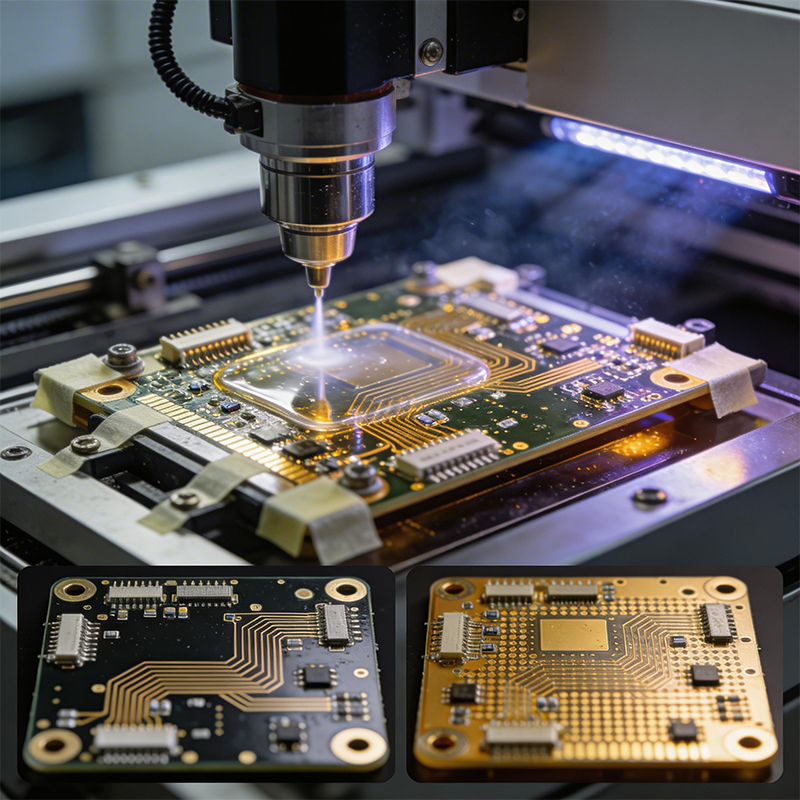
Selective coating uses precision spraying equipment to coat only certain areas of the board. This is common when you have connectors, switches, or test points that must stay uncoated. The machine follows a programmed path, spraying coating exactly where it's needed.
Parylene is applied in a vacuum chamber. The raw material is heated and vaporized, then polymerizes onto the board surface. It gets everywhere, making it the most thorough option.
Areas that shouldn't be coated need to be masked—connectors, test points, switches, LEDs. If coating gets on a connector contact, it can prevent a good connection. If it gets on an LED, it can dim or discolor it.
Too thin, and it won't protect. Too thick, and it can crack or insulate components that need to dissipate heat. Typical thickness is 25-75 microns for most coatings.
Some coatings need heat to cure. Others cure at room temperature. The curing process matters—if it's not done correctly, the coating won't provide proper protection.
After coating, the board needs to be inspected. UV lights help with some coatings (they fluoresce under UV). Others are harder to see. But you need to know that coverage is complete and there are no voids.
If any of these apply, you should be thinking about coating:
The product goes outside. Weather, humidity, temperature swings.
It's used in a vehicle. Automotive, marine, aerospace—all bring vibration, moisture, temperature changes.
It's in an industrial environment. Dust, chemicals, conductive particles.
It needs to last. Long life means protection from the slow corrosion that eventually kills uncoated boards.
It's medical. Body fluids, cleaning agents, sterilization processes.
If none of these apply—if your board lives in a climate-controlled office and never gets touched—you might skip it. But for most real-world products, coating is cheap insurance.
At Kaboer, we've been building custom PCBs since 2009. Based in Shenzhen with our own PCBA factory, we apply conformal coatings every day. We know that the right coating, applied correctly, can be the difference between a product that lasts and one that fails in the field.
What we offer:
Multiple coating types: Acrylic, urethane, silicone, epoxy—we'll help you choose the right one for your application.
Selective coating: For boards with connectors, test points, or other areas that need to stay bare, we use precision spraying equipment to coat only what needs protection.
Masking services: We mask connectors, switches, LEDs, and other sensitive areas before coating.
Flexible circuits: For flexible and rigid-flex boards, we use coatings that bend without cracking.
Fast prototyping: Need to validate your coating choice? We can coat prototypes quickly so you can test before production.
We work across the full range of boards—rigid, flexible, rigid-flex, HDI—and we understand that coating requirements change with the application.
If your product needs protection from moisture, dust, or chemicals—or if you're not sure whether coating is necessary—send us your requirements or Gerber files. We'll review your design, give you honest feedback, and get back to you with a quote. We've been at this for over 15 years, and we believe the best partnerships start with straightforward conversations.
And if you're ever in Shenzhen, we'd be happy to show you around our factory and walk you through how we apply conformal coating.

Kaboer manufacturing PCBs since 2009. Professional technology and high-precision Printed Circuit Boards involved in Medical, IOT, UAV, Aviation, Automotive, Aerospace, Industrial Control, Artificial Intelligence, Consumer Electronics etc..


 English



 Wechat
 +86 13670210335
 +86 13670210335
 E-mail