
Date: 2026-03-27
If you've ever watched a pick-and-place machine work, you know the feeling. Components flying onto boards, hundreds of tiny parts placed in seconds, everything lining up perfectly. But before any of that happens, there's a critical step that most people never think about: the soldering paste.
This grayish, sticky goo is the unsung hero of SMT assembly. It's what holds components in place before they're soldered. It's what cleans the metal surfaces so the solder can bond. And if it's not right, nothing else matters.
Let's talk about what soldering paste actually is, why it matters, and how to get it right so your boards don't fail.
Soldering paste (also called solder paste or solder cream) is a mixture of tiny solder spheres suspended in flux. It looks like gray toothpaste, and its job is to temporarily hold components in place and then become the permanent solder joint when heated.
Think of it as the glue and the solder all in one.
The composition is simple but precise:
Solder powder: Microscopic balls of solder alloy. The most common is SAC305 (tin, silver, copper) for lead-free applications.
Flux: A chemical agent that cleans metal surfaces, removes oxidation, and helps the solder flow.
Additives: Thickeners and stabilizers that give the paste its consistency and shelf life.
When you apply soldering paste through a stencil, it deposits onto the pads. Components sit on top. Then, in the reflow oven, the paste melts, the flux does its cleaning work, and the solder forms permanent connections.
Here's the reality: in SMT assembly, the soldering paste printing step is responsible for the majority of defects. Get the paste wrong, and you're fighting an uphill battle.
Too much paste leads to bridges between pins. That's a short circuit waiting to happen.
Too little paste leads to weak joints, cold joints, or components that don't connect at all.
Old paste that's lost its tackiness won't hold components in place. They shift during reflow.
Incorrect paste type for your components can cause tombstoning, poor wetting, or voids.
The paste is the foundation. If the foundation is wrong, nothing else can be right.
The solder powder is the actual metal that becomes the joint. The size of these tiny balls is measured in "type" numbers. The most common are:
Type 3: 25-45 microns. Good for standard components down to 0603.
Type 4: 20-38 microns. For finer pitch components like 0402 and some QFPs.
Type 5: 15-25 microns. For ultra-fine pitch, 0201 and smaller, and fine-pitch BGAs.
The rule is simple: smaller components need smaller powder. If you're using 0402 passives or fine-pitch BGAs, Type 4 or Type 5 is safer. Using Type 3 for 0201? You're going to have problems—the paste won't release from the stencil properly.
The alloy also matters. For most commercial electronics, SAC305 (Sn96.5/Ag3.0/Cu0.5) is the standard lead-free alloy. It melts around 217°C and peaks around 235-245°C in reflow.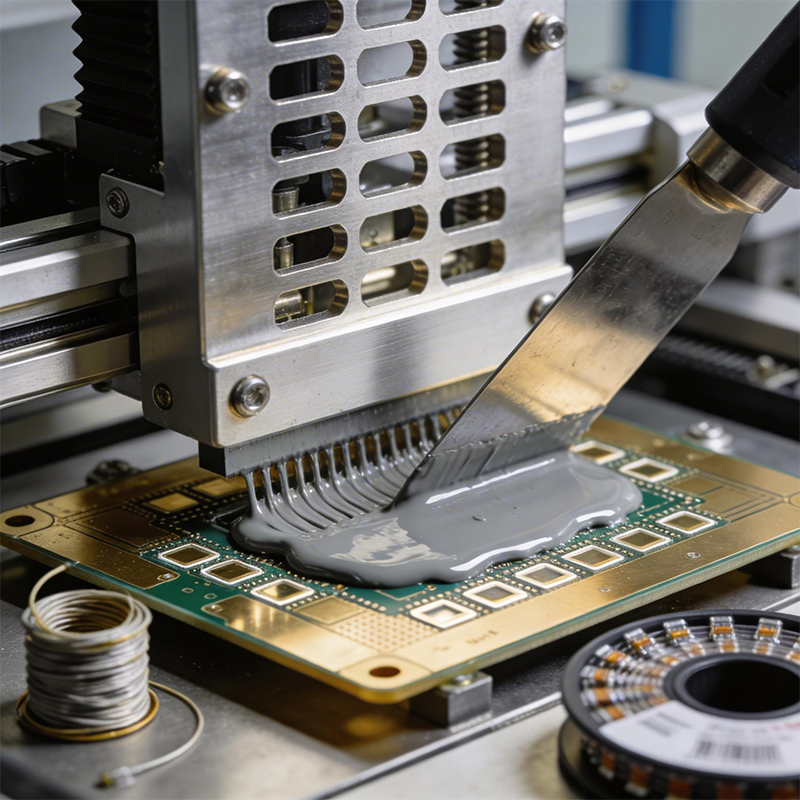
Flux is the secret sauce. Without it, solder won't wet properly. It does several things:
Removes oxidation from the pads and component leads.
Prevents new oxidation during the reflow process.
Lowers surface tension so the solder flows where it's supposed to.
Flux comes in different activity levels:
No-clean flux: Leaves minimal residue that doesn't need to be cleaned. Most common for general electronics. The residue is benign, so it's left on the board.
Water-soluble flux: More active, leaves residue that must be cleaned with water. Used when you need stronger cleaning action.
Rosin-based flux: Traditional, leaves residue that may need cleaning depending on the application.
For most applications, no-clean is the default. It's easier, faster, and the residue isn't a problem. For high-reliability applications like medical or aerospace, you might need water-soluble or rosin-based with cleaning.
Soldering paste has a shelf life. It doesn't last forever. Here's what you need to know:
Storage. Solder paste must be refrigerated, typically at 2-8°C. If it sits at room temperature for too long, the flux starts to degrade. The solder balls can separate from the flux. The paste loses its tackiness.
Warming up. Before use, refrigerated paste needs to warm to room temperature—usually 2-4 hours. If you use it cold, moisture can condense on the paste, causing solder spatter during reflow.
Once opened. Most pastes have a working life of 8-12 hours once opened. After that, the flux starts to dry out, and the paste becomes difficult to print. Some manufacturers allow longer with controlled conditions, but for reliable printing, don't push it.
Stencil life. Once paste is on the stencil, it should be used within 4-8 hours, depending on humidity. If it sits too long, the paste can dry in the apertures, causing clogged prints.
The solder balls up on the pad instead of flowing.
What causes it: Oxidized pads, old paste, or insufficient flux activity.
How to avoid: Use fresh paste. Ensure boards are stored properly and used within their shelf life. For boards that have been sitting, consider baking them before assembly to remove moisture.
Paste connects adjacent pads, causing shorts after reflow.
What causes it: Too much paste, apertures too large, or paste that slumps after printing.
How to avoid: Optimize stencil aperture design. Use the right paste viscosity. Control printing parameters (pressure, speed, separation).
Weak joints or missing connections.
What causes it: Too little paste, clogged apertures, or paste that's too thick to release.
How to avoid: Clean stencils regularly. Check aperture area ratio (>0.66). Use paste with appropriate particle size.
Small components stand up on one end during reflow.
What causes it: Uneven paste deposition or uneven heating. One pad melts before the other, pulling the component upright.
How to avoid: Use symmetrical pad design. Ensure paste volume is balanced on both pads. Check reflow profile for even heating.
Tiny balls of solder scattered around the board.
What causes it: Paste spattering during reflow, often from moisture or too-rapid heating.
How to avoid: Bake boards before assembly if they've been stored. Use proper reflow profile with controlled ramp rates. Check paste quality.
Air pockets inside solder joints, especially under BGAs.
What causes it: Outgassing during reflow, or paste with insufficient flux activity.
How to avoid: Optimize reflow profile to allow volatiles to escape. Use paste with appropriate flux for your components.
When you're selecting paste, here's what to consider:
Alloy: SAC305 is the default for lead-free. For leaded applications (where allowed), Sn63/Pb37 is standard.
Particle size: Type 3 for standard components down to 0603. Type 4 for 0402 and fine-pitch. Type 5 for 0201 and ultra-fine.
Flux type: No-clean for most applications. Water-soluble for high-reliability where cleaning is possible.
Viscosity: Higher viscosity for better print stability. Lower viscosity for better release. Your process determines the right balance.
Shelf life: Check the date. Old paste is unreliable.
At Kaboer, we've been doing SMT assembly since 2009. Based in Shenzhen with our own PCBA factory, we know that soldering paste is the foundation of reliable assembly.
What we do:
Strict storage: Our paste is stored in temperature-controlled environments, tracked by batch, and used within shelf life.
Proper handling: Paste is warmed to room temperature before use. We follow manufacturer recommendations for working life.
Process control: We monitor printing parameters, stencil cleanliness, and paste condition to ensure consistent deposits.
Design review: Before production, we check your pad designs against the paste requirements. If we see potential issues, we flag them.
Fast prototyping: Need to validate a design quickly? We can assemble prototypes with the right paste for your components.
We work across the full range of boards—rigid, flexible, rigid-flex, HDI—and we understand that different boards need different paste handling. Flexible circuits need paste that works with thinner stencils. HDI boards need finer particle sizes.
If you're designing a board and want to make sure your soldering paste process is right—or if you need help with paste selection—send us your requirements or Gerber files. We'll review your design, give you honest feedback, and get back to you with a quote. We've been at this for over 15 years, and we believe the best partnerships start with straightforward conversations.
And if you're ever in Shenzhen, we'd be happy to show you around our factory and walk you through how we handle soldering paste from storage to reflow.

Kaboer manufacturing PCBs since 2009. Professional technology and high-precision Printed Circuit Boards involved in Medical, IOT, UAV, Aviation, Automotive, Aerospace, Industrial Control, Artificial Intelligence, Consumer Electronics etc..


 English



 Wechat
 +86 13670210335
 +86 13670210335
 E-mail