
Date: 2026-06-15
You're an electronics manufacturer. Your product needs a "brain" – something that reads sensors, controls motors, drives a display, or manages power. That brain is a control board.
Control boards are everywhere. Inside your AC remote, your car's engine control unit, a factory robot arm, and even your smartwatch. But different products have completely different requirements – some need to be cheap, some tiny, some bendable, some capable of high‑speed signals.
In this guide, I'll explain the common types of control boards, material choices, design considerations, and the custom manufacturing process. By the end, you'll know which type fits your product and how to talk to suppliers without making costly mistakes.
A control board is essentially a printed circuit board with a microcontroller (MCU) or microprocessor (MPU). It reads inputs (buttons, sensors), runs program logic, and sends outputs (LEDs, motors, data).
A typical control board includes:
Main processor – MCU, FPGA, DSP, or MPU – the brain.
Power management – converts input voltage to what the chips need (e.g., 5V to 3.3V).
Input interfaces – buttons, touch, sensors, communication ports (UART, I2C, SPI, CAN, Ethernet).
Output interfaces – motor drivers, display drivers, relays, LEDs, communication ports.
Memory – Flash, EEPROM, SD card for program and data storage.
Protection circuits – over‑current, ESD, reverse polarity.
The quality of your control board directly affects your product's stability, safety, and lifespan.
| Type | Characteristics | Best For |
|---|---|---|
| Rigid control board | Traditional FR4 – hard, cheap | Industrial equipment, appliances, power supplies, most fixed products |
| Flex control board | Polyimide base – bendable | Wearables, foldable screens, printers, camera modules |
| Rigid‑flex control board | Rigid and flex sections in one board | Drones, medical endoscopes, automotive sensors, foldable phones |
| HDI high‑frequency control board | Fine traces, low loss materials | 5G equipment, radar, optical modules, high‑speed data acquisition |
Let me explain each.
1. Rigid control board
The most common type. Made of FR4 fiberglass and epoxy – hard and stiff. Advantages: cheap, strong, mature process. Disadvantages: heavy, can't bend, takes space. Best for fixed devices that don't need bending.
2. Flex control board
Made of polyimide (PI) film – can bend like a plastic card. Advantages: thin, light, bendable, fits tight spaces. Disadvantages: more expensive, harder to manufacture, special design rules required. Best for smartwatches, TWS earbuds, foldable phones, printer cables – anything that bends or has space constraints.
3. Rigid‑flex control board
Rigid‑flex combines rigid and flex sections into one board. Rigid areas hold heavy chips and connectors; flex areas bend and connect different modules. Advantages: eliminates connectors and cables, high reliability, easier assembly. Disadvantages: difficult to design and manufacture, higher cost. Best for drone flight controllers, medical endoscopes, automotive camera modules, foldable devices.
4. HDI high‑frequency control board
HDI (High Density Interconnect) uses fine trace/space (0.05mm or smaller) and microvias. High‑frequency boards use low‑loss materials (Rogers, PTFE, LCP) to minimize signal loss. Best for 5G, radar, optical modules, high‑speed data acquisition – anything demanding signal integrity.
Regardless of type, a good control board needs to address these aspects:
1. Power integrity
MCUs and peripheral chips are sensitive to power quality. Excessive voltage ripple can cause program crashes or inaccurate ADC readings. Design tips: adequate input capacitors, 0.1µF decoupling caps near each chip's power pin, tightly coupled power and ground planes.
2. Signal integrity
High‑speed signals (USB, MIPI, DDR, Ethernet) need controlled impedance, matched differential pair lengths, and continuous reference planes. Poor design causes reflection, crosstalk, and eye diagram closure.
3. Electromagnetic compatibility (EMC)
Your control board must not interfere with others and must resist outside interference. Good practices: solid ground plane, guard traces around sensitive signals, clock sources away from connectors, filtering caps close to pins, proper chassis grounding.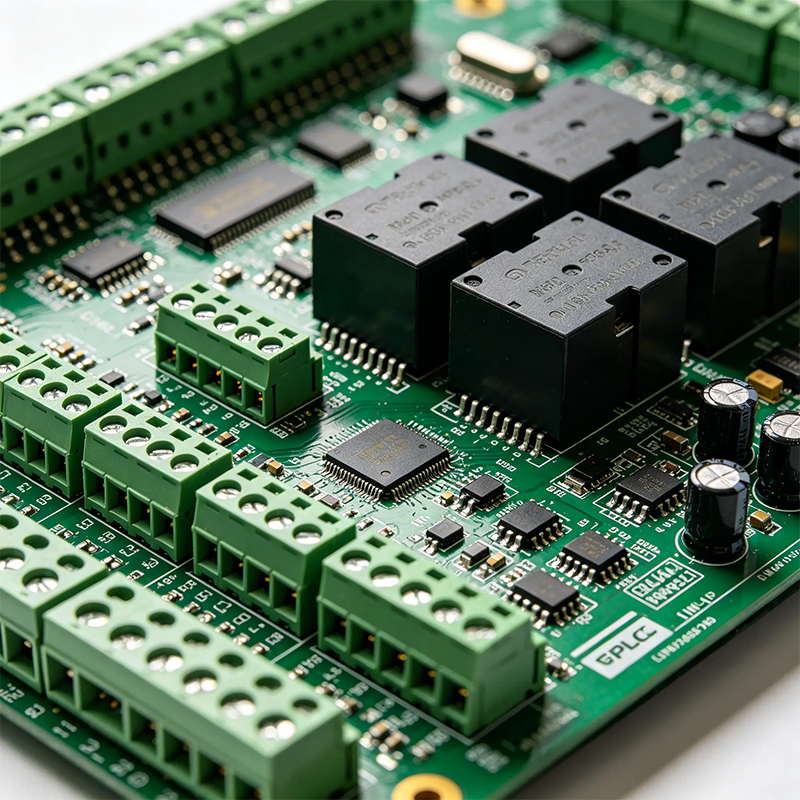
4. Thermal management
MCUs and power devices generate heat. Poor cooling causes crashes or shortened life. Solutions: thermal pads with vias, large copper pours, heat sinks, fans, or thermal conductive pads.
5. Mechanical fit
The board's shape and mounting holes must match your enclosure. For flex or rigid‑flex, also consider bend radius, stiffener placement, and expected bend cycles.
Q1: Is FR4 enough, or do I need flex or HDI?
If your product doesn't bend, has enough space, and signal speeds are below ~100MHz, FR4 rigid boards are perfectly fine. Only go to flex, rigid‑flex, or HDI when you need thinness, bending, higher density, or high‑frequency performance.
Q2: Do rigid‑flex boards break at the transition?
They can – that's the weakest point. Good design keeps vias and pads away from the transition, uses a sufficiently long taper, and respects the minimum bend radius (typically 10× the flex thickness). We've been making rigid‑flex for over a decade and have proven design rules to ensure reliability.
Q3: How to choose high‑frequency materials?
Common options: Rogers 4000 series (best balance of performance and manufacturability), Rogers 3000 series, PTFE (lowest loss but hard to process and expensive), LCP (for flexible high‑frequency boards). Not sure? Send your requirements – we'll recommend.
A control board goes through these steps from design to shipping:
PCB fabrication – Bare boards (rigid, flex, rigid‑flex, or HDI) based on your Gerber files.
SMT placement – Automated pick‑and‑place machines solder components.
DIP assembly – Through‑hole components (large caps, connectors) are hand‑soldered or wave‑soldered.
Programming – Firmware is flashed into the MCU or Flash memory.
Functional test – Custom test fixtures check each board (buttons, communications, outputs).
Conformal coating (optional) – A protective layer against moisture, dust, and corrosion.
Packaging – ESD bags, anti‑static foam, cartons.
We provide one‑stop service from PCB fabrication to PCBA to functional testing. You don't have to coordinate between a board house and an assembly shop – one window handles everything.
1. Have you made similar control boards before?
Ask for experience with your product type (motor control, IoT gateway, medical device). Past projects are proof of capability.
2. Do you provide DFM (design for manufacturing) review?
A good supplier will DFM your files before production – catching issues like undersized pads, insufficient clearances, or unplugged thermal vias. This saves you from expensive rework.
3. How do you test?
Ask: Do you have ICT? Functional test? Who designs the test fixtures? What's your test coverage?
4. For flex or rigid‑flex – do you do bend life testing?
If your product needs dynamic bending, ask if the supplier can run bend cycle tests. No testing means you might discover cracked traces months after shipping.
5. What about lead time and warranty?
Sample lead time is typically 5‑10 days; volume depends on order size. Ask: what happens if samples fail? What's the warranty for volume production?
We are not just a PCB manufacturer. We are a one‑stop solution that designs and makes flexible PCBs, rigid‑flex boards, HDI high‑frequency boards, and then does full PCBA. For control boards, we bring deep experience.
All in‑house – PCB fab, SMT, testing under one roof. No hand‑offs, better quality control and lead time.
Free DFM review – Send your files, get a DFM report within 24 hours with potential issues and optimization suggestions.
Flex/rigid‑flex expertise – Over a decade of experience. We know how to avoid flex‑to‑rigid transition cracks and design proper stiffeners.
HDI and high‑frequency capability – Any‑layer HDI, 0.05mm trace/space, 0.075mm laser blind vias. Rogers, PTFE, LCP – we've done them all.
Turnkey PCBA – SMT, DIP, programming, functional test, conformal coating – all available. Send Gerbers and BOM, receive finished boards.
Control board applications we've served: home appliance main boards (AC, refrigerator, washer), industrial automation (PLC, motor drives, sensor acquisition), automotive (window control, seat adjustment, BMS), medical (patient monitors, infusion pumps, glucose meters), IoT (smart gateways, sensor nodes, NB‑IoT modules).
Three simple steps:
Send your files – PCB design files (Gerber or source), BOM, functional requirements (I/O definitions, communication protocols, test needs).
We review and quote – Within 24 hours, you'll receive a DFM report, sample and volume pricing, and lead time estimate.
Sample, then scale – We build 10‑20 samples. You test functionality and reliability. Then we move to pilot and volume production.
The control board is the heart of your electronic product. A well‑designed, well‑manufactured control board makes your product reliable and market‑ready. A problematic one leads to endless rework, delayed shipments, and lost customers.
If you're developing a new product or want to improve an existing control board, send us your requirements. We won't push a contract – we'll first run a free DFM review and let our expertise speak.
When you contact us, please include:
Product type and application (e.g., "AC main control board", "drone flight controller")
PCB design files (or at least a schematic and functional description)
Estimated annual quantity (samples, small batch, or mass production)
We'll give you an honest answer – what we can do, what we can't, and how to modify your design to make it work. Let's turn your control board from a drawing into a reliable product.

Kaboer manufacturing PCBs since 2009. Professional technology and high-precision Printed Circuit Boards involved in Medical, IOT, UAV, Aviation, Automotive, Aerospace, Industrial Control, Artificial Intelligence, Consumer Electronics etc..


 English



 Wechat
 +86 13670210335
 +86 13670210335
 E-mail