
Date: 2026-03-21
You've designed a board that fits perfectly into its enclosure. The connectors line up, the mounting holes are in the right places, and everything looks good on screen. But then you realize: your board needs to wrap around a component, or fit over a protruding feature, or clear a cable that passes through from the other side.
A simple rectangular board won't do. You need a double cutout.
If you've never designed a board with complex cutouts before, you might not realize that these features aren't just "draw a shape and it happens." They come with their own set of design rules, manufacturing challenges, and cost implications.
Let's walk through what double cutouts are, why they're used, and what you need to know to get them right.
A double cutout (sometimes called a dual cutout or internal cutout) is exactly what it sounds like: two openings cut out from the interior of a PCB . Unlike the outer board edge, which defines the shape of the board itself, cutouts are holes or slots that go completely through the board but don't touch the outer perimeter.
Think of it like a piece of paper with holes punched in the middle. The outer edge stays the same, but now there are voids inside the board.
Double cutouts can be:
Simple cutouts: A single hole or slot
Multiple cutouts: Two or more separate openings
Complex cutouts: Openings with intricate shapes, sometimes connected by narrow bridges of material
These features are common in boards that need to accommodate mechanical components, allow airflow, provide cable pass-through, or create strain relief for connectors.
There are plenty of reasons to add internal cutouts to your PCB:
Component clearance. Sometimes a component on the board needs to sit over an opening—maybe a display that needs to be visible from the other side, or a sensor that needs an unobstructed view.
Cable pass-through. If your board sits between two sections of an enclosure, cables might need to run through it. Cutouts let you route wiring without going around the edges.
Thermal management. Cutouts can allow airflow across hot components or provide paths for heat to escape.
Weight reduction. In aerospace or portable applications, every gram counts. Removing material where it's not needed lightens the board.
Strain relief. Connectors and cables can be secured through cutouts, reducing stress on solder joints.
Mounting features. Some designs use cutouts to snap into plastic housings or to accommodate mounting hardware.
Adding internal cutouts isn't as simple as drawing them on your layout. Here's what you need to think about:
When you have two cutouts close together, the material between them—called the bridge—has to be strong enough to survive fabrication and assembly. If the bridge is too thin, it can break during handling or depaneling.
The minimum bridge width depends on your manufacturer's capabilities, but a common rule of thumb is at least 1.5mm to 2mm for standard boards. For flexible circuits, you might need even more because the material is less rigid.
Cutouts that are too close to the board edge can weaken the outer perimeter. If the distance from the cutout to the edge is less than the board thickness, you risk breaking during fabrication or use.
Internal corners should be rounded, not sharp. Sharp corners concentrate stress and can become starting points for cracks. A radius of 0.5mm to 1mm is typical, though smaller radii are possible with more advanced manufacturing.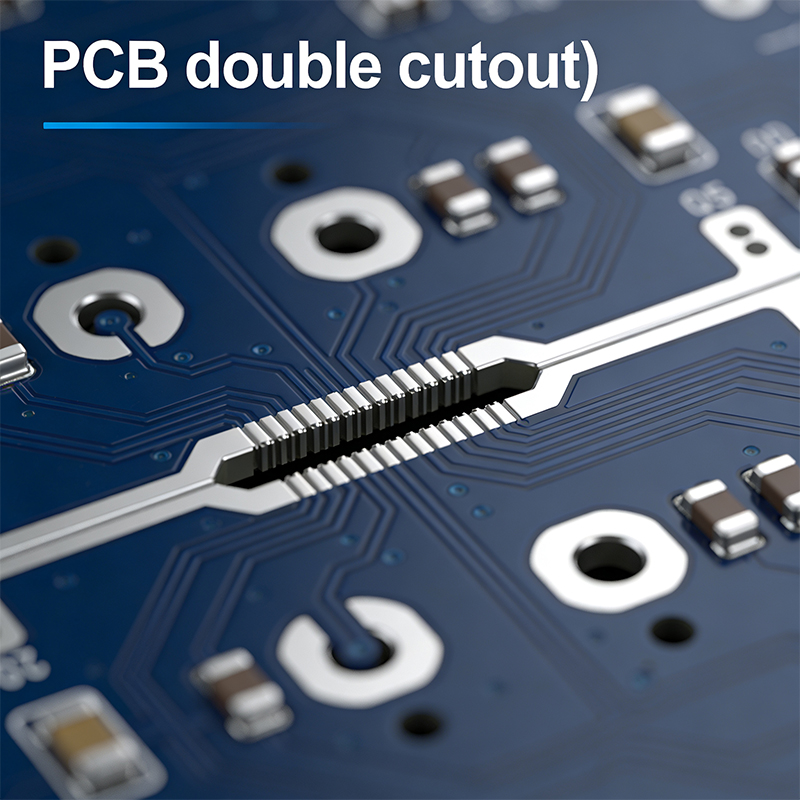
You can't route copper or place components inside the cutout area—that's the point of the cutout. But you also need to leave clearance around the cutout for manufacturing tolerances. Typically, keep copper and components at least 0.3mm to 0.5mm away from the cutout edge.
Internal cutouts are typically created with tab routing—a CNC router mills out the opening. For very high volume, custom dies can punch the cutouts, but this adds tooling cost and is only economical for large runs.
If the cutout is intended for electrical connection (like a mounting hole with plating), it needs to be designed as a plated cutout. This requires special consideration because the plating process expects holes, not arbitrary shapes. Most manufacturers can plate simple cutouts, but complex shapes may not be platable.
From the manufacturer's perspective, double cutouts add complexity. Here's what happens on the production floor:
Material removal. Cutting internal voids takes time. Each cutout adds to the routing time, which increases cost.
Deburring. After routing, the cutout edges need to be deburred to remove sharp fibers and copper burrs. This is an extra step.
Handling during assembly. Boards with large cutouts can be flimsy. If the cutouts remove too much material, the board might flex during solder paste printing or component placement, causing misalignment.
Panelization. If your board has internal cutouts, it might need more support tabs to hold it in the panel during assembly. These tabs get routed away later, but they need to be there to keep the board stable.
Flexible circuits add another layer of complexity. Polyimide flex materials are less rigid than FR-4, so cutouts can make the board even more delicate.
For flex circuits, cutouts are usually laser cut rather than routed. Lasers provide cleaner edges and don't stress the material the way a router bit does. However, laser cutting is slower and adds cost.
When designing cutouts for flex circuits:
Use larger corner radii to prevent tearing
Avoid narrow bridges between cutouts
Consider adding stiffeners near cutouts if the area will be handled
Remember that flex circuits are often populated with components after cutouts are formed
At Kaboer, we've been manufacturing custom PCBs since 2009. Based in Shenzhen with our own PCBA factory, we understand that sometimes your design needs more than a simple rectangle.
We handle double cutouts across our entire product range:
Rigid PCBs with complex internal cutouts, from simple slots to intricate shapes
Flexible circuits where laser-cut cutouts preserve material integrity
Rigid-flex boards where cutouts may span both rigid and flexible sections
Our engineers review every design before production, checking:
Bridge widths between cutouts to ensure mechanical stability
Distances from cutouts to board edges and other features
Copper and component clearance
Manufacturing feasibility for your specific board type
We'll flag potential issues before they become expensive problems—not after your boards are already in production.
If you're designing a board with double cutouts and want to make sure it's manufacturable, send us your requirements or Gerber files. We'll review your design, give you honest feedback, and get back to you with a quote. We've been at this for over 15 years, and we believe the best partnerships start with straightforward conversations.
And if you're ever in Shenzhen, we'd be happy to show you around our factory and walk you through how we handle complex cutouts on both rigid and flexible boards.

Kaboer manufacturing PCBs since 2009. Professional technology and high-precision Printed Circuit Boards involved in Medical, IOT, UAV, Aviation, Automotive, Aerospace, Industrial Control, Artificial Intelligence, Consumer Electronics etc..


 English



 Wechat
 +86 13670210335
 +86 13670210335
 E-mail