
Date: 2026-03-21
If you've ever drilled a standard rigid PCB, you know the drill—pun intended. You set up the CNC, pick the right bit size, and run the program. The board sits flat, the material is rigid, and as long as your tooling is sharp, holes come out clean.
Now try that on a flexible circuit. The board bends. It shifts. It doesn't hold still. And if you're not careful, your carefully positioned holes end up in the wrong place, or worse, the material tears instead of drilling cleanly.
That's where flexible drill technology comes in. Drilling flex circuits isn't just "the same thing on a softer material." It's a completely different challenge that requires specialized equipment, processes, and know-how.
Let's walk through what makes drilling flexible circuits different, why it matters for your product, and what to look for in a manufacturer who gets it right.
A standard rigid PCB is stable. It's a solid sheet of FR-4 fiberglass that doesn't move, doesn't stretch, and doesn't care about being handled. You can clamp it, stack multiple boards, and drill dozens of holes at once.
A flexible circuit is, well, flexible. It's thin. It's floppy. It stretches if you pull it. And if you try to stack multiple layers the way you would with rigid boards, they shift relative to each other .
This matters because flexible circuits still need holes. They need plated through-holes (vias) to connect different layers. They need tooling holes for alignment during assembly. And sometimes they need cutouts or slots for mechanical fit.
If you treat a flex circuit like a rigid board, you'll end up with misaligned vias, torn material, and boards that don't work.
For flexible circuits, laser drilling is the dominant method. Instead of using mechanical drill bits that spin and push through the material, lasers use focused light to vaporize the material away .
This is a game-changer for flex circuits for a few reasons:
No mechanical force. The laser doesn't push or pull the material. The board stays where it is.
No tool wear. Drill bits dull over time, which changes hole quality. Lasers don't.
Extremely small holes. Mechanical drills struggle below 0.2mm. Lasers can reliably drill down to 0.075mm (75 microns) or even smaller for advanced HDI designs.
Precision. Laser systems can position holes with incredible accuracy, critical for fine-pitch components.
The two most common laser types for flex circuit drilling are CO₂ lasers and UV lasers. CO₂ lasers are faster and good for larger holes and cutting outlines. UV lasers have shorter wavelengths that are absorbed more readily by the material, producing cleaner holes with less heat-affected zone—critical for drilling through copper and polyimide layers with precision .
Not all laser drilling is created equal. Here's what matters:
A laser that isn't stable produces inconsistent holes. The beam profile, power output, and pulse duration all need to be tightly controlled. This is where experience and equipment quality show up.
The flexible material needs to be held flat and stationary during drilling. Advanced systems use vacuum chucks or adhesive films to keep the flex circuit in place without stretching or distorting it . If the board moves even a fraction of a millimeter, your vias won't line up with the pads above and below.
Flex circuits often have multiple layers that need to align perfectly. The drilling system needs to reference registration marks on the board to ensure holes are positioned correctly relative to the copper features . This is especially critical for blind and buried vias, where the hole stops at an inner layer.
Lasers generate heat. Too much heat in one spot can damage the polyimide material or cause the copper to lift. Good process control manages pulse energy and repetition rate to remove material cleanly without overheating .
Even in the flex world, mechanical drilling isn't dead. For larger holes (above 0.3mm), mechanical drills can be more efficient and cost-effective . They're also used for tooling holes that don't need the same precision as vias.
But mechanical drilling on flex requires special considerations:
Backing material. Flex circuits need support to prevent tearing. Manufacturers often use special backing sheets that hold the material rigid during drilling.
Entry material. A thin sheet on top of the board prevents the drill from "skipping" on the surface.
Sharpness and speed. Drill bits dull faster on flex materials and need more frequent changes.
Even with these precautions, mechanical drilling on flex has limits. For fine-pitch, high-density designs, laser drilling is the standard.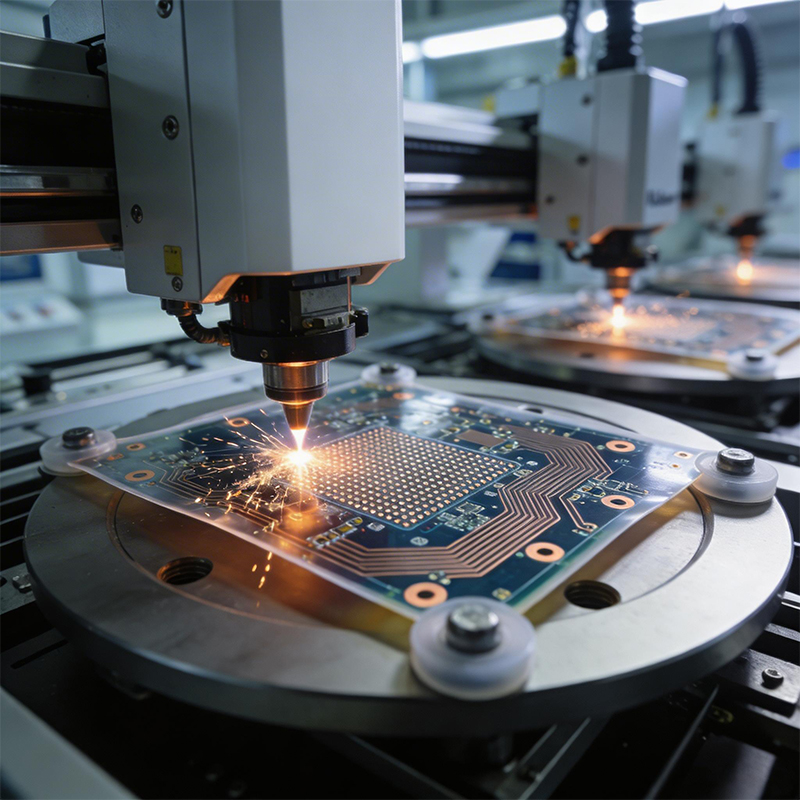
The drill pulls the material instead of cutting it cleanly, leaving ragged edges.
Prevention: Use sharp tools, proper backing, and consider laser drilling for small holes.
Holes are off from where they should be, causing vias to miss pads.
Prevention: Use registration pins and optical alignment systems. Ensure the board is held flat during drilling.
Raised material around the hole edge that can interfere with plating or cause shorts.
Prevention: Optimize drilling parameters (speed, feed rate) or switch to laser drilling for critical holes.
Discoloration around the hole from excess heat.
Prevention: Reduce laser power, adjust pulse duration, or improve heat dissipation.
The drilling requirements change depending on what you're building:
Single-layer flex: Simpler. You only need to drill through one copper layer and the polyimide base. Alignment is less critical.
Double-layer flex: More complex. The top and bottom copper layers need to align, and vias must connect through the polyimide insulator.
Multilayer flex: This is where things get serious. You're drilling through multiple copper and polyimide layers, sometimes with staggered vias that connect specific layer pairs . Registration requirements are tight, and process control is critical.
Rigid-flex: Combines rigid sections with flexible interconnects. The drilling challenges apply to both the rigid and flex parts, with the added complexity of managing the transition areas.
At Kaboer, we've been manufacturing flexible circuits and rigid-flex boards since 2009. Based in Shenzhen with our own PCBA factory, we understand that drilling is one of the most critical steps in flex circuit production.
Our capabilities include:
Laser drilling with precision down to 0.075mm for microvias and fine-pitch designs
CO₂ and UV laser systems optimized for different materials and hole sizes
Advanced registration systems that reference fiducial marks to ensure hole-to-pad alignment
Proper material handling with vacuum chucks and film carriers to keep flex circuits flat during drilling
Mechanical drilling for larger holes and tooling holes when it makes sense
We work with the full range of flexible circuits:
Single and double-layer flex for simpler applications
Multilayer flex for complex designs with tight registration requirements
Rigid-flex boards combining rigid sections with flexible interconnects
HDI flex boards with microvias for high-density designs
If you're working on a flexible circuit project and need a partner who understands the nuances of drilling and the rest of the process, send us your requirements or Gerber files. We'll review your design, give you honest feedback, and get back to you with a quote. We've been at this for over 15 years, and we believe the best partnerships start with straightforward conversations.
And if you're ever in Shenzhen, we'd be happy to show you around our factory and demonstrate how we drill flexible circuits with precision and care.

Kaboer manufacturing PCBs since 2009. Professional technology and high-precision Printed Circuit Boards involved in Medical, IOT, UAV, Aviation, Automotive, Aerospace, Industrial Control, Artificial Intelligence, Consumer Electronics etc..


 English



 Wechat
 +86 13670210335
 +86 13670210335
 E-mail