
Date: 2026-04-02
Let’s be real—in a world where chips are getting smaller and HDI traces are shrinking to the width of a human hair, electrolytic capacitors can feel like the "dinosaurs" of the PCB. They are bulky, they have a lifespan, and they are polarized.
But if you are designing power supplies, industrial controllers, or high-end audio gear, you can’t live without them. They provide the massive capacitance and ripple current handling that tiny ceramic caps just can't touch.
However, as a specialist in custom Flex, Rigid-Flex, and HDI boards, we see a lot of engineers struggle with how to integrate these giants into modern, compact designs.
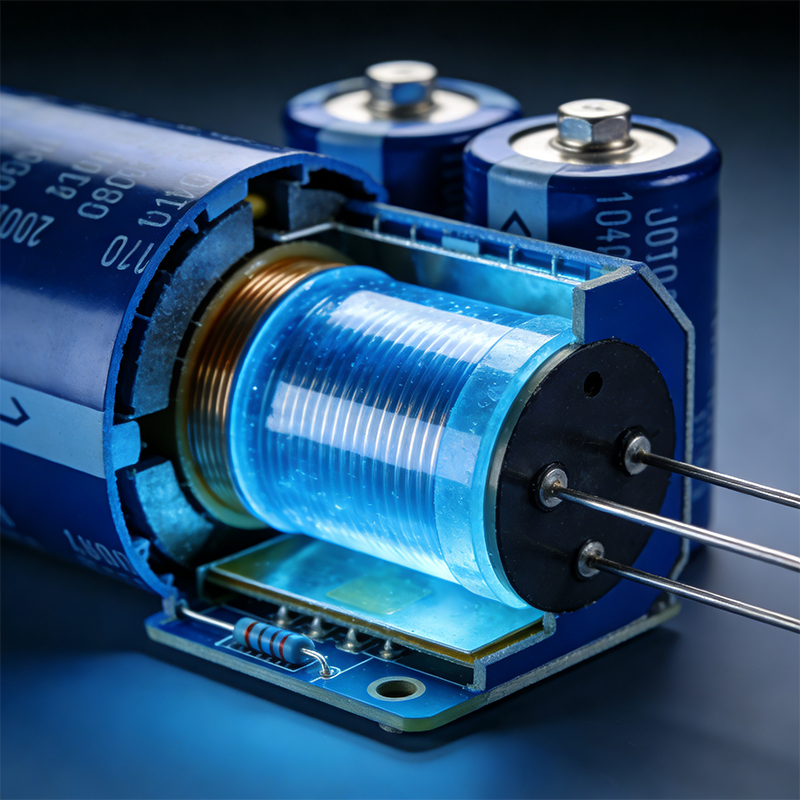
In plain English, an electrolytic capacitor is like a high-capacity reservoir. It smooths out voltage spikes and keeps your system stable. But they come with a "ticking clock." The electrolyte inside eventually dries out.
In 2026, with the push for more sustainable and longer-lasting electronics, choosing the right electrolytic capacitors is no longer just about the microfarads ($\mu F$). It’s about:
ESR (Equivalent Series Resistance): Lower is better for efficiency, but it can affect your power loop stability.
Operating Temperature: If your HDI board is packed tight and running hot, a standard 85°C cap will fail far sooner than expected. We always recommend 105°C or higher for industrial PCBA.
This is where the magic (and the headache) happens in our factory.
The Flex PCB Dilemma: Electrolytic capacitors are rigid and heavy. If you solder one onto a Flexible PCB, the solder joints will crack the moment the board bends. Our solution? We design custom stiffeners (usually FR4 or Polyimide) directly under the capacitor to create a stable "island" for the component.
HDI and Heat Sinks: HDI designs are all about density. But electrolytic capacitors hate heat. If you place a large cap right next to a high-speed CPU or a power MOSFET, you’re basically cooking the capacitor. We provide DFM (Design for Manufacturing) feedback to help you optimize the airflow and spacing.
Polarity and AOI: Because these are polarized, putting them in backward means a literal "pop" on the test bench. We use advanced Optical Inspection (AOI) and X-ray to ensure every single cap is oriented perfectly before it leaves our facility.
We know that when you're ordering from China, you're not just looking for a low price—you're looking for peace of mind.
Sourcing Transparency: We don't use "no-name" capacitors that dry out in six months. We work with Tier-1 brands like Rubycon, Nichicon, and Panasonic to ensure your product lasts.
Complex Rigid-Flex Expertise: We specialize in the boards that other shops find "too difficult." Combining heavy electrolytic caps with thin-film flex circuits is our bread and butter.
Full PCBA Testing: We don't just ship boards; we ship solutions. Every board undergoes rigorous functional testing to ensure the power stages are rock solid.
Are you worried about the footprint of your electrolytic capacitors? Or maybe you're unsure if your Rigid-Flex design can handle the weight?
Send us your Gerber files and BOM today. Let our engineering team do a free DFM review. We’ll show you how we can turn your complex design into a high-reliability reality.

Kaboer manufacturing PCBs since 2009. Professional technology and high-precision Printed Circuit Boards involved in Medical, IOT, UAV, Aviation, Automotive, Aerospace, Industrial Control, Artificial Intelligence, Consumer Electronics etc..


 English



 Wechat
 +86 13670210335
 +86 13670210335
 E-mail