
Date: 2026-05-18
You know those stiff, green circuit boards that have been around for decades? They work fine – until you need something to bend, fold, or squeeze into a crazy tight space. That’s where FPCB (Flexible Printed Circuit Board) comes in.
FPCBs are exactly what they sound like: circuit boards that bend. They’re thin, lightweight, and can twist into shapes that rigid boards could never dream of. If you’re making a wearable, a foldable phone, a medical implant, or anything with moving parts, you need to understand FPCBs.
Let’s break down what an FPCB is, why you’d use one, and how to get it right for your product.
What Is an FPCB?
FPCB stands for Flexible Printed Circuit Board. Instead of a hard fiberglass material like FR4, an FPCB uses a flexible plastic base – usually polyimide (the same stuff as Kapton tape). Copper traces are laminated onto this flexible film, and a protective coverlay (also polyimide) keeps everything safe.
In plain English: it’s a circuit board you can roll up, fold over, or snake through a narrow gap. And it still carries electricity just like a rigid board.
Why Would You Choose an FPCB Over a Rigid Board?
Three big reasons: space, weight, and reliability.
Space – FPCBs are paper‑thin (often 0.1mm or less). They can go where rigid boards can’t – around corners, through hinges, inside curved housings.
Weight – An FPCB can replace a bundle of wires and multiple connectors. That saves grams, which matters a lot in drones, wearables, and aerospace.
Reliability – Every connector is a potential failure point. FPCBs eliminate many connectors by creating a continuous, solid circuit. No loose wires, no corroded pins.
Where Are FPCBs Used?
Almost everywhere modern electronics are getting smaller and smarter.
Smartphones – FPCBs connect the main board to the display, camera modules, buttons, and battery.
Wearables – Fitness trackers, smartwatches, and hearing aids use FPCBs to fit the curves of your body.
Medical devices – Implantable sensors, endoscope cameras, and wearable monitors rely on FPCBs for thinness and biocompatibility.
Automotive – Dashboard displays, steering wheel controls, battery management systems in EVs.
Aerospace and defense – Satellites, drones, and avionics use FPCBs to save weight and survive vibration.
Industrial – Robots, printers, and cameras with moving heads.
Types of FPCBs
Not all FPCBs are the same. Here are the main categories:
1. Single‑Sided FPCB
One layer of copper on one side of the polyimide film. Simple, cheap, and great for low‑complexity interconnects.
2. Double‑Sided FPCB
Copper on both sides, with plated through‑holes to connect them. More routing options, still flexible.
3. Multi‑Layer FPCB
Three or more conductive layers. Used for complex circuits that still need to bend. The flex material is thin, but multiple layers can make it stiffer.
4. Rigid‑Flex Board (Hybrid)
A combination of rigid FR4 sections and flexible polyimide tails. You get the best of both: rigid areas for components, flex areas for bending. This is incredibly popular for compact products that need to open and close (like laptops or foldable phones).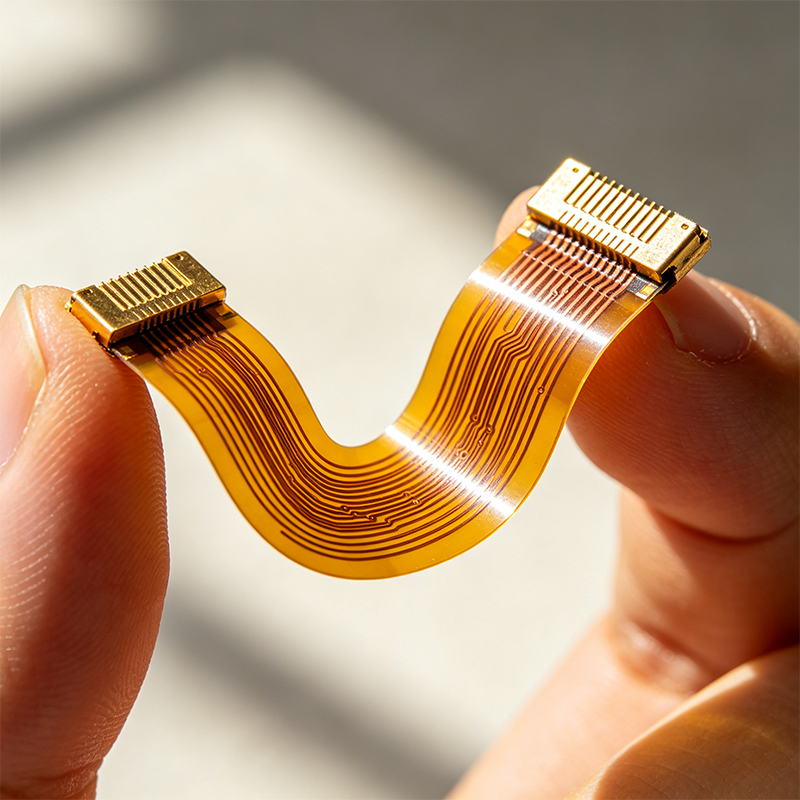
5. Sculptured FPCB
Some copper traces are thicker than others. Used for high‑current paths or for contacts that need to plug into connectors.
What Materials Are Used in FPCBs?
Substrate (base) – Almost always polyimide (like Kapton). It handles high temperatures (up to 260°C) and remains flexible.
Copper – Rolled annealed copper is more flexible than standard electrodeposited copper. For high‑flex applications, we use RA copper.
Coverlay – A polyimide film with adhesive that protects the copper traces, like solder mask on rigid boards. It’s flexible and won’t crack when bent.
Stiffeners – FR4 or polyimide pieces glued to specific areas where components are placed or where the flex plugs into a connector. Stiffeners prevent the FPCB from flopping around.
How Is an FPCB Made? (Simple Version)
Material preparation – Polyimide base with copper foil laminated on one or both sides.
Circuit patterning – Photoresist applied, exposed, developed. Unwanted copper etched away.
Coverlay application – A polyimide coverlay is laminated over the traces, leaving pads exposed.
Drilling – Holes for vias and through‑hole components are laser‑drilled (mechanical drills can damage flex).
Plating – Vias are plated with copper to connect layers.
Stiffener attachment – If needed, FR4 or polyimide stiffeners are bonded to specific areas.
Surface finish – ENIG (gold) or other finish applied to exposed pads.
Cutting – The individual FPCBs are cut out (often with a laser or precision die).
FPCB vs. Rigid PCB – A Quick Comparison
| Feature | FPCB (Flexible) | Rigid PCB |
|---|---|---|
| Material | Polyimide film | FR4 fiberglass |
| Thickness | 0.05mm – 0.3mm typical | 0.8mm – 2.4mm typical |
| Flexibility | Yes, can bend and fold | No, breaks under stress |
| Weight | Very light | Heavier |
| Cost | Higher | Lower |
| Best for | Tight spaces, moving parts, weight‑sensitive | Standard electronics, high‑power, low cost |
Designing an FPCB – What You Need to Know
Designing an FPCB is different from designing a rigid board. Here are key rules:
Bend radius – Don’t bend the FPCB too sharply. Minimum bend radius is usually 5–10 times the thickness. For a 0.1mm FPCB, that’s 0.5–1mm. Bend it tighter, and the copper cracks.
Bend area – No vias, no components, no sudden changes in trace width in the bend zone. Keep traces perpendicular to the bend axis (not parallel).
Staggered traces – Instead of routing all traces straight across the bend, stagger them. That reduces stress.
Teardrops – Where traces meet pads, add teardrops to prevent cracking.
Anchor points – Use extra copper or adhesive to anchor traces near the edge of stiffeners.
Neutral bend axis – Design the stackup so the copper is in the middle of the FPCB thickness, not at the surface. That puts it under less tension when bent.
Common Mistakes When Using FPCBs
Bending too tight – Cracks the copper. Always follow the minimum bend radius.
Bending repeatedly in the same spot – Even within the bend radius, repeated flexing can fatigue copper. For dynamic flex applications (like a folding phone hinge), use rolled annealed copper and larger bend radii.
Not adding stiffeners – If you try to put a connector directly on a thin FPCB, it will flop around and break. Stiffeners are mandatory under connectors and heavy components.
Using standard rigid PCB design rules – FPCBs require larger annular rings, no sharp corners, and special pad shapes. Many rigid‑board designers forget this.
Forgetting about assembly – FPCBs need special fixtures to hold them flat during soldering. If you don’t plan for that, you’ll get tombstoned components and poor solder joints.
FPCB Prototyping vs. Production
For prototypes, you can get FPCBs made in small quantities (5–50 pieces) in about 10–15 days. For production, lead times are longer, but unit costs drop significantly. Because FPCBs require special materials and processes, prototypes are more expensive than rigid PCB prototypes – but the cost is worth it for the benefits.
Can You Solder Components on an FPCB?
Yes – but carefully. FPCBs are assembled just like rigid boards, with one big difference: they must be held flat during soldering. We use vacuum fixtures or mechanical clamps to prevent warping. High temperatures (reflow at 260°C) are fine because polyimide can handle it. However, repeated heating can damage the FPCB, so rework is harder than on rigid boards.
For components that will be bent, use flexible adhesives and avoid large BGAs on bend areas.
What About Rigid‑Flex? When Should You Choose It?
Rigid‑flex is the best of both worlds. You get rigid FR4 areas for heavy components (processors, connectors) and flexible polyimide tails for bending. Rigid‑flex eliminates connectors between boards – the flex tails are built into the same board. That means fewer failure points, lower assembly cost, and a thinner overall product.
Use rigid‑flex when:
You have two or more rigid boards that need to communicate.
The boards are at different angles (like a laptop screen and base).
You want to replace a wiring harness with a single, reliable circuit.
Real‑World Example: A Fitness Tracker
A customer wanted a wrist‑worn fitness tracker that curved around the user’s arm. A rigid board would have been uncomfortable and bulky. We designed a double‑sided FPCB shaped like a long, thin banana. The FPCB followed the curve of the wrist. Components were placed on the rigid sections (using small FR4 stiffeners under the chips). The result was a comfortable, lightweight device with no bulky battery compartment. The customer went from prototype to production in 3 months.
What We Offer – Custom FPCBs and More
We’re a custom circuit board manufacturer specializing in flexible and rigid‑flex technologies. But we don’t stop there. We also make:
Flexible PCBs (FPCBs) – Single‑sided, double‑sided, multi‑layer, with stiffeners, coverlay, and any surface finish.
Rigid‑flex boards – Rigid sections with integral flex tails. We’ll help you design the transition zone.
HDI high‑frequency boards – For radar, 5G, and high‑speed digital – with microvias and low‑loss materials.
PCBA – Full assembly of FPCBs and rigid‑flex boards, including component sourcing, soldering, and testing.
Here’s how we help you succeed with FPCBs:
Design review – We’ll check your layout for bend radius, trace routing, stiffener placement, and material selection.
Prototyping – Fast turnaround (10–15 days) so you can test your design.
Volume production – We scale up without compromising quality.
Assembly – We have custom fixtures to hold FPCBs flat during SMT. We’ll solder even fine‑pitch BGAs on flex.
Testing – Electrical test, AOI, X‑ray, and functional test for every board.
Ready to Move from Rigid to Flexible?
If your product is held back by bulky rigid boards or messy wiring harnesses, it’s time to consider an FPCB. You’ll save space, cut weight, and improve reliability.
Send us your schematic or a rough idea. We’ll recommend the best solution – whether that’s a simple single‑sided FPCB, a complex multi‑layer, or a rigid‑flex hybrid. And we’ll build it for you, from prototype to production.

Kaboer manufacturing PCBs since 2009. Professional technology and high-precision Printed Circuit Boards involved in Medical, IOT, UAV, Aviation, Automotive, Aerospace, Industrial Control, Artificial Intelligence, Consumer Electronics etc..


 English



 Wechat
 +86 13670210335
 +86 13670210335
 E-mail