
Date: 2026-06-05
If you’ve ever held a soldering iron, you know that solder is the “glue” that holds electronic components to a circuit board. For decades, that glue was a mix of tin and lead. It worked beautifully – low melting point, smooth flow, shiny joints. But lead is toxic. It poisons water, soil, and people. So the electronics industry did something unusual: it voluntarily changed a material that worked perfectly well.
That change gave us lead‑free solder material. Today, almost every new electronic device – your phone, your laptop, your car – is built with lead‑free solder. Let’s explore what lead‑free solder is, why it exists, how it differs from the old stuff, and which type you should use for your projects.
What Is Lead‑Free Solder Material?
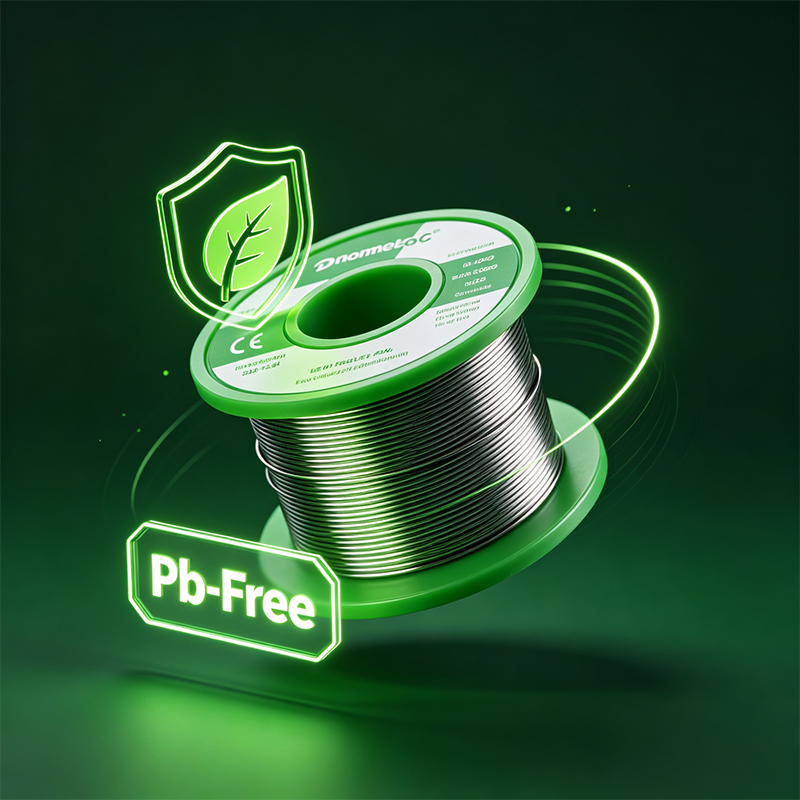
Lead‑free solder is an alloy (a mixture of metals) that contains no lead. Instead, it uses other metals like tin, silver, copper, bismuth, or antimony to do the same job – joining electronic components to PCBs.
The most common lead‑free solder is called SAC – which stands for Tin‑Silver‑Copper. You’ll see numbers like SAC305 (96.5% tin, 3% silver, 0.5% copper) or SAC105 (98.5% tin, 1% silver, 0.5% copper). There are also simpler (and cheaper) alloys like Sn99.3Cu0.7 (tin‑copper) and low‑temperature alloys like Sn42Bi58 (tin‑bismuth).
Why Did the Industry Switch from Lead?
Two big reasons: health and the environment.
Lead is a neurotoxin. When lead‑containing electronics end up in landfills, rain can leach lead into groundwater. That lead can eventually get into drinking water, affecting children’s brain development. Also, workers in recycling plants and solder factories were exposed to lead fumes.
In 2006, the European Union passed a law called RoHS (Restriction of Hazardous Substances). It banned lead (and several other toxic materials) from most new electronics sold in Europe. Other regions followed. Suddenly, manufacturers had to switch to lead‑free or lose access to huge markets.
Lead‑Free vs. Leaded – What’s Different?
Let’s compare the classic 63/37 tin‑lead solder with the most common lead‑free, SAC305.
| Property | Leaded (63Sn/37Pb) | Lead‑Free (SAC305) |
|---|---|---|
| Melting point | 183°C (361°F) | 217‑220°C (423‑428°F) |
| Melting behavior | Eutectic (melts at one temperature) | Pastes (melts over a small range) |
| Solder joint appearance | Shiny, smooth | Dull, grainy (normal) |
| Wetting (how well it spreads) | Excellent | Good (needs more flux) |
| Mechanical strength | Good | Better (tensile and creep resistance) |
| Thermal cycling resistance | Good | Better |
| Cost | Lower | Higher (silver is expensive) |
| Toxicity | Toxic | Non‑toxic (except for some additives) |
The biggest practical difference is temperature. Lead‑free melts about 35‑40°C higher. That means you need a hotter soldering iron – typically 370‑400°C instead of 350°C. It also means components and boards are exposed to more heat during reflow soldering, which can stress them.
The Most Common Lead‑Free Solder Alloys
1. SAC305 (96.5% Sn, 3% Ag, 0.5% Cu) – The industry standard. Used in most consumer electronics. Good balance of melting point, strength, and cost. The silver content makes it expensive, but it works reliably.
2. SAC105 (98.5% Sn, 1% Ag, 0.5% Cu) – Lower silver, cheaper. Used in cost‑sensitive applications where reliability requirements aren’t as extreme.
3. Sn99.3Cu0.7 (Tin‑Copper) – No silver at all. Very cheap. Melts around 227°C. Used in transformers, switches, and some consumer products. Not as strong as SAC.
4. Sn42Bi58 (Tin‑Bismuth) – Low‑temperature solder. Melts at only 138°C. Great for soldering heat‑sensitive components (like on flexible PCBs). But it’s brittle and not good for mechanical stress.
5. Sn96.5Ag3.5 (Tin‑Silver) – An older lead‑free alloy. Melts at 221°C. Less common now that SAC is standard.
What’s Good About Lead‑Free Solder?
Non‑toxic – Safe for the environment and for workers (no lead fumes).
Stronger joints – Lead‑free solder is mechanically stronger and more resistant to thermal fatigue. That means it lasts longer in hot‑cold cycling (like a car’s engine bay).
Meets legal requirements – You can sell your products worldwide without worrying about RoHS violations.
What’s Not So Good?
Higher melting point – Requires more heat, which can damage sensitive components or warp thin PCBs.
Poorer wetting – It doesn’t flow as smoothly as leaded solder. You need more flux, and the joints look dull (that’s normal, not a defect).
Tin whiskers – Pure tin (and high‑tin alloys) can grow tiny conductive hairs called whiskers that can cause short circuits. Adding a small amount of lead solves this, but that’s not allowed in RoHS. Manufacturers use other strategies like nickel barriers or conformal coating.
More expensive – Silver is costly. SAC305 can be 2‑3 times more expensive than leaded solder per pound.
Is Lead‑Free Solder Harder to Use?
For hand soldering, yes, it’s a bit trickier. You need a temperature‑controlled iron set to around 370‑400°C. You’ll also notice that the solder doesn’t flow as eagerly. Don’t use too much heat – that burns the flux and makes things worse. Instead, use more flux. A little extra flux makes lead‑free solder behave almost like the old leaded stuff.
For automated reflow soldering (where a whole board goes through an oven), the process is well established. Manufacturers adjust the temperature profile to match the higher melting point.
What About Flexible PCBs? Can You Use Lead‑Free on Flex?
Yes, but with care. Flexible circuits are made of polyimide, which can handle reflow temperatures up to 260°C – well within the range of lead‑free solder. However, the flexible material can warp if heated unevenly. For hand soldering on flex, use a lower temperature (around 320‑350°C) and a fine tip. For reflow, ensure the board is properly supported.
If you’re soldering delicate flex circuits, you might consider low‑temperature lead‑free solder like tin‑bismuth (Sn42Bi58). It melts at only 138°C, so there’s much less thermal stress.
How to Choose the Right Lead‑Free Solder for Your Project
General electronics (phones, laptops, hobby projects) – SAC305. It’s the standard, and it works.
Cost‑sensitive consumer products – SAC105 or Sn99.3Cu0.7. Cheaper, but still RoHS compliant.
High‑reliability applications (medical, aerospace) – SAC305 with added nickel or other stabilizers. Some use Sn‑Ag‑Cu with small amounts of other metals to prevent tin whiskers.
Heat‑sensitive components or flexible PCBs – Low‑temperature Sn42Bi58. But remember, it’s brittle. Don’t use it where the board will bend or vibrate.
Repairing old lead‑soldered boards – You can use lead‑free, but mixing leaded and lead‑free solder creates a low‑melting point alloy that’s weak and brittle. It’s better to remove the old leaded solder completely before using lead‑free.
A Quick Word on “Lead‑Free” vs. “RoHS Compliant”
“Lead‑free” usually means the solder itself has no lead. “RoHS compliant” means the entire product (including solder) meets the EU’s restrictions. Sometimes you’ll see “RoHS compliant” stickers on products – that’s your assurance that no banned substances (including lead) were used.
Real‑World Example: Why Lead‑Free Solder Is Good for Your Car
Your car’s engine computer sits in a hot, vibrating environment. Every time you drive, it heats up; every time you park, it cools down. That’s thermal cycling. Lead‑free solder is actually more resistant to thermal fatigue than old leaded solder. So while lead‑free was a pain for manufacturers to adopt, it made automotive electronics more reliable.
Final Answer – What Is Lead‑Free Solder Material?
Lead‑free solder is an alloy of tin, silver, copper, and sometimes other metals that contains no lead. It was developed to replace toxic lead‑based solder after RoHS regulations took effect. The most common type is SAC305 (96.5% tin, 3% silver, 0.5% copper). Lead‑free solder melts at a higher temperature (around 217‑220°C) and requires more flux, but it produces stronger, more durable joints and is safe for the environment.
If you’re building electronics today, you’ll almost certainly use lead‑free solder. It takes a little practice, but it’s the responsible choice – for your health and for the planet.

Kaboer manufacturing PCBs since 2009. Professional technology and high-precision Printed Circuit Boards involved in Medical, IOT, UAV, Aviation, Automotive, Aerospace, Industrial Control, Artificial Intelligence, Consumer Electronics etc..


 English



 Wechat
 +86 13670210335
 +86 13670210335
 E-mail