
Date: 2026-04-30
If you are a hardware engineer or a procurement manager, you know that designing an LED light circuit board used to be simple. You’d slap some LEDs on a rigid FR4 or aluminum board, and you were good to go.
But in 2026, things have changed. Whether you’re working on adaptive automotive headlights, ultra-thin wearable medical devices, or architectural "smart" lighting, the standard board often doesn't cut it anymore. Today, it’s about heat, shape, and extreme reliability.
Let’s be real: heat is the #1 killer of LEDs. When an LED light circuit board gets too hot, the light shifts color, dims, and eventually dies.
Traditionally, people jumped straight to Metal Core PCBs (MCPCB). But here’s what we’ve noticed in the lab: for high-power, space-constrained designs, Flex PCBs combined with specialized thermal vias or thin-film polyimides can actually offer better heat dissipation in 3D spaces. If your board can’t "breathe," your LEDs won't last.
Why stick to a flat board when your product isn't flat? We’ve helped manufacturers move away from clunky, wire-heavy assemblies by using Rigid-Flex technology.
The Advantage: You can fold the circuit into a 360-degree light fixture.
The Result: Fewer connectors (which are often the first part to break), lower weight, and a much sleeker product.
If you are still using connectors to join multiple rigid LED strips, you are literally adding "fail points" to your design. Flex and Rigid-Flex allow the circuit to be the structure itself.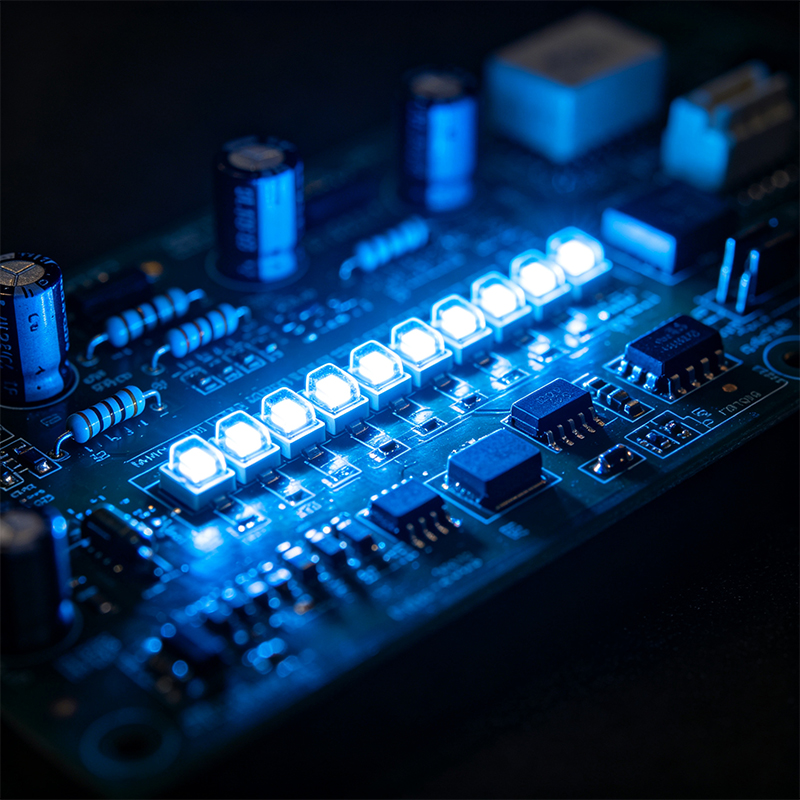
Modern LEDs aren't just "on or off." They have drivers, sensors, and ICs right on the board. This is where HDI (High-Density Interconnect) comes in. By using microvias and finer traces, we can pack control intelligence directly behind the LED without increasing the board's footprint. This is essential for high-speed data transmission in Li-Fi or complex display arrays.
A great board design is useless if the assembly is sloppy. In LED PCBA, the precision of the solder paste application and the reflow temperature profile are everything. If the reflow is too hot, you damage the LED’s phosphor; if it's too cool, you get "cold joints" that fail under vibration.
Choosing a partner for your LED light circuit board needs shouldn't be a guessing game. We specialize in the "tough stuff"—the custom Flex, the high-speed HDI, and the precision PCBA that keeps your lights on when others fail.
[Have a design that’s giving you headaches? Send us your Gerber files, and let’s see how our engineering team can optimize your LED project.]

Kaboer manufacturing PCBs since 2009. Professional technology and high-precision Printed Circuit Boards involved in Medical, IOT, UAV, Aviation, Automotive, Aerospace, Industrial Control, Artificial Intelligence, Consumer Electronics etc..


 English



 Wechat
 +86 13670210335
 +86 13670210335
 E-mail