
Date: 2026-02-26
Ever wondered how a smartphone thinner than a pencil can pack more computing power than a desktop computer from a few years ago? The secret lies beneath the surface—in the intricate layers of a multilayer PCB.
A multilayer printed circuit board is exactly what it sounds like: a circuit board made up of three or more conductive copper layers stacked together like a precision-engineered sandwich . These layers are bonded together with insulating material in between, allowing far more complex circuits to fit into smaller spaces.
Think of it this way:
A single-layer PCB is like a one-story house—simple, but limited in how much you can fit.
A double-layer PCB is like a two-story house—more space, but still constrained.
A multilayer PCB is like a skyscraper—you can pack an incredible amount of functionality into the same footprint by building upward.
Today, everything from smartphones and laptops to medical devices, automotive electronics, and 5G infrastructure relies on multilayer PCBs. They're the unsung heroes that make modern technology possible.
This guide will walk you through how multilayer PCBs are made, what makes them different, and what you need to know if you're designing or specifying them for your products.
A multilayer PCB consists of three or more conductive copper layers separated by insulating material and bonded together under heat and pressure . The most common configurations are 4-layer, 6-layer, 8-layer, and even 10-layer or more for complex applications .
The basic building blocks are:
Core: A rigid sheet of insulating material (typically FR-4 epoxy glass) with copper foil bonded to both sides. This forms the foundation for inner layers .
Prepreg: Short for "pre-impregnated" fibers—thin sheets of glass fabric impregnated with partially cured epoxy resin. When heated and pressed, the resin melts and flows, bonding layers together .
Copper Foil: Thin sheets of copper that form the outer layers after etching .
Vias: Plated-through holes that create electrical connections between different layers. These can be through-holes (going all the way through), blind vias (connecting an outer layer to one or more inner layers), or buried vias (connecting inner layers only) .
The beauty of multilayer construction is that it allows designers to dedicate entire layers to power distribution and ground planes while using other layers for signal routing. This separation dramatically improves electrical performance, reduces noise, and enables controlled impedance for high-speed signals .
More Space, Smaller Footprint
The most obvious advantage is density. A 6-layer board can route complex circuits that would require multiple double-sided boards, saving enormous space . This is why your smartwatch can do so much in such a tiny package.
Better Signal Integrity
With dedicated ground and power planes, signals have clean return paths and are shielded from interference. This is essential for high-speed circuits like DDR memory, PCIe, and USB . The close proximity of signal layers to reference planes also enables precise impedance control—critical for maintaining signal quality at gigahertz frequencies .
Improved Power Distribution
Power planes provide low-impedance power delivery across the entire board. Decoupling capacitors can be placed close to ICs, and multiple voltage rails can be routed efficiently .
EMI Reduction
Continuous ground planes act as natural shields, containing electromagnetic radiation and making it easier to pass EMC testing . Proper stack-up design can significantly reduce emissions without extra shielding components.
Thermal Management
Copper planes help spread heat from hot components. Thermal vias can conduct heat to inner layers or to heatsinks on the opposite side .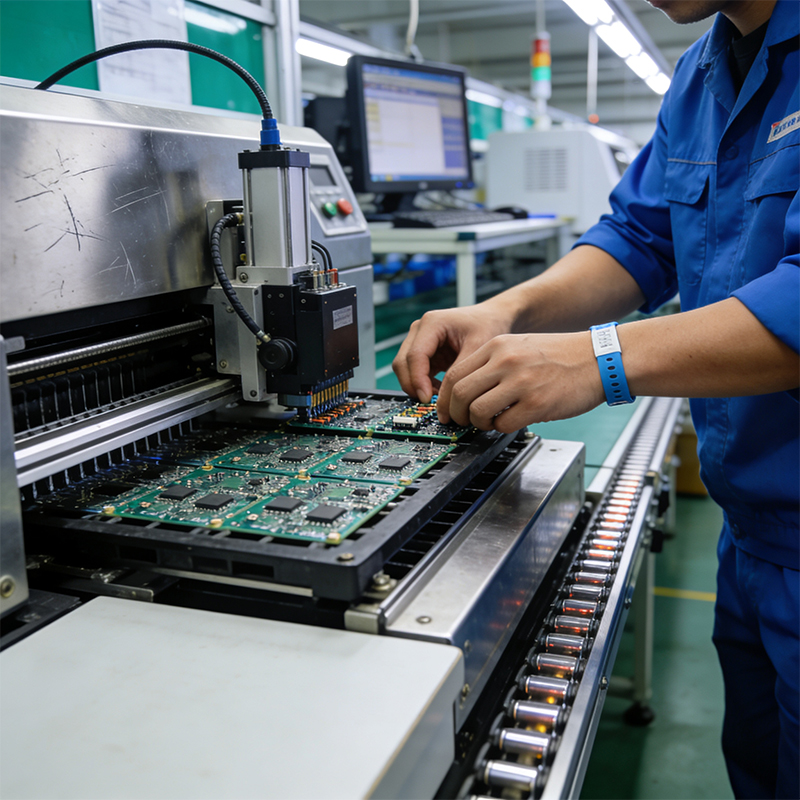
Making a multilayer PCB is a precision manufacturing process with many steps. Here's how it works:
The process starts with cores—double-sided copper-clad laminates. A photosensitive film called photoresist is applied to the copper surfaces. Using specialized equipment, the circuit pattern for each inner layer is transferred onto the photoresist—either by exposing through a photographic film or by direct laser imaging .
The exposed areas harden, protecting the copper underneath. The unexposed photoresist is washed away, leaving bare copper where etching will occur.
The cores go through an etching process that removes the unprotected copper, leaving only the desired circuit traces. After etching, the hardened photoresist is stripped away, revealing the copper circuitry .
Each core is then inspected, often using automated optical inspection (AOI) systems that compare the actual patterns to the original design data .
This is where the magic happens. The prepared cores are stacked with sheets of prepreg between them. The stack-up must be carefully planned—typically symmetrical around the center to prevent warping during lamination .
For example, a 6-layer board might be stacked as: copper foil, prepreg, core (with circuits on both sides), prepreg, core, prepreg, copper foil. The exact arrangement depends on the design requirements .
The layers must align with incredible precision—misalignment of just a few thousandths of an inch can cause registration problems later .
The stacked layers are placed in a laminating press. Under high temperature and pressure, the epoxy resin in the prepregs melts, flows, and then cures, bonding everything into a solid board . The process must be carefully controlled—too little resin flow can leave voids (called "resin starvation"), while too much can squeeze resin out and change thickness .
After lamination, the board is a solid panel with internal circuits completely encased.
Holes must be drilled to create connections between layers. For through-holes, CNC drilling machines drill completely through the board. For blind or buried vias, more complex processes are used—sometimes requiring drilling before final lamination .
Hole sizes can be as small as 0.2mm or less, and positioning accuracy is critical. After drilling, a desmear process cleans away resin residue from the hole walls .
The drilled holes need copper to make electrical connections. The panel goes through an electroless copper deposition process that coats the hole walls with a thin layer of copper . Then electrolytic plating builds up the copper to the required thickness—typically 20-35 microns in the holes .
This plating step also adds copper to the outer layer surfaces, preparing them for outer layer imaging.
Now it's time to create the outer layer circuitry. Photoresist is applied, the outer layer patterns are exposed, and the process repeats—similar to inner layer imaging but with a reverse image. Copper is plated where circuitry is needed, then tin is applied as an etch resist. The remaining photoresist is removed, and the unprotected copper is etched away. Finally, the tin is stripped, revealing the finished outer layer traces .
A protective solder mask (usually green, but other colors available) is applied over the entire board, leaving only the pads and features that need to be exposed . This prevents solder bridges and protects the copper from oxidation.
The exposed pads then receive a surface finish—options include HASL (hot air solder leveling), ENIG (electroless nickel immersion gold), immersion silver, or OSP (organic solderability preservative). The choice depends on assembly requirements and shelf life needs .
Legends, component outlines, and other markings are printed on the board. Finally, every board is electrically tested for continuity and isolation—checking for shorts and opens . For complex boards, this might include flying probe testing or fixture-based testing.
For very dense designs, standard multilayer fabrication may not be enough. That's where sequential lamination comes in.
In sequential lamination, the board is built up in stages . First, a sub-assembly of inner layers is created with buried vias. Then additional layers are added on one or both sides, with new vias connecting to the inner sub-assembly. This process can be repeated multiple times.
This technique enables High-Density Interconnect (HDI) boards—the kind used in smartphones and advanced electronics. HDI features include microvias (laser-drilled holes under 150 microns), fine lines and spaces, and high connection density .
But sequential lamination comes with costs: each lamination cycle adds about a week to lead time, and the additional processing steps increase the risk of defects and yield loss . Designers should minimize lamination cycles where possible and use staggered rather than stacked microvias for better reliability .
If you're designing multilayer boards, here are key things to keep in mind:
Stack-Up Symmetry
A symmetrical stack-up—mirroring the layer construction around the center—prevents warping during lamination and assembly . Copper distribution should also be balanced across the board.
Impedance Control
For high-speed signals, you must specify target impedance values (often 50Ω single-ended, 90Ω or 100Ω differential). Work with your fabricator early to determine the right trace widths and dielectric thicknesses .
Material Selection
Standard FR-4 works for many applications, but high-speed designs may need low-loss materials like Rogers or Megtron series . For high-reliability applications, consider high-Tg materials that better withstand thermal stress .
Via Structures
Through-holes are simplest. Blind and buried vias add complexity and cost but save space. If you need blind vias, keep them shallow—connecting only the outer layer to the first inner layer is most reliable .
For HDI designs, staggered vias are more reliable than stacked vias, and microvia aspect ratios should typically be 1:1 or less .
Copper Distribution
Uneven copper can cause plating problems and board warpage. Add dummy copper fills where needed to balance copper density across layers .
Design for Manufacturing
Engage with your PCB fabricator early. They can review your stack-up, confirm material availability, and suggest adjustments that improve yield and reduce cost . Small changes—like using standard thickness cores or avoiding exotic materials—can make a big difference.
Warpage and Twist
Caused by asymmetric stack-ups or uneven copper distribution. Solution: symmetrical design, balanced copper, and proper material selection .
Registration Problems
Layers shifting during lamination leads to misaligned vias and pad breakout. Solution: careful stack-up design and working with capable fabricators .
Via Reliability Issues
Insufficient plating, voids, or cracks can cause intermittent failures. Solution: proper aspect ratios, quality plating processes, and microsection verification .
Impedance Variations
Changes in dielectric thickness or trace width affect impedance. Solution: tight process control and TDR testing to verify actual impedance .
Delamination
Poor bonding between layers causes separation. Solution: correct prepreg selection, proper lamination cycles, and avoiding moisture absorption .
Multilayer PCB fabrication is a sophisticated process that turns design concepts into physical reality. It's what enables today's compact, powerful, and reliable electronics.
For electronic device manufacturers, understanding this process helps you design boards that are not only functional but also manufacturable—saving time, reducing cost, and avoiding headaches.
The key takeaways:
Multilayer boards pack more functionality into smaller spaces while improving electrical performance.
The fabrication process involves precise imaging, etching, lamination, drilling, and plating.
Design choices—stack-up symmetry, material selection, via structures—directly impact manufacturability and reliability.
Early collaboration with your PCB fabricator is the single best way to ensure success.
Whether you're building medical devices, industrial controls, consumer electronics, or automotive systems, getting multilayer PCB fabrication right is essential. And with the right partner and good design practices, it's absolutely achievable.

Kaboer manufacturing PCBs since 2009. Professional technology and high-precision Printed Circuit Boards involved in Medical, IOT, UAV, Aviation, Automotive, Aerospace, Industrial Control, Artificial Intelligence, Consumer Electronics etc..


 English



 Wechat
 +86 13670210335
 +86 13670210335
 E-mail