
Date: 2026-02-26
Ever held a smartphone or a laptop and wondered how all those tiny components connect and communicate? The answer lies in a marvel of modern engineering—the Printed Circuit Board (PCB) . At its simplest, a PCB is a board that mechanically supports and electrically connects electronic components using conductive tracks, pads, and other features etched from copper sheets laminated onto a non-conductive substrate .
PCBs are everywhere. They're the brains behind your computer, the heart of your smartwatch, and the nervous system of your car's electronics. They allow for complex circuits to be packed into incredibly small spaces, which is why today's devices are so powerful yet so compact .
If you're an electronic device manufacturer, or even just curious about how these essential components come to life, understanding the PCB fabrication process is invaluable. This guide breaks down the entire journey—from the initial idea to a finished, ready-to-assemble board—using plain language and real-world steps.
Before diving into the process, it's helpful to know that there are two very different scales of PCB manufacturing:
DIY/Hobbyist Method: This is for makers, students, and hobbyists creating one-off prototypes at home. It's low-cost, uses simple tools, and is great for learning. You might use a laser printer, an iron, and a chemical etching solution . The result is a basic, single-layer board without the protective green solder mask you see on commercial products .
Professional/Industrial Method: This is what this guide will focus on. It's for manufacturers who need high-quality, reliable, multi-layered boards in large quantities. This process involves precision machinery, cleanrooms, and strict quality controls. The result is a durable, high-performance board that meets exact specifications .
Understanding the professional method is key for any manufacturer looking to produce reliable electronic products.
The journey from a digital design to a physical PCB involves a series of precise, fascinating steps. Think of it as building a multi-story building, but on a microscopic scale.
Step 1: Design and Layout
Everything starts with an idea. An engineer uses specialized software (like Altium, Eagle, or KiCad) to create the circuit schematic and then the PCB layout . This layout defines where every component goes and how they are connected by copper traces. The final output of this stage is a set of files, most importantly Gerber files, which act as the blueprint for the factory .
Step 2: Design for Manufacturing (DFM) Review
Once the Gerber files are sent to a manufacturer like us at Kaboer, our engineers perform a crucial DFM check. They analyze the design to ensure it can be built efficiently and reliably with our equipment. They check things like trace widths, hole sizes, and spacing to prevent issues later in production . This collaboration upfront can save a huge amount of time and money.
Step 3: Material Selection & Cutting (The Foundation)
The right materials are selected based on the board's requirements. The most common base material is FR-4, a flame-retardant composite of fiberglass and epoxy resin . Large sheets of copper-clad laminate—the base material with a thin layer of copper bonded to it—are then cut down into panels, the standard working size for the factory line .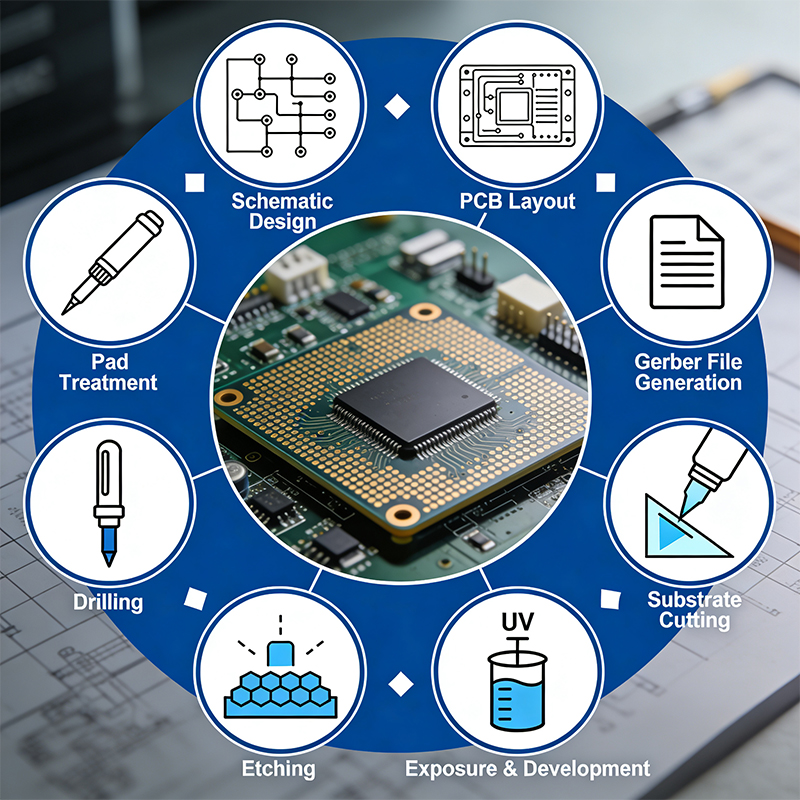
Step 4: Inner Layer Imaging
For multi-layer boards, we start with the inner layers. A light-sensitive film called photoresist is applied to the copper surface. The PCB design is then transferred onto this film using a laser or by shining UV light through a photographic film mask. The light hardens the photoresist in the pattern of the desired copper traces .
Step 5: Inner Layer Etching
The panel is then washed with a chemical solution. The unhardened photoresist is washed away, exposing the copper underneath. The panel then goes into an etching machine, where chemicals remove the exposed copper, leaving only the traces protected by the hardened photoresist. Finally, the hardened resist is stripped away, revealing the copper circuit pattern on the inner layer .
Step 6: Inner Layer Inspection (AOI)
Each inner layer is meticulously inspected by an Automated Optical Inspection (AOI) machine. It uses high-resolution cameras to scan the board and compare it to the digital design, looking for any defects like opens, shorts, or thin traces .
Step 7: Layer Up and Laminate
For a multi-layer board, the individual inner layers must be fused together. This is done by stacking them with sheets of a special glue-like material called prepreg (pre-impregnated fiberglass) in between . This stack is placed in a high-pressure, high-temperature press. The heat melts the prepreg, bonding all the layers into a single, solid panel .
Step 8: Drilling the Holes
Holes are needed to connect the different layers (vias) and for through-hole components. A computer-controlled drilling machine uses tiny, high-speed drill bits to drill hundreds of precise holes per minute. For extremely small holes in advanced boards, lasers are used instead .
Step 9: Plating the Holes
The drilled panel is now a stack of separate layers with holes through them. To make these holes conductive, the panel undergoes an electroplating process. First, a thin layer of copper is chemically deposited on all surfaces, including the inside of the holes. Then, more copper is electroplated on, building up the thickness and creating a solid conductive tube through each hole, connecting all the layers .
Step 10: Outer Layer Imaging and Plating
The process for the outer layers is similar to the inner ones, but with an extra step. Photoresist is applied and exposed with the outer layer design. Instead of etching immediately, the panel is plated again. Copper is plated onto the exposed areas (the traces and pads). Then, a thin layer of tin or tin-lead is plated on top of the copper. This tin acts as an etch resist .
Step 11: Outer Layer Etching
The photoresist is stripped away, and the panel is etched. The tin protects the copper traces underneath, while the rest of the unprotected copper is etched away. Finally, the tin is stripped off, leaving only the finished outer layer copper traces and pads .
Step 12: Outer Layer AOI
Just like the inner layers, the outer layers now undergo another AOI inspection to ensure the circuitry is perfect .
Step 13: Applying Solder Mask
This is where the board gets its characteristic color, usually green. A liquid epoxy solder mask is applied to the entire board. It is then exposed to light through a mask that protects the pads and holes. The unexposed (soft) solder mask is washed away from these areas, leaving the pads bare for soldering. The solder mask is then cured to harden. This layer protects the copper traces from short circuits and the environment .
Step 14: Silkscreen
White (or other color) lettering and symbols are printed onto the board. This silkscreen layer shows component outlines, reference designators (like R1 for a resistor, C5 for a capacitor), logos, and test points, making assembly and troubleshooting much easier .
Step 15: Surface Finish
The bare copper pads need to be protected from oxidation to ensure they remain solderable. A surface finish is applied. Common options include :
HASL (Hot Air Solder Leveling): A cost-effective finish where the board is dipped in molten solder and then leveled with hot air.
ENIG (Electroless Nickel Immersion Gold): A high-quality, flat finish with a layer of nickel followed by a thin layer of gold, perfect for fine-pitch components.
OSP (Organic Solderability Preservative): A water-based, organic coating that protects the copper until soldering.
Step 16: Electrical Testing
Every single board is electrically tested to ensure there are no shorts or opens. This is often done with a flying probe tester, which uses tiny moving probes to touch every single net on the board and verify its connection .
Step 17: Profiling and V-Scoring
The individual circuit boards are still attached to the larger manufacturing panel. They are cut out using a CNC router (profiling) or by cutting V-shaped grooves (V-scoring) that allow them to be easily snapped apart later .
Step 18: Final Visual Inspection and Packaging
The finished boards undergo a final visual check (FQC) for any blemishes or defects. They are then carefully cleaned, vacuum-sealed in anti-static bags to protect them from moisture and static, and packaged for shipment to you, the customer .
As you can see, making a PCB is a complex, highly technical process. The quality of your final product depends entirely on the precision and reliability of this fabrication process. When you're looking for a partner to bring your designs to life, you need a team that understands every one of these steps and has the experience to execute them flawlessly.
At Kaboer, based in the heart of Shenzhen's electronics manufacturing hub, we've spent over 16 years perfecting this process. We don't just build PCBs; we build partnerships. With our own advanced factory, we specialize in a full range of technologies, from standard rigid boards to complex Flexible PCBs, Rigid-Flex boards, and high-frequency HDI PCBs. And as a one-stop shop with in-house PCBA (Printed Circuit Board Assembly) capabilities, we can take your project from a bare board to a fully assembled, tested electronic module.
We believe in transparency and quality, which is why we welcome our global clients to visit our Shenzhen factory and see our process firsthand. From the initial DFM review to the final flying probe test, we are committed to delivering the reliable, high-performance boards that your products deserve.

Kaboer manufacturing PCBs since 2009. Professional technology and high-precision Printed Circuit Boards involved in Medical, IOT, UAV, Aviation, Automotive, Aerospace, Industrial Control, Artificial Intelligence, Consumer Electronics etc..


 English



 Wechat
 +86 13670210335
 +86 13670210335
 E-mail